Saudi Arabia fights forged accounting certificates to enhance sector performance

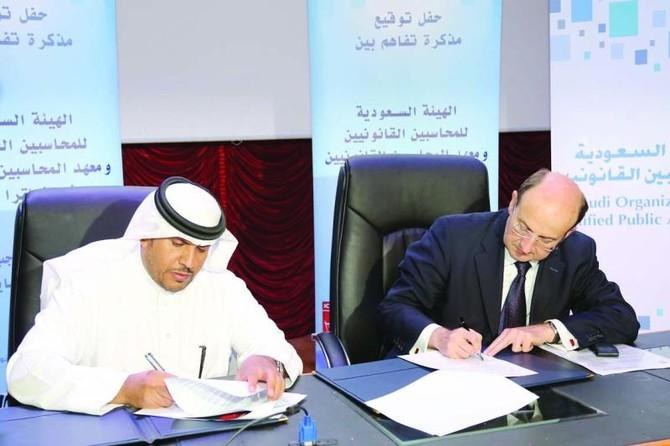
SOCPA signed an agreement with the Institute of Chartered Accountants in England and Wales (ICAEW) in 2014. (Supplied)
Short Url
Updated 12 August 2021
Follow

Saudi Arabia fights forged accounting certificates to enhance sector performance

  • (SOCPA) recorded about 517 forged accounting certificates out of 200,000 submitted to the authority during the past three years

RIYADH: The Saudi Organization for Chartered and Professional Accountants (SOCPA) recorded about 517 forged accounting certificates and 191 unrecognized certificates out of 200,000 submitted to the authority during the past three years, the authority said.

The authority aims at limiting the use of forged certificates and ensuring the integrity and credibility of the documents and information received, SOCPA said in the report in a report titled “The role of the accounting profession in building a thriving economy.”

All the owners of those forged certificates were referred to the Public Prosecution, Secretary-General Ahmed Al-Meghames said.

SOCPA adopted international standards and the application of 110 international standards in the Kingdom, and played a role in raising the level of performance of practitioners of the accounting and auditing profession, by offering 1,101 training programs during which more than 25,000 people were trained, according to the report.

The authority’s report also reviewed an increase in the number of certified public accountants by 98 percent, to reach 436.

The pace of membership in the authority has also increased in the past years, with more than 99,000 members joining it, including 4,900 students, through student membership.


Saudi industrial output rises 8.9% in December: GASTAT 

Updated 16 sec ago
Follow

Saudi industrial output rises 8.9% in December: GASTAT 

RIYADH: Saudi Arabia’s industrial production rose 8.9 percent in December from a year earlier, driven by stronger mining and manufacturing activity, signaling continued momentum in the Kingdom’s non-oil and energy sectors. 

The Industrial Production Index reached 113.6 in December, up from 104.3 a year earlier, the General Authority for Statistics said.  

The latest IPI figures underscore continued momentum in the Kingdom’s industrial sector as Saudi Arabia pursues economic diversification under its Vision 2030 agenda. 

In its latest report, GASTAT stated: “Preliminary results indicate an increase of 8.9 percent in the IPOI in December 2025 compared to the same month of the previous year, supported by the rise in mining and quarrying activity, manufacturing activity and water supply, sewerage and waste management and remediation activities.”  

Mining and quarrying activity — the largest component of the index — increased 13.2 percent year on year after Saudi Arabia raised oil production to 10.1 million barrels per day from 8.9 million bpd a year earlier. Manufacturing expanded 3.2 percent, supported by a 13.4 percent rise in chemicals output and a 7.3 percent increase in food production. 

The sub-index of electricity, gas, steam and air-conditioning supply activity recorded an annual decrease of 2.5 percent. 

The sub-index of water supply, sewerage and waste management and remediation activities increased 9.4 percent. 

Compared to November, Saudi Arabia’s IPI recorded a marginal decline of 0.1 percent. 

On a monthly basis, the sub-index of mining and quarrying activity increased 0.3 percent. 

Manufacturing activities also rose 0.3 percent in December compared to the previous month, driven by a 2.8 percent increase in the manufacture of chemicals and chemical products. 

Compared to November, the manufacture of food products increased 9.6 percent in December. 

Overall, the index of oil activities advanced 10.1 percent year on year in December, while non-oil activities increased 5.8 percent. 

Compared to November, oil activities decreased 0.3 percent, while non-oil activities increased 0.4 percent. 

The IPI measures changes in industrial output based on the International Standard Industrial Classification framework and covers mining, manufacturing, utilities and waste management sectors.