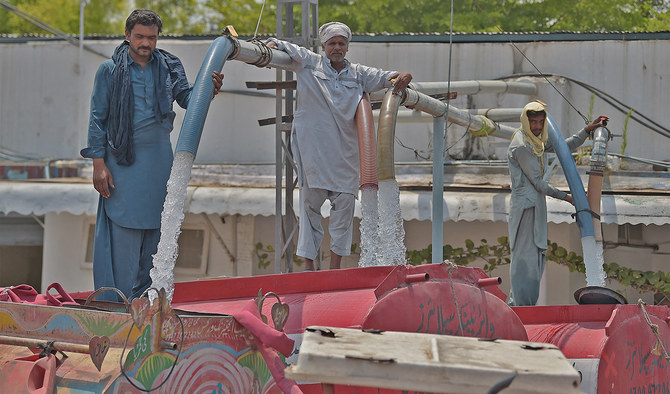

ISLAMABAD: Islamabad has started water rationing as the Pakistani capital is facing a critical reduction in storage reserves, officials said on Wednesday.
Pakistan already ranks third among countries facing acute water shortages. According to the International Monetary Fund, the country of 220 million people may face absolute water scarcity by 2040 due to climate change and increasing population.
In the federal capital, the availability of drinking water is already a concern to its two million inhabitants, the water level in its main sources — the Simly Dam and Khanpur Dam — has plummeted to close to the dead level, according to the Capital Development Authority (CDA), forcing it sharply reduce supply to residents.
“We have cut the water supply to residents to 60 million gallons per day against the original demand of around 220 million gallons per day,” CDA water management deputy director general Sardar Khan Zimri told Arab News.
According to CDA data, the Simly Dam on Wednesday recorded 1,106 million gallons of water, against its maximum storage of 6,500 million gallons, which would suffice only for the next 42 days. The water level at the Khanpur Dam was 1,937 feet against its maximum of 1,982 feet.
“We will be forced to cut the water supply further to the residents in coming weeks if the reserves failed to improve,” Zimri said, adding that people should adopt water conservation habits.
While he said the CDA has managed to reduce water leakage from the city’s pipelines from over 35 percent to 15 percent, experts still cite it as one of the main issues, along with the city’s expansion that is disproportional to the area’s natural resources.
“Millions of gallons of water are lost daily in Islamabad due leaky and aging pipes and other infrastructure. This all needs to be fixed at emergency basis,” Mome Gul, founder of Reclaiming Green Islamabad, told Arab News.
“We need to check the urban sprawl and manage the existing water resources efficiently with their regular dredging and maintenance,” she said, adding that the CDA should also fix water quotas for skyscrapers and commercial centers.
According to Gul, the imminent water emergency is no surprise as the city has not been mapping its underground water resources and has not developed even one water reservoir in the past two decades.
Authorities are hopeful the water crisis will abate by next week as the met office forecasts a “good spell of rain” Murree, Haripur, Abbottabad and Kashmir, which are the catchment areas of the Simly and Khanpur dams.
“We are expecting a good rainfall in the catchment areas of these dams,” Dr. Azmat Hayat Khan, chief meteorologist at the Pakistan Meteorological Department in Islamabad told Arab News.
“Hopefully this will help resolve water supply issues of the federal capital by next week.”