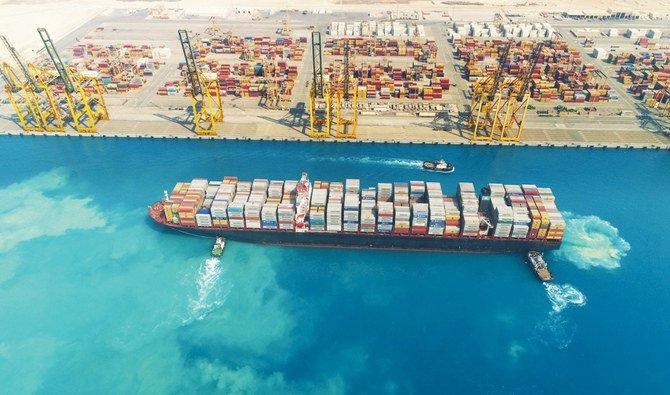
King Abdullah Port handled 78 percent more bulk and general cargo in H1

King Abdullah Port is the country's first privately owned and developed port. (Supplied)
Short Url
Updated 11 August 2021
Follow

King Abdullah Port handled 78 percent more bulk and general cargo in H1

  • King Abdullah Port handled more than 2.5 million tons of bulk and general cargo in H1
  • Port managed 1,402,200 TEUs in H1

RIYADH: Saudi Arabia’s King Abdullah Port said it handled more than 2.5 million tons of bulk and general cargo in the first half of the year, a 78 percent jump on the previous year as economy rebounded from the COVID pandemic.

The Kingdom’s first privately-owned port at King Abdullah Economic City saw 1,402,200 twenty foot equivalent containers (TEUs) between January and June, a 45 percent increase on a year ago, it said in a statement.

The strong performance of King Abdullah Port highlights the growing operational capabilities and the continuation of the upward path of the Saudi economy strength, and this success will contribute to consolidating the Kingdom’s position as a leading global logistics center linking the three continents, CEO Jay New said.

In 2020, King Abdullah Port successfully received three of the largest container ships in the world in one week, and was chosen as a major logistics terminal on the Red Sea for two of the largest shipping lines, Maersk and MSC, reinforcing the importance of its position as a strategic link between East and West that supports trade between continents.

King Abdullah Port has been ranked second among the most efficient container ports in the world, according to the Container Port Performance Index (CPPI) for the year 2020 published by the World Bank and IHS Markit last June.

“King Abdullah Port’s continued milestone underlines the success of the public-private partnership model, considering that we are partnered with over 17 government agencies while being fully managed and operated by the private sector,” New said.


Kuwait to boost Islamic finance with sukuk regulation

Updated 05 February 2026
Follow

Kuwait to boost Islamic finance with sukuk regulation

  • The move supports sustainable financing and is part of Kuwait’s efforts to diversify its oil-dependent economy

RIYADH: Kuwait is planning to introduce legislation to regulate the issuance of sukuk, or Islamic bonds, both domestically and internationally, as part of efforts to support more sustainable financing for the oil-rich Gulf nation, Prime Minister Sheikh Ahmad Abdullah Al-Ahmad Al-Sabah said on Wednesday.

Speaking at the World Governments Summit in Dubai, Al-Sabah highlighted that Kuwait is exploring a variety of debt instruments to diversify its economy. The country has been implementing fiscal reforms aimed at stimulating growth and controlling its budget deficit amid persistently low oil prices. Hydrocarbons continue to dominate Kuwait’s revenue stream, accounting for nearly 90 percent of government income in 2024.

The Gulf Cooperation Council’s debt capital market is projected to exceed $1.25 trillion by 2026, driven by project funding and government initiatives, representing a 13.6 percent expansion, according to Fitch Ratings.

The region is expected to remain one of the largest sources of US dollar-denominated debt and sukuk issuance among emerging markets. Fitch also noted that cross-sector economic diversification, refinancing needs, and deficit funding are key factors behind this growth.

“We are about to approve the first legislation regulating issuance of government sukuk locally and internationally, in accordance with Islamic laws,” Al-Sabah said.

“This enables us to deal with financial challenges flexibly and responsibly, and to plan for medium and long-term finances.”

Kuwait returned to global debt markets last year with strong results, raising $11.25 billion through a three-part bond sale — the country’s first US dollar issuance since 2017 — drawing substantial investor demand. In March, a new public debt law raised the borrowing ceiling to 30 billion dinars ($98 billion) from 10 billion dinars, enabling longer-term borrowing.

The Gulf’s debt capital markets, which totaled $1.1 trillion at the end of the third quarter of 2025, have evolved from primarily sovereign funding tools into increasingly sophisticated instruments serving governments, banks, and corporates alike. As diversification efforts accelerate and refinancing cycles intensify, regional issuers have become regular participants in global debt markets, reinforcing the GCC’s role in emerging-market capital flows.

In 2025, GCC countries accounted for 35 percent of all emerging-market US dollar debt issuance, excluding China, with growth in US dollar sukuk issuance notably outpacing conventional bonds. The region’s total outstanding debt capital markets grew more than 14 percent year on year, reaching $1.1 trillion.