

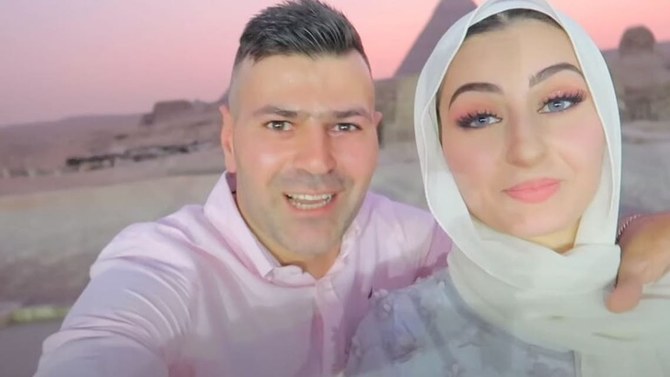
Syrian YouTuber holds ‘fake’ gender reveal party by Giza pyramids

Siamand and Shahad, who are expecting their second child together, shared a video on their YouTube channel. (Screenshot)
Short Url
Updated 11 August 2021
Follow

Syrian YouTuber holds ‘fake’ gender reveal party by Giza pyramids

  • Siamand and Shahad, who are expecting their second child together, shared a video on their YouTube channel
  • An Egyptian official in charge of the site, however, said the lights had nothing to do with with social media personalities

CAIRO: A Syrian YouTuber and his Iraqi wife could face legal issues in Egypt after sharing a clip claiming to have held their baby’s gender reveal party by the pyramids at Giza.

Siamand and Shahad, who are expecting their second child together, shared a video on their YouTube channel with the title: “First gender reveal party held by the pyramids.”

The couple appear in the footage carrying their daughter and alongside family and friends, all looking excited to discover the new baby’s gender.

Then, as a light show begins to play projected onto the site of the pyramids and other ancient structures, the entire site turns blue following a countdown, indicating a boy.

An Egyptian official in charge of the site, however, said the lights had nothing to do with with social media personalities, adding “private parties are strictly prohibited near the pyramids, and … the pyramids are not used for advertising purposes.”

The official stressed that the site had in fact been illuminated in blue and orange in coordination with work done by the ministries of tourism and health to mark World Liver Day, and that the gender reveal stunt was a “lie.”

Siamand and Shahad’s attempt to stage a gender reveal party at the pyramids is thought to have been inspired by a Dubai YouTuber couple, Anas Marwah and Asala Maleh, who hosted a gender reveal party at Dubai’s iconic Burj Khalifa tower in 2020.


Second doctor in Matthew Perry overdose case sentenced to home confinement

Updated 17 December 2025
Follow

Second doctor in Matthew Perry overdose case sentenced to home confinement

  • Dr. Mark Chavez, 55, a onetime San Diego-based physician, pleaded guilty in federal court in October
  • Judge Sherilyn Peace Garnett also sentenced Chavez to 300 hours of community service

LOS ANGELES: A second California doctor was sentenced on Tuesday to eight months of home confinement for illegally supplying “Friends” star Matthew Perry with ketamine, the powerful sedative that caused the actor’s fatal drug overdose in a hot tub in 2023.
Dr. Mark Chavez, 55, a onetime San Diego-based physician, pleaded guilty in federal court in October to a single felony count of conspiracy to distribute the prescription anesthetic and surrendered his medical license in November.
Judge Sherilyn Peace Garnett also sentenced Chavez to 300 hours of community service. As part of his plea agreement, Chavez admitted to selling ketamine to another physician Dr. Salvador Plasencia, 44, who in turn supplied the drug to Perry, though not the dose that ultimately killed the performer. Plasencia, who pleaded guilty to four counts of unlawful drug distribution, was sentenced earlier this month to 2 1/2 years behind bars.
He and Chavez were the first two of five people convicted in connection with Perry’s ketamine-induced death to be sent off to prison.
The three others scheduled to be sentenced in the coming weeks — Jasveen Sangha, 42, a drug dealer known as the “Ketamine Queen;” a go-between dealer Erik Fleming, 56; and Perry’s former personal assistant, Iwamasa, 60.
Sangha admitted to supplying the ketamine dose that killed Perry, and Iwamasa acknowledged injecting Perry with it. It was Iwamasa who later found Perry, aged 54, face down and lifeless, in the jacuzzi of his Los Angeles home on October 28, 2023.
An autopsy report concluded the actor died from the acute effects of ketamine,” which combined with other factors in causing him to lose consciousness and drown.
Perry had publicly acknowledged decades of substance abuse, including the years he starred as Chandler Bing on the hit 1990s NBC television series “Friends.”
According to federal law enforcement officials, Perry had been receiving ketamine infusions for treatment of depression and anxiety at a clinic where he became addicted to the drug.
When doctors there refused to increase his dosage, he turned to unscrupulous providers elsewhere willing to exploit Perry’s drug dependency as a way to make quick money, authorities said. Ketamine is a short-acting anesthetic with hallucinogenic properties that is sometimes prescribed to treat depression and other psychiatric disorders. It also has seen widespread abuse as an illicit party drug.