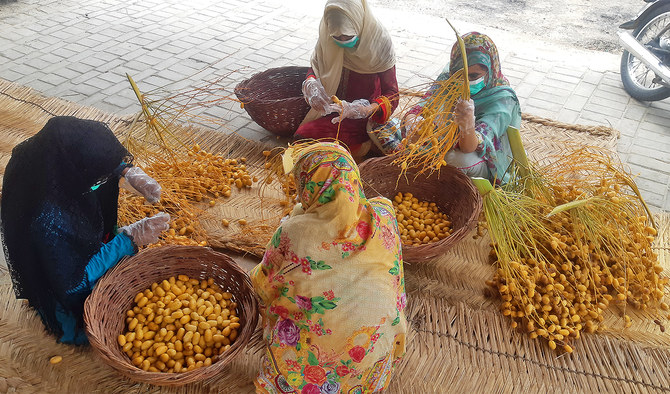

KHAIRPUR: In Khairpur district in southern Pakistan, a group of women is working with new drying techniques to improve the fruit’s quality and longevity, with the aim that it can be sold in the premium market and become a model for the country’s largest date growing region.
Khairpur accounts for some 40 percent of the country’s annual date production of over 535,000 tons. However, most of its produce comprises lower quality, sun-dried dates, with only one percent of the fruit put through value-added processing, according to market estimates.
The way dates are dried is what makes the difference in their quality and value.
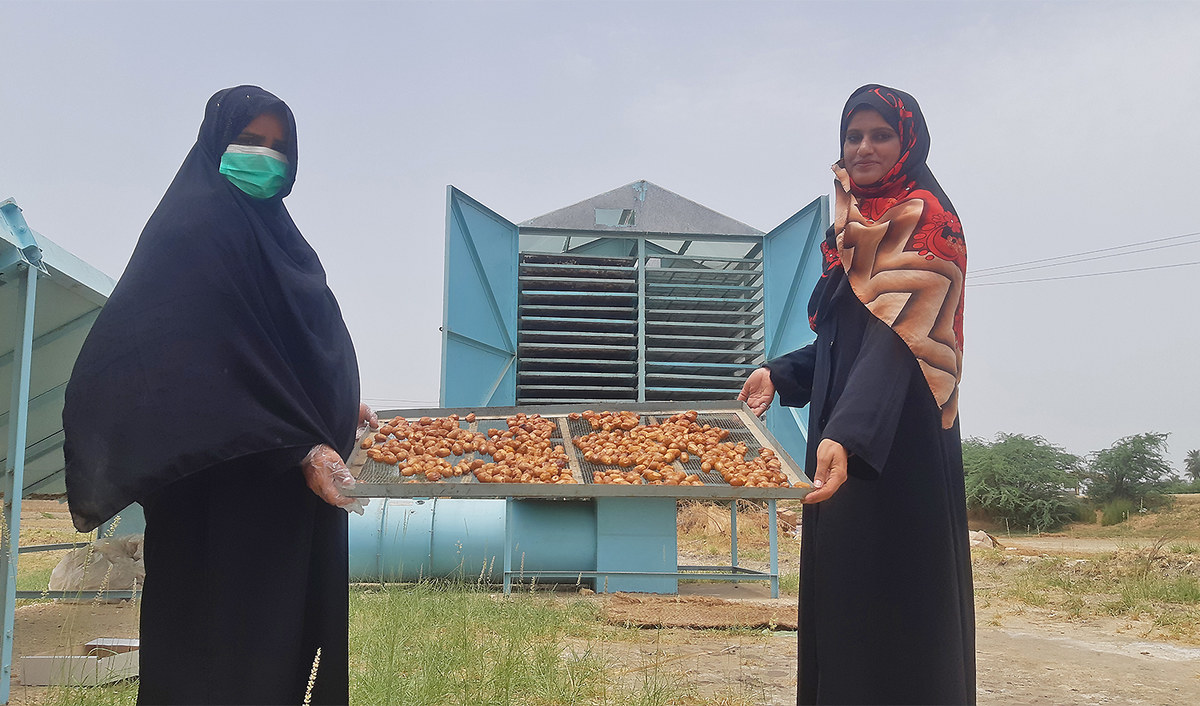
Dates are traditionally dried in the open, dehydrated by direct sunlight. But as part of the non-governmental Women Agriculture Development Organization (WADO), a group of over two dozen women are using solar and tunnel dryers that cover the fruit and protect it from contamination by other substances brought by the wind and animals. The process also ensures the color of the dates does not fade.
“Despite that Pakistan cultivates dates in abundance, little is done to produce hygienic dates and value-added products,” WADO chairperson Zahida Parveen Jiskani told Arab News. “However, we are the first group of females in the country’s leading date-producing Khairpur district producing refined dates.”

Women Agriculture Development Organization (WADO) leader Zahida Parveen Jiskani shows how fresh dates are processed in an indirect solar dryer at WADO's facility in Khairpur, Pakistan, on August 2, 2021. (AN photo by Zulfiqar Kunbhar)
WADO was funded by the World Bank and the provincial government from 2011-2015 but has since borne its own expenses.
Explaining WADO’s process, Jiskani said once the dates had been picked, the female workers separated them from bunches and washed them, and then transferred them into drying trays where they were kept for a specified number of days.
Once dry, the dates are sorted, graded, packed, and stored in airtight containers, which increases their shelf life.
During the date harvest season in Khairpur which lasts from mid-July to mid-August, the women produce 20 maunds, or about 37 kilograms, of different categories of refined dates, Jiskani said.
Due to the new processing techniques, the market value of the dates can almost double: “For instance, ordinary date prices range up to Rs4,000 per maund whereas refined dates go over Rs6,000 per maund,” Jiskani added.
Workers sort dried dates at the Women Agriculture Development Organization's facility in Khairpur, Pakistan, on August 2, 2021. (AN photo by Zulfiqar Kunbhar)
While the project is small, the workers and experts say it can become a model for date processing in Khairpur. In the impoverished region, it would also be a welcome source of income, with each woman worker currently earning about Rs10,000 ($60) per harvest season.
“The money we receive is good support for our families,” teenager Ghulam Kubra, who works on the project with her three cousins, said. “It is a pride for us to work to produce date products which bring a good name to our area.”
Nasir Abbas, head of operations and supply chain at PARC Agrotech Company (Pvt) Ltd, an Islamabad-based organization associated with the Pakistan Agricultural Research Council, said the demand for refined dates, including from Khairpur, was increasing in the country.
“We supply Khairpur’s reined dates at foreign diplomat’s offices in Islamabad where it is served to dignitaries,” Abbas told Arab News. “Also, it is sent abroad as a gift mainly to the Middle East and some European countries.”
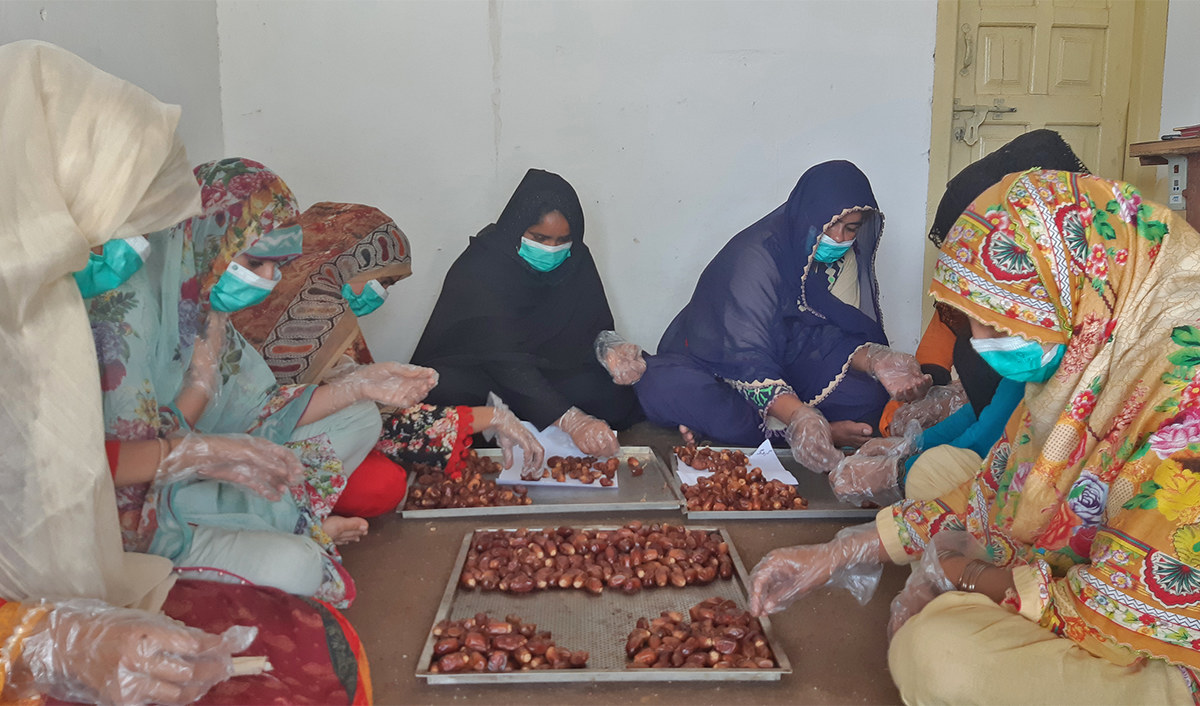
Workers sort dried dates at the Women Agriculture Development Organization's facility in Khairpur, Pakistan, on August 2, 2021. (AN photo by Zulfiqar Kunbhar)
But farmers in the region said they needed more processing units for dates so their produce could formally enter the premium market.
“As there are no processing units, growers have no choice but to make Chowara dates even though it sells at lowest prices,” Riaz Hussain Soomro, a local grower, said, referring to a low-quality date variety. “So what we need are driers as well as rain-protection bags to avoid rain losses as well as improve our gains.”
Jiskani agreed: “We lack facilities like a laboratory that will improve shelf-life, cold storage and proper marketing. Despite that there is a lot of demand [but] we cannot fulfill the local demand.”
Fruit driers and value-added agriculture practices could indeed be a game-changer for the region, where 85 percent of date production is the cheap Chowara type, according to Dr. Ghulam Sarwar Markhand, a former director at the Date Palm Research Institute Khairpur, who said Pakistan could earn “over ten times more” through value addition and advanced processing.
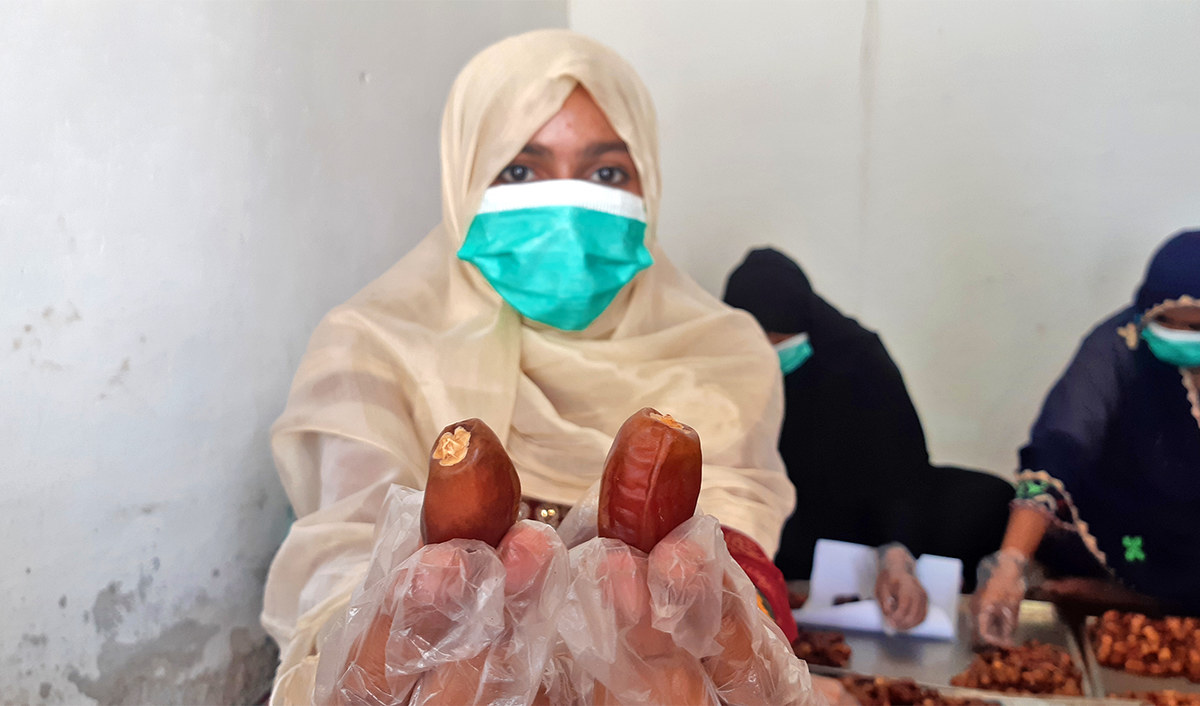
Ghulam Kubra, a seasonal worker at the Women Agriculture Development Organization, shows ready to pack dates processed at the group's facility in Khairpur, Pakistan, on August 2, 2021. (AN photo by Zulfiqar Kunbhar)
Lawmakers promise improvements are just around the corner.
Dr. Nafisa Shah, a Khairpur-based member of the National Assembly of Pakistan, said the Khairpur Special Economic Zone (KSEZ) was established by the provincial government in 2012, aiming to facilitate industrialization.
“Recently, some foreign companies, including Koreans, have shown interest in date units, so one can see eight to nine units will start working by the end of this year,” she added. “Soon, there will be a visible change in Khairpur’s date market in terms of resources.”