

Facebook shuts down anti-vaccine influencer campaign

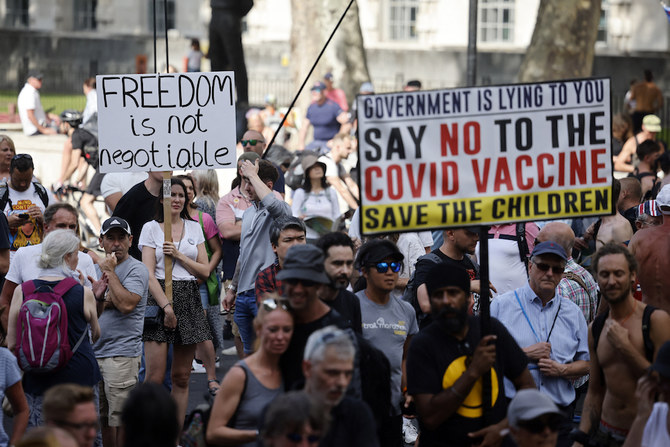
Protesters hold up placards at a demonstration against government lockdown restrictions in Parliament Square in central London on June 14, 2021. (File/AFP)
Short Url
Updated 11 August 2021
Follow

Facebook shuts down anti-vaccine influencer campaign

  • The leading social network labeled the operation a “disinformation laundromat” which sought to legitimize false claims
  • Facebook said that in July it removed 65 accounts at the leading social network and 243 accounts at photo-centric Instagram that were linked to the campaign

SAN FRANCISCO: Facebook on Tuesday said it shut down a disinformation operation which sought to spread Covid-19 vaccine hoaxes by duping social media influencers into backing false claims.
The leading social network labeled the operation a “disinformation laundromat” which sought to legitimize false claims by pushing them through people with clean reputations.
Influencers who caught onto the sham turned out to be the undoing of a deceitful influence campaign orchestrated by marketing firm Fazze in Russia, according to Facebook.
“The assumption was the influencers wouldn’t do any of their own homework, but two did,” Facebook global threat intelligence lead Ben Nimmo said while briefing journalists.
“It’s really a warning — be careful when someone is trying to spoon feed you a story. Do your own research.”
Facebook said that in July it removed 65 accounts at the leading social network and 243 accounts at photo-centric Instagram that were linked to the campaign, and banned Fazze from its platform.
Fazze is a subsidiary of a AdNow, an advertising company registered in Britain, according to media reports.
The operation targeted primarily India and Latin America, but also took aim at the United States, as governments debated approving vaccines to fight the pandemic, according to Nimmo.
Late last year, the network of fake accounts tried to fuel a false meme that the AstraZeneca vaccine against Covid-19 would turn people into chimpanzees, Facebook reported.
After going quiet for five months, the organizers attacked the safety of the Pfizer vaccine and leaked what it billed as an AstraZeneca document stolen by hacking, Facebook said.
The campaign took advantage of online platforms including Reddit, Medium, Change.org, and Facebook, creating misleading articles and petitions then providing “influencers” with links, hashtags and more to spread vaccine misinformation, according to Nimmo.
“In effect, this campaign functioned as a cross-platform disinformation laundromat,” Nimmo said.

The operation was exposed by influencers in France and Germany who questioned claims made in email pitches from Fazze, prompting journalists to dig into the matter, according to Facebook.
Facebook does not know who hired Fazze for the anti-vaccine campaign, but has shared its findings with regulators, police, and Internet industry peers, according to head of security policy Nathaniel Gleicher.
The campaign appeared to fall flat, with almost none of the Instagram posts receiving “likes,” and English and Hindi language petitions at Change.org each getting fewer than 1,000 signatures, Facebook said.
The security team at the social network has seen a trend of deceptive influence operations targeting multiple social media platforms and trying to recruit established personalities with followings to spread false messages, according to Gleicher.
“When these operations turn to influencers, they often don’t give them full context on who is behind it,” Gleicher said during the briefing.
“And when influencers find out, they are eager to blow the whistle.”
The news comes amid a spat between Facebook and the US administration over reining in virus misinformation, and government efforts to enlist popular social media characters to promote vaccinations.


Semafor targets Gulf expansion after first profitable year

Updated 09 January 2026
Follow

Semafor targets Gulf expansion after first profitable year

  • Digital news brand generates $2m in earnings on $40m of revenue in 2025, and raises $30m in new financing
  • Platform aims to be the ‘business and financial news brand of record for the Gulf,’ CEO says, and to ‘blanket the world’ within 2 years

DUBAI: Digital news platform Semafor generated $2 million in earnings in 2025 before interest, taxes, depreciation and amortization, on revenue of $40 million, marking its first year of profitability.

It also closed $30 million in new financing, which it plans to use to grow its editorial operations and live events business.

These achievements are particularly notable at a time when the global news industry is facing declining revenues and the erosion of audience trust, the company said.

Justin B. Smith, the company’s co-founder and CEO, told Arab News that Semafor’s model and approach is distinguished by several factors, which can be encapsulated by its vision of building a news product to “serve consumers that are increasingly not trusting news, but also designed with a business model that could deliver sustainable economic advantage.”

Following its first profitable year and armed with new funding, Semafor, founded in 2022, now plans an accelerated phase of global expansion with a focus on scaling editorial output and global convenings.

The company said it will broaden its publication schedule in the year ahead. Semafor Gulf and Semafor Business will become daily publications as the platform increases the frequency of its “first-read” services, which are daily briefings designed to showcase “front page” news and intended to serve as the “first read” for audiences, Smith said.

The Gulf edition of Semafor launched in September 2024, with former Dow Jones reporter Mohammed Sergie as editor. In 2025 Matthew Martin was appointed its Saudi Arabia bureau chief.

Semafor’s brand slogan is “intelligence for the new world economy” and “the Gulf is the epicenter of the new world economy,” Smith said. Currently, its Gulf operation employs eight journalists, based in the UAE and Saudi Arabia, and as it moves to a daily publishing schedule it plans to significantly bolster its editorial team, both in existing markets and new ones, such as Qatar.

Semafor is “obsessed with the business, financial and economic story” in the region and aims to become “the business and financial news brand of record for the Gulf,” Smith said.

In the US, Semafor DC, currently published daily, will move to a twice-a-day format in March. In addition, the company’s flagship annual Semafor World Economy platform in Washington will expand this year from a three-day event to five days, with extended programming. The event, in April, is expected to attract more than 400 global CEOs, more than double the number that took part in 2025.

In addition to the US and the Gulf, Semafor currently operates in Africa. It held its first event in the Gulf region last month, during Abu Dhabi Finance Week, and said it is now looking to grow its events footprint across the Gulf, and into Asia. It will launch a China edition next month, its first foray into Asia, and plans to launch in Europe in 2027, followed eventually by Latin America.

Within the next two years, Semafor aims to have “blanketed the whole world” and become a mature, global intelligence and news brand competing with the “greatest legacy business and financial news brands in the world,” Smith said.

“Our goal is to become the leading global intelligence and news company for the world, founded on independent, high-quality content and convenings,” he added.