

Lebanon’s American University of Beirut to ration fuel as crisis hits new highs

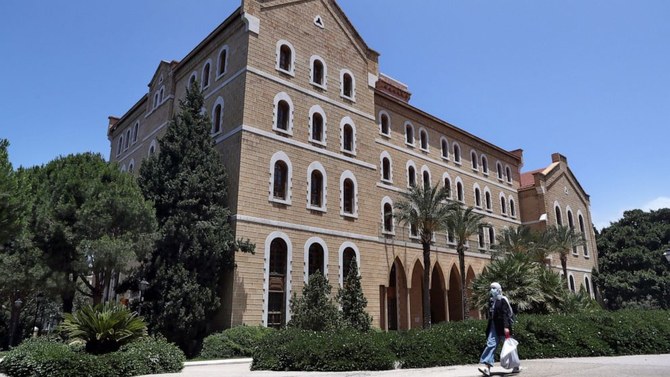
A woman walks on American University of Beirut's campus (AUB,) one of the oldest and most prestigious education institutions in the Middle East region, Monday, June. 22, 2020. (AP)
Short Url
Updated 11 August 2021
Follow

Lebanon’s American University of Beirut to ration fuel as crisis hits new highs

  • Rationing will stay in place until Aug. 22 with “exceptions made for buildings that house critical laboratories and heat-sensitive materials and equipment.”

DUBAI: Lebanon’s oldest and most prestigious university, the American University of Beirut, has started rationing electricity on campus as the country’s fuel crisis exacerbates.

The campus, made up of 64 buildings including the American University of Beirut Medical Center, will switch off its central air conditioning due to the shortage of fuel.

The move came into effect Monday in order to “prioritize critical functions especially at the medical center,” a letter sent to faculty and staff, seen by Arab News, said.

Human Resources Director Samar Diab Rouhana said the decision was due to “disruptions in fuel supplies in the country” and the fact that AUB’s fuel reserves have reached a critical threshold.

Rationing will stay in place until Aug. 22, she said, with “exceptions made for buildings that house critical laboratories and heat-sensitive materials and equipment.”

The university, which was founded in 1866, also requested all faculty and non-essential staff to work remotely from Aug. 13 until Aug. 20.

“In the meantime, the physical plant department will continue its efforts to secure fuel and rebuild the university’s fuel reserves,” the letter added.

The university could not be reached for comment.

Lebanon has faced months of severe fuel shortages that have caused hour-long lines at gas pumps and plunged the small Mediterranean country, dependent on private generators for power, into hours of darkness.

Meanwhile, the state-owned Électricité du Liban provider is barely providing two to three hours of electricity in most regions.

The shortages are blamed on smuggling to neighboring Syria, hoarding and the cash-strapped caretaker government’s inability to secure hard currency for fuel deliveries. 

As the central bank’s foreign currency reserves reached a critical threshold, caretaker Prime Minister Hassan Diab gave an “exceptional approval” on June 25 to partially lift subsidies by financing fuel imports at the exchange rate of LL3,900 to the dollar “for the next three months,” to little effect.

Despite increasing the price of gasoline, the easing of the shortage crisis in the country was short-lived.

On Monday, tensions morphed into deadly violence at Lebanon’s gas stations, killing three men after knives, guns and a hand grenade were used.

Top Lebanese officials are set to meet today to discuss the future of subsidies, including the caretaker deputy prime minister, energy minister, economy minister and the central bank governor.

They will discuss a ration cards proposal to replace the current subsidies scheme for essential goods such as fuel, gasoline, medicine, and wheat. 


Ceasefire with Kurdish-led force extended for another 15 days, Syrian army says

Updated 25 January 2026
Follow

Ceasefire with Kurdish-led force extended for another 15 days, Syrian army says

  • The defense ministry said the extension was in support of an operation by US forces to transfer accused Daesh militants to Iraq
  • The Kurdish-led Syrian Democratic Forces confirmed the ceasefire extension

RAQQA, Syria: Hours after the expiration of a four-day truce between the Syrian government and Kurdish-led fighters Saturday, Syria’s defense ministry announced the ceasefire had been extended by another 15 days.
The defense ministry said in a statement that the extension was in support of an operation by US forces to transfer accused Daesh militants who had been held in prisons in northeastern Syria to detention centers in Iraq.
The Kurdish-led Syrian Democratic Forces confirmed the ceasefire extension.
“Our forces affirm their commitment to the agreement and their dedication to respecting it, which contributes to de-escalation, the protection of civilians, and the creation of the necessary conditions for stability,” the group said in a statement.
Over the past three weeks, there have been intense clashes between government forces and the SDF, in which the SDF lost large parts of the area they once controlled.
Earlier in the day, the Kurdish-led force called on the international community to prevent any escalation.
The end of the truce came as government forces have been sending reinforcements to Syria’s northeast.
Syria’s interim government signed an agreement last March with the SDF for it to hand over territory and to eventually merge its fighters with government forces. In early January, a new round of talks failed to make progress over the merger, leading to renewed fighting between the two sides.
A new version of the accord was signed last weekend, and a four-day ceasefire was declared Tuesday. Part of the new deal is that SDF members will have to merge into the army and police forces as individuals.
The SDF said in a statement Saturday that military buildups and logistical movements by government forces have been observed, “clearly indicating an intent to escalate and push the region toward a new confrontation.” The SDF said it will continue to abide by the truce.
On Saturday, state TV said authorities on Saturday released 126 boys under the age of 18 who were held at the Al-Aqtan prison near the northern city of Raqqa that was taken by government forces Friday. The teenagers were taken to the city of Raqqa where they were handed over to their families, the TV station said.
The prison is also home to some of the 9,000 members of the Daesh group who are held in northeastern Syria. Most of them remain held in jails run by the SDF. Government forces have so far taken control of two prisons while the rest are still run by the SDF.
Earlier this week, the US military said that some 7,000 Daesh detainees will be transferred to detention centers in neighboring Iraq.
On Wednesday, the US military said that 150 prisoners have been taken to Iraq.