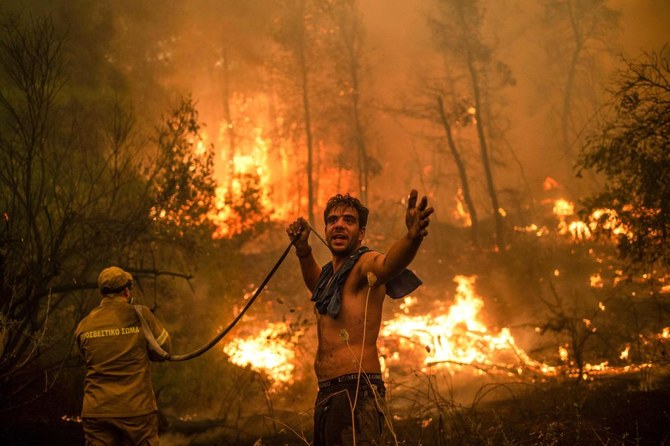
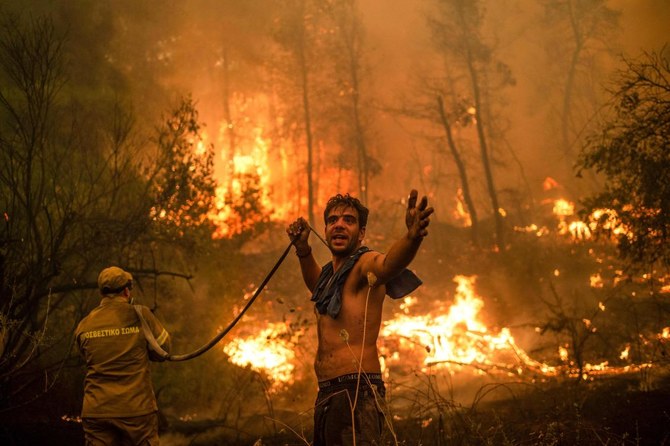
PEFKI, Greece: Firefighters battled heat and suffocating smoke for a seventh consecutive day Monday on Greece’s Evia Island, swept by the most destructive of the wildfires that have destroyed hundreds of homes and forced thousands to flee.
Greece and neighboring Turkey have been battling devastating blazes for nearly two weeks as the region suffers its worst heatwave in decades.
The wildfires continue as an alarming UN climate report warned that the planet is warming faster than previously estimated.
Two people have been confirmed dead in Greece and eight in Turkey, while dozens have been hospitalized.
While most of the fires that have blazed elsewhere in Greece for nearly two weeks have stabilized or receded, the ones on rugged and forested Evia — Greece’s second largest island after Crete — were the most worrying, creating apocalyptic scenes.
Authorities were on Monday putting the priority on saving the villages of Kamatriades and Galatsades because “if the fire passes through there, it will end up in a thick forest that will be difficult to extinguish,” firefighters told the Greek news agency ANA.
As the sweeping wall of fire laid siege to one village after another on the north of the island, firefighters toiled until dawn to quench flames at Monokarya in order to protect the town of Istiaia, all without the help of water-dousing aircraft, ANA reported.
Thick and suffocating smoke on Monday also enveloped the coastal region of Pefki, where hundreds of villagers had been evacuated by sea, while others regrouped, an AFP reporting team said.
Around 300 people evacuated from surrounding villages spent the night in a ferry moored near the long beach. Looming in the haze offshore, a military ship awaited further evacuees.
The ferry “was the only place where people could get a little peace and security,” a military official, Panagiotis Charalambos, told AFP.
Like many nearby communities, Pefki “had no electricity or water,” he said.
“Here, the people lived from the forest, from the crops, olives and tourism. There’s nothing of that left now,” said Louisa, a penioner in Pefki.
Finance Minister Christos Staikouras said up to 6,000 euros per household would be allocated to residents whose homes were damaged, as well as 4,500 euros for the injured.
In the town of Aidipsos, collections of basic necessities were organized for villagers who had lost everything in the fire.
“Have you seen the state offer us water? Snacks for the children? No one! They are just letting shopkeepers and individuals give water to people,” Pefki resident Giorgos told AFP.
While rain brought some respite from the blazes in Turkey over the weekend, Greece continued to suffer from an intense heatwave that Greek Prime Minister Kyriakos Mitsotakis said should show even doubters the hard reality of climate change.
Monday’s report by the UN’s Intergovernmental Panel on Climate Change concluded that the 1.5C temperature goal of the Paris Agreement would likely be breached around 2030 — a decade earlier than it projected just three years ago.
Meanwhile the EU said it was mobilizing “one of Europe’s biggest ever common firefighting operations” to assist Greece and other countries.
The response was needed “as multiple fires affect several countries simultaneously,” EU crisis management commissioner Janez Lenarcic said.
Giorgos Kelaitzidis, Evia’s deputy governor, echoed many when he blasted the “insufficient forces” to fight the fires while “the situation is critical” on the island.
He said at least 35,000 hectares of land and hundreds of homes have been burned.
From July 29 to August 7, 56,655 hectares (140,000 acres) were burnt in Greece, according to the European Forest Fire Information System.
The average area burnt over the same period between 2008 and 2020 was 1,700 hectares.
Some 650 firefighters have so far been deployed on Evia, according to Greek authorities.
But the air support faced “serious difficulties” because of turbulence, thick smoke and limited visibility, Greece’s Civil Protection deputy minister Nikos Hardalias said.
The situation looked better elsewhere, with officials saying that fires in the southwestern Peloponnese region and in a suburb north of Athens had abated. A fire on Crete was brought under control.
But Hardalias warned the risk of fires resurging was heightened.

Firefighters try to stop Greek island blaze from reaching forest
https://arab.news/pmf9r
Firefighters try to stop Greek island blaze from reaching forest
- Wildfires continue as an alarming UN climate report warned that the planet is warming faster than previously estimated
- Two people are confirmed dead in Greece and eight in Turkey, while dozens have been hospitalized
Inaction over UAE’s role is prolonging ‘worst proxy war in the world,’ Sudan justice minister says
- Had international community characterized it as ‘military rebellion’ and countered Emirati sponsorship of ‘terrorist militia’ it would not have endured, he tells UN Human Rights Council
- He accuses paramilitary Rapid Support forces of ‘targeting basic infrastructure, strategic facilities and public services,’ and ‘atrocities beyond our capacity to describe’
NEW YORK CITY: Sudan’s justice minister on Wednesday blamed the prolongation of the near-three-year conflict in his country on what he described as the failure of the international community to properly label the war as a rebellion.
He also accused the UAE of sponsoring and arming a militia, the Rapid Support Forces, he said was responsible for widespread abuses.
“The war has outstayed its welcome and it should not have gone on for this long had the international community, and particularly the UN and its bodies, fulfilled their responsibility in rightly characterizing this military rebellion,” said Abdullah Mohammed Dirif, “and had they called a spade a spade and countered the Abu Dhabi government, which sponsored this terrorist militia and provided it with high-tech arms and provided it with mercenaries.”
Speaking during the high-level segment of the 61st session of the UN Human Rights Council in Geneva, he warned that “the misleading characterization of this war has given a green light for the militia to keep its flagrant violations.”
The minister, who said he was speaking “on behalf of the government of Sudan and its people,” described the conflict between the Sudanese Armed Forces and the RSF, which began in April 2023, as “one of the worst proxy wars in the world,” which had “targeted the very existence of Sudan and its people.”
The RSF has “continued its methodic targeting of basic infrastructure and strategic facilities and all public services,” Dirif said, adding that “the aim is to displace civilians against whom it has committed atrocities beyond our capacity to describe them.
“The violations and crimes of the militia are going unabated. Yesterday it invaded Moustahiliya region in northern Darfur. It targeted civilians, killed them. It looted. It scorched villages and cities.”
Sudan’s military was “conducting its constitutional responsibility by standing up to the militia, protecting the civilians, preserving the unity of the country and the rule of law,” he said, and it remains “committed to international humanitarian law and the rules governing military engagement, and taking into account proportionality principles in order to protect civilians.”
Khartoum remains “open to genuine efforts which aim to end the war and the rebellion” based on a road map presented by the president of the Transitional Sovereignty Council, and a peace initiative submitted by the prime minister to the UN Security Council on Dec. 22, he added.
Dirif stressed his government’s commitment to continued “cooperation and coordination with human rights mechanisms in Sudan,” including the presence of the UN’s Office of the High Commissioner for Human Rights in the country and the UN special rapporteur on the human rights situation in Sudan.
“We recall, nationally, that achieving justice and redress to victims and ensuring impunity is a top priority for us,” he said, adding that authorities had made progress by investigating violations of national laws and international humanitarian laws.
He also underscored Sudan’s “commitment to continue facilitating and expediting delivery of humanitarian assistance to those affected by the war, including those under the control of the rebellious militia.”
Later, Sudan’s representative to the UN in Geneva exercised his right of reply and responded to prior remarks by the representative from the UAE.
“This is not a mere accusation, it is a well-known fact that is predicated on a number of evidence and documented proofs,” he said, referring to the UAE’s sponsorship of the RSF.
He cited in particular a report by a UN panel of experts on Sudan published on Jan. 15, 2024, which he described as “an official document of the Security Council” that referred to “lines of transferring weapons from Abu Dhabi International Airport” based on “clear-cut evidence.”
Other major international organizations and Sudan’s national commission of inquiry have provided further proof, he added, and Khartoum had submitted “a number of complaints, with proof, to the Security Council of the proven sabotage by the Abu Dhabi authority.”
The Sudanese representative continued: “It is paradoxical that the same authority that is sponsoring criminal militia, that the whole world is seeing and is attesting to its crimes, is now talking about peace in the Sudan. Peace is a noble value, that you have to be full of peace before you talk about it.
“The people of Sudan are only requesting this country stop sponsoring this criminal militia that is killing the innocent people in my country on a daily basis.”
The UAE has denied accusations that it provides military support to armed groups in Sudan, and says it supports efforts to achieve a peaceful resolution to the conflict.