AFIDNES, Greece: Fires raging in Greece claimed their first two lives on Friday during a punishing heatwave, while devastating wildfires in neighboring Turkey piled pressure on the Turkish government.
Greece and Turkey have been fighting blaze upon blaze over the past week, hit by the region’s worst heatwave in decades, a disaster that officials and experts have linked to increasingly frequent and intense weather events caused by climate change.
A UN draft report seen by AFP has warned that the Mediterranean region, which it called a “climate change hotspot,” will be hit by fiercer heatwaves, droughts and fires supercharged by rising temperatures.
Hundreds of people have been evacuated in both countries as temperatures hover between 40 to 45 degrees Celsius (104 to 113 Fahrenheit).
A 38-year-old man from Ippokrateio, a town north of Athens hit by giant flames, died in hospital on Friday after being hit by a falling electric pole as he was riding a moped, the health ministry said.
In the nearby town of Krioneri, Konstantinos Michalos, the president of the Athens Chamber of Commerce and Industry, was found unconscious in a factory and was transported to hospital where he was also confirmed dead, a hospital source said.
They are the first two deaths recorded from the fires in Greece, while 18 people have been injured, most with respiratory problems or minor burns. Two volunteer firefighters have been hospitalized in a critical condition, local media reported.
In Turkey, some eight people have been killed and dozens more hospitalized during 10 days of fire.
“Our country is facing an extremely critical situation,” Greek Prime Minister Kyriakos Mitsotakis said.
“We’re facing unprecedented conditions after several days of heatwave have turned the country into a powder keg.”
North of Athens, a fierce blaze tore through vast areas of pine forest, forcing yet more evacuations of villages overnight and blowing thick, choking smoke all over the Greek capital.
Text alerts were sent out to people in Athens warning of “extreme fire danger in the coming days.”
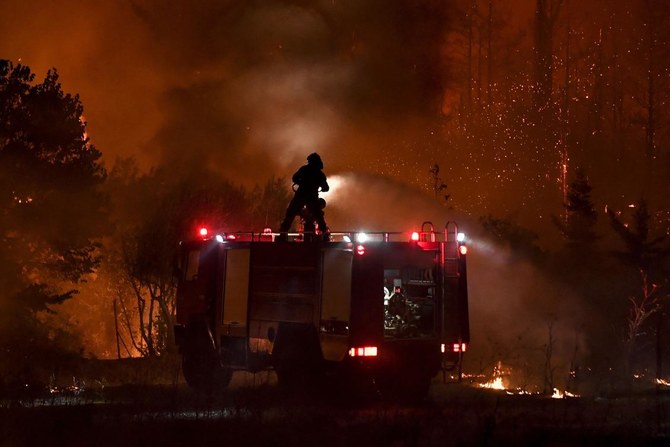
In the small town of Afidnes, 30 kilometers (12 miles) north of the capital, firefighters were seen standing on their truck in the dead of night, dousing flames that leapt high above them.
In the morning, the fires had left desolation in their wake — burnt cars, trees, and houses destroyed.
In nearby Krioneri, the fire scorched homes, businesses and factories.
“The fire is uncontrollable,” said resident Vassiliki Papapanagiotis. “I don’t want to leave, my whole life is here.”
Part of a motorway linking Athens to the north of the country has been shut down as a precaution.
Around 5,000 residents and tourists were evacuated in the southern Peloponnese town of Gytheio, the ERT channel reported.
Deputy Civil Protection Minister Nikos Hardalias said that out of 99 fires reported on Thursday, 56 were still active.
At least 450 Greek firefighters were fighting the blaze, along with water-dropping air support and reinforcements from France, Switzerland, Romania, Sweden, Israel and Cyprus.
In Turkey, 208 fires have flared up since July 28, and 12 were still ablaze on Friday, according to the presidency.
In one particularly critical event earlier this week, winds whipped up a flash fire that subsumed the grounds of an Aegean coast power plant in Turkey storing thousands of tons of coal.
More evacuations took place on Friday in five Turkish provinces, including tourist hotspots Antalya and Mugla, according to NTV.
President Recep Tayyip Erdogan has come under withering criticism for being slow or unwilling to accept some offers of foreign assistance after revealing that Turkey had no functioning firefighting planes.
The Turkish government is also facing pressure after the opposition referred to a report which showed only a fraction of the budget for forest fire prevention had been spent.
The General Directorate of Forestry (OGM) spent only 1.75 percent of nearly 200 million Turkish lira ($23 million) allocated for forest fires in the first six months of 2021, main opposition party MP Murat Emir said, referring to numbers apparently from the state agency’s own report.
“This is a situation that one could go as far as to describe as treachery,” he told AFP.
Extreme fires like those in Greece and Turkey will become even worse, the UN’s Intergovernmental Panel on Climate Change warned in a draft report due out next year seen by AFP.
“Climate change is forcing Mediterranean landscapes into a flammable state more regularly by drying out vegetation and priming it to burn,” said Matthew Jones, research fellow at the University of East Anglia’s Tyndall Center for Climate Change Research.


![]()

Greece fires claim first deaths as Turkey under pressure
Short Url
https://arab.news/8upa3
Greece fires claim first deaths as Turkey under pressure
- Greece and Turkey have been fighting blaze upon blaze over the past week
- A UN draft report seen by AFP has warned that the Mediterranean region will be hit by fiercer heatwaves, droughts and fires supercharged by rising temperatures

Latest updates


Recommended


© 2026 SAUDI RESEARCH & PUBLISHING COMPANY, All Rights Reserved And subject to Terms of Use Agreement.