

‘Knowledgeable’ UN envoy gains international support to end Yemen war 

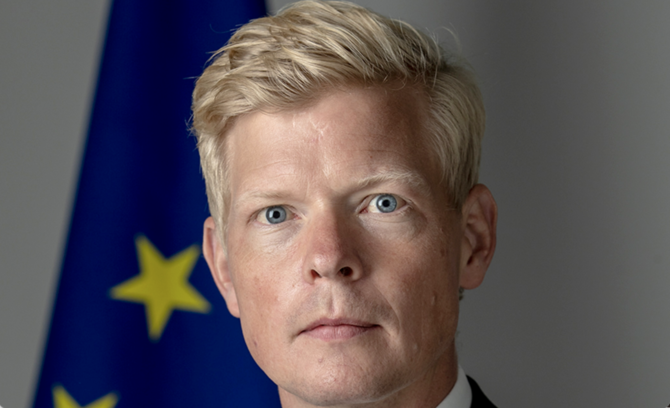
Hans Grundberg has received support from regional and international countries along with Yemeni factions. (File/@EUinYemen)
Short Url
Updated 07 August 2021
Follow

‘Knowledgeable’ UN envoy gains international support to end Yemen war 

  • Grundberg has been the European Union ambassador to Yemen since September 2019
  • Saudi FM said Kingdom would stand by the new UN envoy and backed all peace efforts to end the war

ALEXANDRIA: Acclaimed as an experienced diplomat who has handled conflicts in the Middle East for two decades, the UN special envoy for Yemen Hans Grundberg has received support from regional and international countries along with Yemeni factions to end the war in Yemen. 

On Friday, UN Secretary-General Antonio Guterres named the Swedish diplomat Grundberg as his special envoy for Yemen, succeeding Martin Griffiths, a Briton. 

The UN chief said the new envoy would draw on more than 20 years of experience in international affairs to help resolve the war in Yemen. He cited his role in helping Yemenis broker the Stockholm Agreement that defused fighting in the western province of Hodeidah in late 2018. 

Shortly after the announcement, the Yemeni government, Saudi Arabia, the US and other countries congratulated the new envoy and expressed support for his mission to end the war in Yemen. 

Saudi Foreign Minister Prince Faisal bin Farhan said the Kingdom would stand by the new UN envoy and backed all peace efforts to end the war. 

“We wish him success in his new role and look forward to working with him. The Kingdom will continue to support all efforts to reach a political solution that helps bring peace and prosperity to Yemen,” Prince Faisal said on Twitter. 

The internationally recognized government of Yemen also expressed support for the new UN envoy and repeated demands for resuming the peace process and reaching a political settlement that would end the Houthi takeover of power. 

“The Yemeni government will continue to extend its hand to a just and sustainable peace based on the three references agreed upon nationally, regionally and internationally,” Yemen’s Foreign Ministry said in a statement carried by the official news agency SABA. It praised the new envoy as a “knowledgeable diplomat about the Yemeni crisis.”

US Secretary of State Antony Blinken said there was great international support for addressing the humanitarian crisis and ending the Yemen conflict. 

“There is unprecedented consensus on resolving the conflict and a real opportunity for peace. Only a durable agreement among Yemenis can reverse the dire humanitarian crisis,” Blinken said in a statement. 

Swedish Foreign Minister Ann Linde said the new envoy was an “excellent” diplomat and her country backed UN diplomatic efforts to end the suffering of the Yemeni people. 

“Sweden looks forward to continuing our close collaboration with the UN in support of a durable cease-fire and a political solution to the conflict in Yemen,” she tweeted. 

Peace efforts to reach a peaceful settlement in Yemen, sponsored by the Griffiths, failed as Iran-backed Houthis refused to put into place a nationwide truce and stop their deadly offensive on the central city of Marib. 

The Omani foreign ministry, whose mediators visited Sanaa in June and failed to convince the Houthis to accept the UN peace initiative, hoped that the new envoy’s expertise on Yemen would help to push for peace, stating that the sultanate would back his mission to solve the Yemeni crisis “as soon as possible.”

Since the start of the Houthi offensive in February, the former UN envoy pushed for a truce for all battlefields in exchange for opening Sanaa airport and easing restrictions on ports under Houthi control, followed by peace talks between warring factions in Yemen. 

The rebels demanded that the Arab coalition first stop its air support to the Yemeni government to accept the proposal. 

On Saturday, Hussein Al-Azzi, a Houthi official, welcomed the appointment of the UN envoy and urged him to solve the humanitarian crisis and to create “a supportive atmosphere for constructive and fruitful talks.” 

During the past seven years, Houthis have boycotted two UN envoys to Yemen and accused them of being biased. 

Other Yemeni key factions such as the separatist Southern Transitional Council (STC) and the National Resistance have also promised to comply with UN peace efforts to end the war.

Yemen experts and political analysts argue that the Houthi reluctance to end their military operations across Yemen might impede the UN envoy’s efforts to end the war. 

“The biggest challenge facing the new envoy is convincing the Houthis to accept a cease-fire. All other parties, including the legitimate government, have accepted the peace initiative,” Najeeb Ghallab, undersecretary at Yemen’s Information Ministry and a political analyst, told Arab News. 

Another challenge is dealing with powerful forces that have emerged during the war, such as the STC, which calls for partitioning Yemen into two states.


Syrian military tells civilians to evacuate contested area east of Aleppo amid rising tensions

Updated 15 January 2026
Follow

Syrian military tells civilians to evacuate contested area east of Aleppo amid rising tensions

  • Syria’s military has announced it will open a “humanitarian corridor” for civilians to evacuate from an area in Aleppo province
  • This follows several days of intense clashes between government forces and the Kurdish-led Syrian Democratic Forces

DAMASCUS: Syria’s military said it would open a corridor Thursday for civilians to evacuate an area of Aleppo province that has seen a military buildup following intense clashes between government and Kurdish-led forces in Aleppo city.
The army’s announcement late Wednesday — which said civilians would be able to evacuate through the “humanitarian corridor” from 9 a.m. to 5 p.m. Thursday — appeared to signal plans for an offensive in the towns of Deir Hafer and Maskana and surrounding areas, about 60 kilometers (40 miles) east of Aleppo city.
The military called on the Kurdish-led Syrian Democratic Forces and other armed groups to withdraw to the other side of the the Euphrates River, to the east of the contested zone.
Syrian government troops have already sent troop reinforcements to the area after accusing the SDF of building up its own forces there, which the SDF denied. There have been limited exchanges of fire between the two sides, and the SDF has said that Turkish drones carried out strikes there.
The government has accused the SDF of launching drone strikes in Aleppo city, including one that hit the Aleppo governorate building on Saturday shortly after two Cabinet ministers and a local official held a news conference there.
The tensions in the Deir Hafer area come after several days of intense clashes last week in Aleppo city that ended with the evacuation of Kurdish fighters and government forces taking control of three contested neighborhoods. The fighting killed at least 23 people, wounded dozens more, and displaced tens of thousands.
The fighting broke out as negotiations have stalled between Damascus and the SDF, which controls large swaths of northeast Syria, over an agreement to integrate their forces and for the central government to take control of institutions including border crossings and oil fields in the northeast.
Some of the factions that make up the new Syrian army, which was formed after the fall of former President Bashar Assad in a rebel offensive in December 2024, were previously Turkiye-backed insurgent groups that have a long history of clashing with Kurdish forces.
The SDF for years has been the main US partner in Syria in fighting against the Daesh group, but Turkiye considers the SDF a terrorist organization because of its association with the Kurdistan Workers’ Party, or PKK, which has waged a long-running insurgency in Turkiye. A peace process is now underway.
Despite the long-running US support for the SDF, the Trump administration has also developed close ties with the government of interim Syrian President Ahmad Al-Sharaa and has pushed the Kurds to implement the integration deal. Washington has so far avoided publicly taking sides in the clashes in Aleppo.
The SDF in a statement warned of “dangerous repercussions on civilians, infrastructure, and vital facilities” in case of a further escalation and said Damascus bears “full responsibility for this escalation and all ensuing humanitarian and security repercussions in the region.”
Adm. Brad Cooper, commander of US Central Command, said in a statement Tuesday that the US is “closely monitoring” the situation and called for “all parties to exercise maximum restraint, avoid actions that could further escalate tensions, and prioritize the protection of civilians and critical infrastructure.” He called on the parties to “return to the negotiating table in good faith.”
Al-Sharaa blasts the SDF
In a televised interview aired Wednesday, Al-Sharaa praised the “courage of the Kurds” and said he would guarantee their rights and wants them to be part of the Syrian army, but he lashed out at the SDF.
He accused the group of not abiding by an agreement reached last year under which their forces were supposed to withdraw from neighborhoods they controlled in Aleppo city and of forcibly preventing civilians from leaving when the army opened a corridor for them to evacuate amid the recent clashes.
Al-Sharaa claimed that the SDF refused attempts by France and the US to mediate a ceasefire and withdrawal of Kurdish forces during the clashes due to an order from the PKK.
The interview was initially intended to air Tuesday on Shams TV, a broadcaster based in Irbil — the seat of northern Iraq’s semi-autonomous Kurdish region — but was canceled for what the station initially said were technical reasons.
Later the station’s manager said that the interview had been spiked out of fear of further inflaming tensions because of the hard line Al-Sharaa took against the SDF.
Syria’s state TV station instead aired clips from the interview on Wednesday. There was no immediate response from the SDF to Al-Sharaa’s comments.