

UN says Afghan war has entered ‘deadlier, more destructive phase’

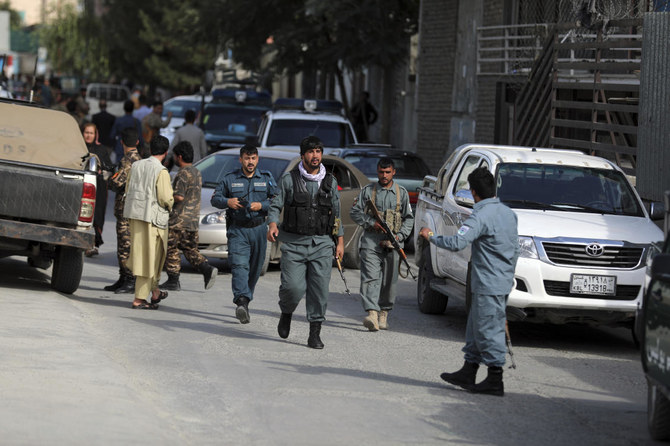
Afghan security personnel arrive at the area where the director of Afghanistan's Government Information Media Center Dawa Khan Menapal was shot dead in Kabul, Afghanistan, Friday, Aug. 6, 2021. (AP)
Short Url
Updated 07 August 2021
Follow

UN says Afghan war has entered ‘deadlier, more destructive phase’

  • The Taliban have stepped up their campaign to defeat the US-backed government since April as foreign forces complete their withdrawal after 20 years of war
  • The Taliban assassinated the government’s top media officer in Kabul on Friday

UNITED NATIONS: The UN special envoy for Afghanistan on Friday questioned the Taliban’s commitment to a political settlement, telling the UN Security Council the war has entered a “deadlier and more destructive phase” with more than 1,000 civilians killed in the past month during a Taliban offensive.
“A party that was genuinely committed to a negotiated settlement would not risk so many civilian casualties, because it would understand that the process of reconciliation will be more challenging, the more blood is shed,” Deborah Lyons said.
The Taliban have stepped up their campaign to defeat the US-backed government since April as foreign forces complete their withdrawal after 20 years of war. The Taliban captured an Afghan provincial capital and assassinated the government’s top media officer in Kabul on Friday.
“This is now a different kind of war, reminiscent of Syria, recently, or Sarajevo, in the not-so-distant past,” Lyons said.
“To attack urban areas is to knowingly inflict enormous harm and cause massive civilian casualties. Nonetheless, the threatening of large urban areas appears to be a strategic decision by the Taliban, who have accepted the likely carnage that will ensue,” she said.
Peace talks between the Afghan government and Taliban negotiators started last year in the Qatari capital of Doha, but have not made any substantive progress.

Opinion

This section contains relevant reference points, placed in (Opinion field)

Russia’s UN Ambassador Vassily Nebenzia told the council that the deteriorating situation in Afghanistan was of increasing concern and “with the withdrawal of foreign forces, the outlook looks grim.
“It is clear that there is no military solution to the Afghan situation, but in the current situation — given the absence of progress on the negotiation track — the prospects of Afghanistan slipping into full scale and protracted civil war, unfortunately, is a stark reality,” he said.
Senior US diplomat Jeffrey DeLaurentis urged the Taliban to halt their offensive, pursue a political settlement and protect Afghanistan’s infrastructure and people.
“The Taliban must hear from the international community that we will not accept a military takeover of Afghanistan or a return of the Taliban’s Islamic Emirate,” he said.
Afghanistan’s UN Ambassador Ghulam Isaczai urged the Security Council to act to “prevent a catastrophic situation.”
“We’re alarmed by reports and incidents of gross human rights violation by the Taliban and their foreign terrorist associates in almost half of our country and we are extremely concerned about the safety and security of people in cities under Taliban attacks,” he said.


Trump’s new tariffs shift focus to balance of payments; economists see no crisis

Updated 2 sec ago
Follow

Trump’s new tariffs shift focus to balance of payments; economists see no crisis

President Donald Trump’s temporary 15 percent tariffs to replace those struck down by the US Supreme Court are meant to resolve a problem that many economists say ​does not exist: a US balance of payments crisis, making them potentially vulnerable to new legal challenges.
Hours after the high court on Friday struck down a huge swath of tariffs Trump had imposed under the International Emergency Economic Powers Act, the president announced the new duties under Section 122 of the Trade Act of 1974 — a never-used statute that even his own legal team dismissed as irrelevant months ago.
Collections of the new 15 percent tariffs began at midnight on Tuesday as IEEPA tariff collections of 10 percent to 50 percent halted.
The Section 122 law allows the president to impose duties of up to 15 percent for up to 150 days on any and all countries to address “large and serious” balance-of-payments deficits and “fundamental international payments problems.”
Trump’s tariff order argued that a serious balance of payments deficit existed in the form of a $1.2 trillion annual US goods trade ‌deficit and a current ‌account deficit of 4 percent of GDP and a reversal of the US primary income surplus.
Some ​economists, ‌including ⁠former International ​Monetary Fund ⁠First Deputy Managing Director Gita Gopinath, disagreed with the Trump administration’s alarm.
“We can all agree that the US is not facing a balance of payment crisis, which is when countries experience an exorbitant increase in international borrowing costs and lose access to financial markets,” Gopinath told Reuters.
Gopinath rejected the White House’s claim that a negative balance on the US primary income for the first time since 1960 was evidence of a large and serious balance of payment problem.
She attributed the negative balance to a large increase in foreign purchases of US equities and risky assets over the past decade, which outperformed foreign equities over this period.
Mark Sobel, a former US Treasury and IMF official, said that balance of payments crises are more associated with countries that have ⁠fixed exchange rates, and noted that the floating-rate dollar has been steady, the 10-year Treasury yield fairly ‌stable, with US stocks performing well.
Josh Lipsky, chair of international economics at the Atlantic Council ‌think tank, agreed, noting that a balance of payments crisis occurred when a country ​could not pay for what it was importing or was unable to ‌service foreign debt. That was fundamentally different from a trade deficit, he added.
Brad Setser, a currency and trade expert at the ‌Council on Foreign Relations who served as a senior adviser to the US Trade Representative in the Biden administration, took a somewhat contrarian view, arguing in lengthy X posts on Sunday that the Trump administration may have a reasonable case that there is a “large and serious” balance of payments deficit.
He noted that the current account deficit was far higher than when then-president Richard Nixon erected tariffs in 1971 to address a balance of payments crisis, and the US net international investment ‌position is much worse. This “gives the administration a real argument,” in favor of its tariffs, Setser wrote.
The White House, US Treasury and US Trade Representative did not immediately respond to requests for comment about ⁠the use of Section 122.

WRONG STATUTE ⁠FOR THE JOB
Despite the Trump administration’s new focus on balance of payments, the Justice Department had previously argued that Section 122 was the wrong statute to handle a national emergency over the trade deficit.
In court filings in its defense of IEEPA tariffs, the Justice Department said Section 122 would not have “any obvious application here, where the concerns the president identified in declaring an emergency arise from trade deficits, which are conceptually distinct from balance-of-payments deficits.”
Neal Katyal, who argued at the Supreme Court on behalf of plaintiffs challenging the IEEPA tariffs, told CNBC that the Trump administration’s stance against the use of Section 122 for a trade deficit will make those tariffs vulnerable to litigation.
“I’m not sure it will necessarily even need to get to the Supreme Court, but if the president adheres to this plan of using a statute that his own Justice Department has said he can’t use, yeah, I think that’s a pretty easy thing to litigate,” Katyal said.
It is unclear who might take the lead in challenging the Section 122 tariffs.
Sara Albrecht, chair of the Liberty Justice Center, a nonprofit, public-interest law firm representing several small businesses that challenged the IEEPA ​tariffs, said the group would closely monitor any new statutes ​being invoked.
Albrecht did not reveal any future litigation strategy, adding: “Our immediate focus is simple: making sure the refund process begins and that checks start flowing to the American businesses that paid those unconstitutional duties.”
In its ruling, the Supreme Court did not give instructions regarding refunds, instead remanding the case to a lower ​trade court to determine next steps.