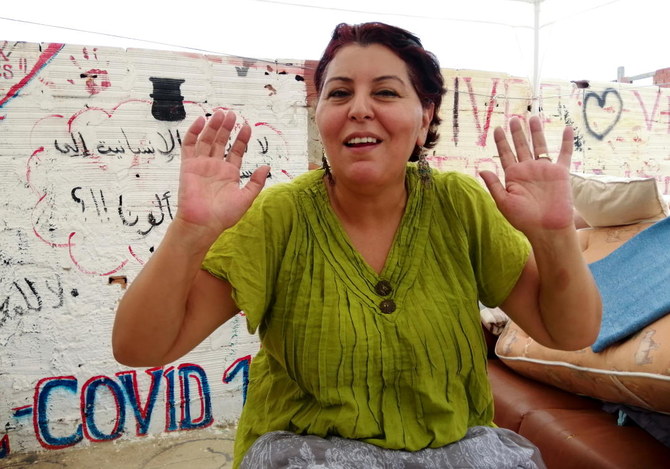
TUNIS: Sitting on her rooftop in Tunis, political activist Fatma Jgham said she and her comrades backed the Tunisian president’s seizure of governing powers but would maintain pressure on him if their demands were not met.
“We must hold a referendum on the constitution, and the demands of the people must not be turned around...not by you (the president) or anyone else,” said Jgham, a 48-year old art teacher.
She was one of the people who organized the wave of protests across Tunisian cities on July 25 that were cited by President Kais Saied later that day as he dismissed the prime minister and froze parliament. His opponents have called the moves a coup.
Saied’s actions have proved mostly popular, with thousands of people crowding the streets immediately afterwards to celebrate, but he has not given any details of how he plans to handle the crisis or Tunisia’s future.
The demonstrations represented a wave of anger that had built over years of economic stagnation and politically dysfunction, sharpened by a COVID-19 surge.
Though the protests were not very big, with hundreds rather than thousands of people braving the sweltering weather in each of the handful of cities where they took place, they also involved several attacks on offices of a major political party.
The moderate Islamist Ennahda, the most consistently successful party since the 2011 revolution that introduced democracy, has played a role in successive coalition governments and is blamed by many Tunisians for their economic problems.
“The demands were the overthrow of the entire failed system of government, especially the parliament, led by the gangs of the Ennahda Party and its coalitions,” Jgham said.
Some Ennahda officials have questioned whether the attacks on their offices were planned by Saied supporters as a pretext for his sudden intervention.
Jgham denies this. “People were angry and marginalized. It wasn’t planned but it was spontaneous,” she said.
The protests that day had not been backed by political parties but were organized by activists like Jgham on social media, she said.
Female activists, like Jgham, have played a prominent role throughout, reflecting Tunisia’s reputation as a leading center of women’s rights in Arab states.
Another activist, Emna Sahli, says that the role of women in protests has fundamentally changed. They are no longer led by men, she said.
“Today those who bear ideas are females and this is really great,” said the 35-year-old, who also took part in the July 25 protests.

Tunisian activists say they will keep up pressure on president
https://arab.news/nwts8
Tunisian activists say they will keep up pressure on president
- “The demands of the people must not be turned around… not by you (the president),” said political activist Fatma Jgham
- Activist Emna Sahli says the role of women in protests has fundamentally changed
Aoun slams ‘systematic policy of aggression’ as Israeli strikes kill 2, wound journalists in south Lebanon escalation
- Lebanese Army: Attacks terrorize civilians and hinder weapons control plan
- Israeli army spokesperson said military eliminated Abu Ali Salameh, who served as a Hezbollah liaison officer in the area
- Israeli drones targeted sites with heavy airstrikes, wounding journalists in Qanarit and destroying their equipment, cameras and vehicles
BEIRUT: Two people were killed and several journalists wounded in a series of Israeli attacks on Wednesday targeting southern areas, most of which lie north of the Litani River.
The Lebanese Army Command described the escalation as “impeding the army’s efforts and hindering the completion of its plan to confine weapons to Lebanese territory.” It said that the strikes terrorized civilians, caused deaths and injuries, displaced dozens of families and undermined regional stability.
The day’s security situation was dominated by hours of Israeli escalation, including airstrikes and evacuation warnings targeting villages and populated areas ahead of further bombardment.
The Israeli army said that warplanes carried out precision strikes on civilian vehicles in Bazouriyeh, killing a Hezbollah member. A separate drone strike hit a civilian vehicle on the Zahrani-Mseileh road, killing one person, with Israel claiming the target was another Hezbollah operative.
Israeli army spokesman Avichai Adraee said that the military “eliminated Abu Ali Salameh, who served as a Hezbollah liaison officer” in the village of Yanouh, in southern Lebanon. He accused Salameh of managing Hezbollah activities to “enable the group to operate within civilian areas and on private property, and to establish terrorist infrastructure in the heart of populated civilian areas, through the deliberate and cynical exploitation of the residents to serve Hezbollah’s objectives.”
Adraee claimed that on Dec. 13, Israel alerted Lebanon’s enforcement mechanism about a Hezbollah weapons depot in Yanouh. Salameh allegedly relayed the notification to other Hezbollah members, who then blocked Lebanese army access by staging a gathering while removing weapons from the site.
He said that Salameh also coordinated with the Lebanese army to falsely document the property as weapons-free, even as “suspicious boxes” were removed via a back entrance. Adraee called these actions a violation of Israel-Lebanon understandings, adding that “the Israeli army will continue to take measures to eliminate all threats.”
Israeli artillery also shelled the Harmoun area in the Bint Jbeil district, south of the Litani River, prompting Israeli army warnings — complete with maps — for residents of Qanarit, Kfour in Nabatieh and Jarjouh to evacuate immediately.
Israeli drones then hammered the sites with heavy airstrikes, wounding journalists in Qanarit and destroying their equipment, cameras and vehicles.
The Press Photographers Syndicate said: “Israeli claims of maintaining safe distances offer no protection, just as the warnings issued by the enemy to civilians offer no protection. It seems that cameras are not a red line.”
The statement urged photojournalists “to exercise caution and avoid turning their professional commitment into a reckless gamble.”
Civilians in the targeted areas reported receiving phone calls from Israel ordering them to clear squares, residential neighborhoods and a mosque.
The Lebanese Army Command confirmed that “Israeli attacks and violations targeted civilian buildings and homes in several areas, most recently in villages in the south, in a blatant violation of Lebanon’s sovereignty and security, the cessation of hostilities agreement, and UN Security Council Resolution 1701.”
Lebanese President Joseph Aoun issued a statement on Wednesday evening condemning the strikes and accused Tel Aviv of “pursuing a systematic policy of aggression” that targeted civilians and violated international humanitarian law, and constituted “a dangerous escalation.”
“This repeated aggressive behavior proves Israel’s refusal to abide by its commitments under the cessation of hostilities agreement and reflects a deliberate disregard for the efforts exerted by the Lebanese state to control the situation on the ground, maintain stability, and prevent the escalation of the confrontation,” he said.
He called on the international community — particularly the agreement’s sponsors — “to assume their legal and political responsibilities and take clear and effective measures to stop these violations and put an end to the policy of impunity.”
The escalation also came as Aoun reaffirmed his commitment to “monopolizing weapons in the hands of the state throughout all Lebanese territory.”
At a meeting of the Higher Supervisory Committee for Lebanon’s border protection program — attended by the US and Canadian ambassadors — Army Commander Gen. Rudolph Haykal stressed the army’s “absolute commitment” to securing borders but called for “qualitative military support” to tackle challenges on the northern and eastern fronts.
The army said that the ambassadors praised “its professionalism and success,” stressing the need to bolster the military institution to enhance its ability to maintain security nationwide. Lebanese military units are currently securing the northern and eastern borders with Syria to combat smuggling, weapons transfers and illegal infiltration.


