


Saudi Ports Authority records 
growth in activities in first half of 2021

Transshipment of containers and other cargoes at Saudi ports has seen growth during the first half of this year, reflecting the Kingdom’s economic recovery from the COVID-19 pandemic. (Shutterstock)
Short Url
Updated 08 August 2021
Follow

Saudi Ports Authority records 
growth in activities in first half of 2021

RIYADH: The Saudi Ports Authority (Mawani) announced on Thursday that all areas of its activities had seen growth during the first half of 2021.

The announcement reflects the Kingdom’s economic recovery from the COVID-19 pandemic.

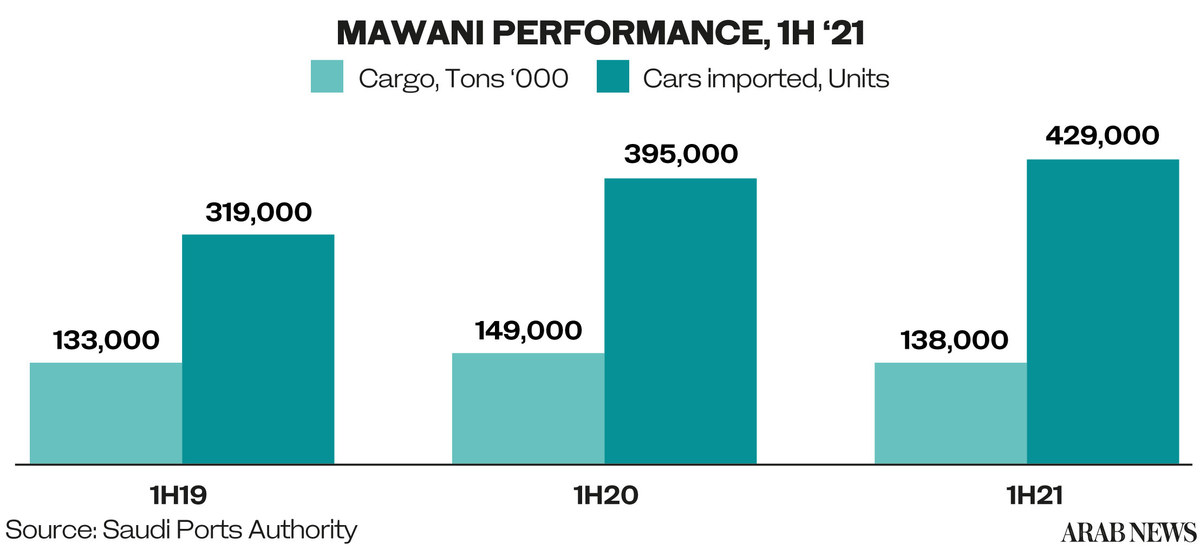
In terms of containers, Mawani handled 3.6 million TEU (a measure of volume equivalent to a 20-foot cargo container) during the first half of the year — a jump of 5.18 percent year-on-year. Transshipment containers increased by 24.49 percent to 1.4 million TEU, while it handled a total of 138 million tons of cargo.

The number of passengers grew by 0.61 percent year-on-year to 288,000, and Mawani handled 429,000 imported cars.

BACKGROUND

In July, Saudi Ports Authority announced investment opportunities in partnership with the private sector to develop and operate multipurpose terminals in eight of the nation’s ports.

The authority also recorded an increase in the number of ships received at the Kingdom’s ports, which received 6,037 vessels — an increase of 6.6 percent over the same period last year.

Mawani launched four shipping lines in 2020 to help increase Saudi ports’ connectivity with their international counterparts.
In July, the authority announced investment opportunities in partnership with the private sector to develop and operate multipurpose terminals in eight of the nation’s ports, in line with the objectives of Saudi Vision 2030, which include making the Kingdom a leading global logistics platform and connecting hub.

The build-operate-transfer (BOT) contracts on offer are for terminals in Jeddah Islamic Port, King Abdulaziz Port in Dammam, Ras Al-Khair Port, Jizan Port, Yanbu Commercial Port, King Fahad Industrial Port in Jubail, King Fahad Industrial Port in Yanbu, and Jubail Commercial Port.

One of the goals of Saudi Vision 2030 is for transport and logistics to contribute 10 percent of the country’s GDP by that date, up from its current 6 percent, following the implementation of the Kingdom’s new strategy for the sector.


New Saudi draft project to regulate direct market entry of listed companies’ subsidiaries

Updated 13 sec ago
Follow

New Saudi draft project to regulate direct market entry of listed companies’ subsidiaries

RIYADH: The Saudi Capital Market Authority has launched a draft regulation for the direct listing of subsidiaries of companies already listed on the main market, inviting stakeholders to provide feedback over a 30-day period, according to a statement issued today.

The proposed framework aims to allow subsidiaries of main-market companies to list their shares directly on the main market without undergoing an initial public offering, thereby shortening timelines, streamlining procedures, and reducing the costs associated with listing on the Saudi stock market.

It also seeks to create more investment opportunities in the Saudi financial market, contributing to market depth and product diversification, while maintaining high levels of transparency and protecting investors’ rights.

The proposals enable the issuer and its financial advisor to share information about the company and its financial statements with a select group of potential investors before obtaining CMA approval for the share registration request, allowing them to assess their interest in a direct listing on the main market.

They also allow a specific group of licensed financial advisory firms to prepare research and financial reports, provided these are not published before CMA approval.

The proposed framework emphasizes the importance of proper disclosure by setting out requirements for registering shares on the main market, including submitting a registration document to the CMA.

It also specifies the information that must be included in the registration document, such as the method for determining the reference share price and the risks associated with this method.

Under the draft regulation, securities offering rules, ongoing obligations, and the CMA’s glossary of terms and regulations will be updated to allow this type of listing.

This approach is expected to bring multiple benefits, including maximizing the overall value of the main market with lower risk by listing companies that have greater knowledge and experience of market regulations, as well as deepening the market by increasing the number of listed companies across multiple sectors.