

Discovery reveals Babylonian geometry ‘1,000 years before Pythagoras’

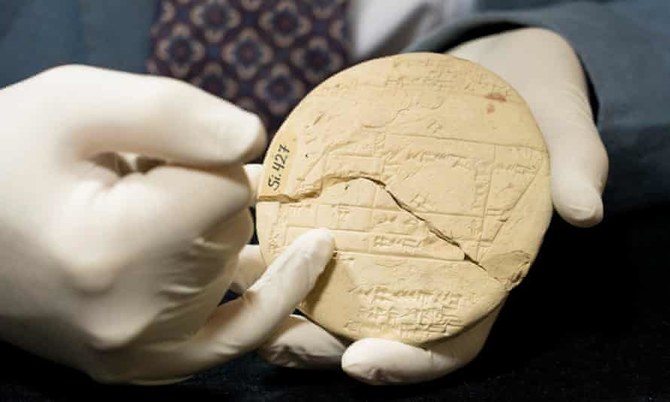
The ancient clay tablet was engraved with a stylus to describe a field containing marshy areas, as well as a threshing floor and nearby tower. (UNSW Sydney)
Short Url
Updated 05 August 2021
Follow

Discovery reveals Babylonian geometry ‘1,000 years before Pythagoras’

  • Researcher: 3,700-year-old clay tablet discovered near Baghdad will ‘change way we view history of maths’
  • The Old Babylonian period lasted between about 1900 and 1600 BC, and saw the advancement of religious, literary and scientific works

LONDON: The sale of a field in ancient Mesopotamia 3,700 years ago has been recognized as the first known use of applied geometry.

It was discovered that the surveyor of the land plot recorded the purchase on a clay tablet about the size of a palm by using complex strings of numbers known as Pythagorean triples.

“It’s a discovery that will completely change the way we view the history of mathematics,” said the lead researcher of the study, Dr. Daniel Mansfield of the University of New South Wales, Australia. “This is more than a thousand years before Pythagoras was born.”

Si.427, the label used by mathematicians to refer to the clay tablet, was first discovered near Baghdad in 1894, but it spent more than 100 years in a museum in Istanbul, left unnoticed by researchers. 

“It’s the only known example of a ‘cadastral’ document from the Old Babylonian period — a plan used by surveyors to define land boundaries,” Mansfield said.

“In this case, it tells us legal and geometric details about a field that was split after some of it was sold off.”

The Old Babylonian period lasted between about 1900 and 1600 BC, and saw the advancement of religious, literary and scientific works.

As a result of the Si.427 research, Mansfield believes that Babylonian surveyors would browse an array of Pythagorean triples and use one that best represented a rectangular plot to formulate a sales map, often using rope and other measuring devices.

“With this new tablet, we can actually see for the first time why they were interested in geometry: To lay down precise land boundaries,” Mansfield said.

“This is from a period where land started to become private. People started thinking in terms of ‘my land and your land,’ wanting to establish a proper boundary to have positive neighborly relationships. And this is what this tablet immediately says. It’s a field being split and new boundaries being made.”

Art Cairo spotlights pioneering artist Inji Efflatoun

Updated 23 January 2026
Follow

Art Cairo spotlights pioneering artist Inji Efflatoun

CAIRO: Art Cairo 2026 returned to Egypt’s bustling capital from Jan. 23-26, with visitors treated to gallery offerings from across the Middle East as well as a solo museum exhibition dedicated to pioneering Egyptian artist Inji Efflatoun.

While gallery booths hailed from across the Arab world, guests also had the chance to explore the oeuvre of the politically charged artist, who died in 1989.

Many of the pieces in the 14-work exhibition were drawn from the collection of the Egyptian Museum of Modern Art and cover four main periods of the artist’s work, including her Harvest, Motherhood, Prison and Knoll series.

While gallery booths hailed from across the Arab world, guests also had the chance to explore the oeuvre of the politically charged artist, who died in 1989. (Supplied)

Efflatoun was a pivotal figure in modern Egyptian art and is as well known for her work as her Marxist and feminist activism.

“This is the third year there is this collaboration between Art Cairo and the Ministry of Culture,” Noor Al-Askar, director of Art Cairo, told Arab News.

“This year we said Inji because (she) has a lot of work.”

Born in 1924 to an affluent, Ottoman-descended family in Cairo, Efflatoun rebelled against her background and took part heavily in communist organizations, with her artwork reflecting her abhorrence of social inequalities and her anti-colonial sentiments.

Many of the pieces in the 14-work exhibition were drawn from the collection of the Egyptian Museum of Modern Art and cover four main periods of the artist’s work, including her Harvest, Motherhood, Prison and Knoll series. (Supplied)

One untitled work on show is a barbed statement on social inequalities and motherhood, featuring a shrouded mother crouched low on the ground, working as she hugs and seemingly protects two infants between her legs.

The artist was a member of the influential Art et Liberte movement, a group of staunchly anti-imperialist artists and thinkers.

In 1959, Efflatoun was imprisoned under Gamal Abdel Nasser, the second president of Egypt. The artist served her sentence for four years across a number of women’s prisons in the deserts near Cairo — it was a period that heavily impacted her art, leading to her post-release “White Light” period, marked dynamic compositions and vibrant tones.

Grouped together, four of the exhibited works take inspiration from her time in prison, with powerful images of women stacked above each other in cell bunkbeds, with feminine bare legs at sharp odds with their surroundings.

Art Cairo 2026 returned to Egypt’s bustling capital from Jan. 23-26. (Supplied)

The bars of the prison cells obstruct the onlooker’s view, with harsh vertical bars juxtaposed against the monochrome stripes of the prison garb in some of her works on show.

“Modern art, Egyptian modern art, most people, they really don’t know it very well,” Al-Askar said, adding that there has been a recent uptick in interest across the Middle East, in the wake of a book on the artist by UAE art patron Sultan Sooud Al-Qassemi.

“So, without any reason, all the lights are now on Inji,” Al-Askar added.

Although it was not all-encompassing, Art Cairo’s spotlight on Efflatoun served as a powerful starting point for guests wishing to explore her artistic journey.