After 14-year gap, Pakistan plans census of livestock population

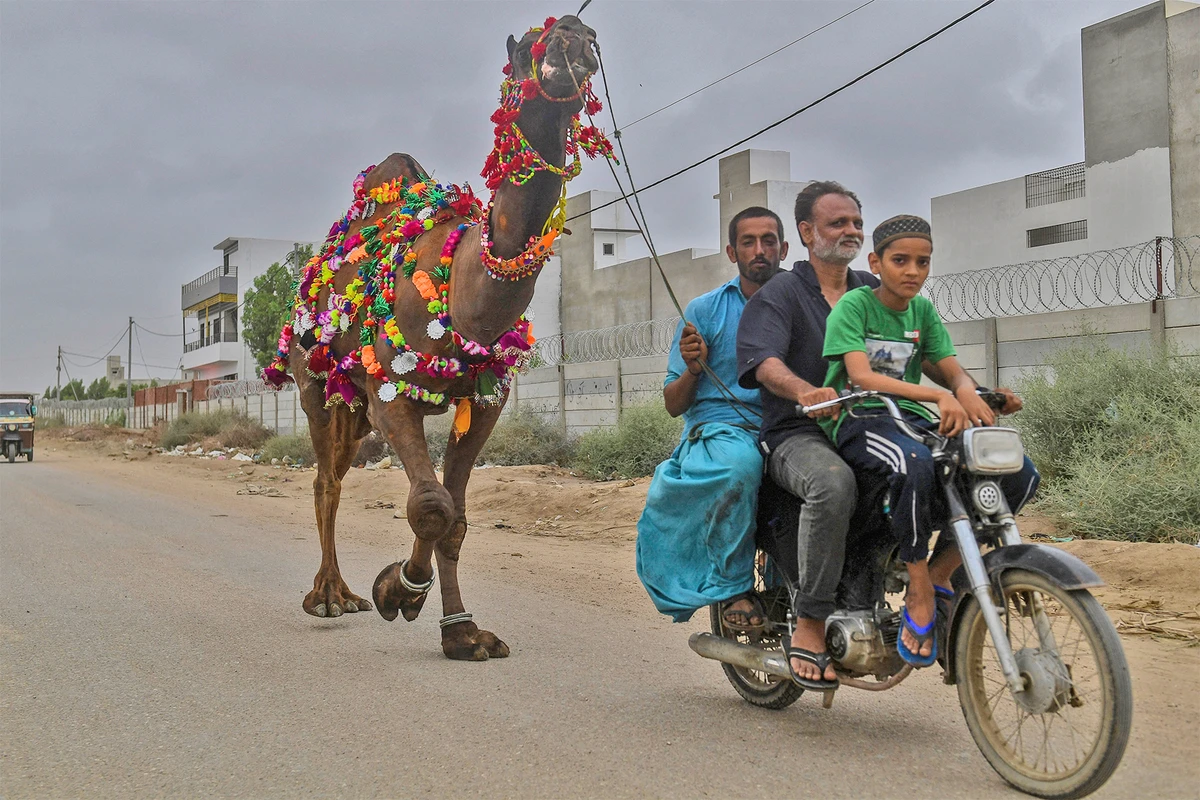
People take home sacrificial animals after purchasing it at a cattle market ahead of the Muslim festival of Eid al-Adha in Karachi, Pakistan, on July 19, 2021. (AFP)
Short Url
Updated 05 August 2021
Follow

After 14-year gap, Pakistan plans census of livestock population

  • Livestock production is largest subsector of Pakistan’s agriculture, contributes over 11 percent to GDP
  • Lack of data, experts say, does not allow the sector to realize its growth and export potential

KARACHI: After relying on estimates for more than 14 years, Pakistan is going to carry out a census of its livestock this year, officials have confirmed. 
Pakistan’s economy significantly relies on agricultural production, which in the previous fiscal year contributed 19 percent of the country’s gross domestic product (GDP), according to the finance ministry’s Economic Survey 2020-21. Livestock is its largest subsector having a 60 percent share in agriculture value addition.
More than 8 million rural families are engaged in livestock production and derive some 35-40 percent of their income from it. Gross value addition of livestock was Rs1.5 trillion in the fiscal year 2020-21.
Despite this huge contribution, no livestock census has been carried out since 2006.
“Pakistan Statistic Bureau has plans to conduct integrated census for Agriculture and Livestock during financial year 2021-22,” the Ministry of National Food Security and Research (MNFSR) has told Arab News.
While the Economic Survey 2020-21 recorded 51.5 million cattle, 42.4 million buffaloes, 80.3 million goats, 5.6 million donkeys, 400,000 horses and 200,000 mules, the figures are estimates based on the 1996-2006 inter-census growth rate which, experts argue, does not represent the country’s actual animal population growth. 
“No census has been conducted after 2006 but the estimates are being made while sitting in offices. That has no value,” Talat Naseer Pasha, vice chancellor of the University of Education, a public research university in Lahore, told Arab News.
For Dr. Jasir Aftab, a veterinary and husbandry analyst, policy making in the absence of actual data may be inaccurate and does not allow the sector to realize its growth and export potential.
“Due to lack of actual data the policy making and allocations for the animal related project could not be made properly,” he said. “That is why the country still could not harness the full potential of the country’s livestock.”
Pakistan warns of landslides, avalanches in northwest amid snowfall forecast

Updated 22 December 2025
Follow

Pakistan warns of landslides, avalanches in northwest amid snowfall forecast

  • Provincial authority warns snowfall may cause road closures, slippery conditions in Khyber Pakhtunkhwa districts in next 24 hours
  • Disaster management authority urges people to exercise caution, avoid unnecessary traveling during next 24 hours in Khyber Pakhtunkhwa

PESHAWAR: Pakistan has warned of landslides and avalanches in the hilly areas of northwestern Khyber Pakhtunkhwa (KP) in the next 24 hours, the Provincial Disaster Management Authority (PDMA) said on Monday, advising the public to remain cautious and avoid unnecessary travel.

In a weather forecast issued by the PDMA KP, the authority warned that snowfall may cause road closure and slippery conditions in the northwestern Naran, Kaghan, Dir, Swat, Buner, Malakand, Kohistan, Mansehra, Abbottabad, Shangla and Galliyat districts in the next 24 hours.

“Possibility of landslides/avalanches in hilly areas of the province during the [24 hours] period,” PDMA said. 

“Travelers and tourists are advised to remain extra cautious and avoid unnecessary travel during the period.”

It also warned of foggy conditions in patches at scattered places over Peshawar, Mardan, Nowshera, Charsadda Swabi and D.I. Khan districts during late nights and early mornings in northwestern Pakistan. 

Pakistan, which contributes less than one percent of global greenhouse gas emissions, is recognized among countries that are most vulnerable to climate change.

Scientists say rising temperatures are making South Asia’s monsoon rains more erratic and intense, increasing the risk of flash floods and landslides in mountainous regions such as KP and northern Gilgit-Baltistan.

Authorities in the past have urged people to avoid northern areas or exercise caution in travel when weather conditions are expected to deteriorate in winter season. 

At least 21 people, including nine children, died in freezing temperatures after being stuck in their vehicles in the Pakistani hill station of Murree in January 2022 when the roads became impassable.