

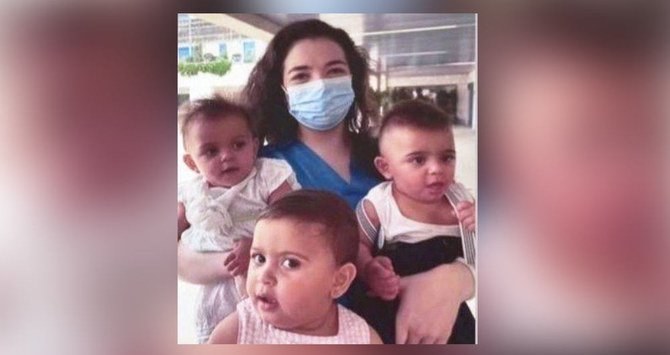

BEIRUT: A nurse hailed as a national hero for rescuing three premature babies from a hospital wrecked by the explosion at Beirut’s port a year ago was reunited with them on Wednesday, the first anniversary of the blast.
Pamela Zeinoun was working at St. George Hospital University Medical Center, less than a kilometer from the port, when the massive explosion sent a devastating shock wave through the city.
Without knowing what had happened, she instinctively scooped up a twin brother and sister and a third baby from their cots in the damaged neonatal intensive care unit on the hospital’s fourth floor and carried them to safety.
“I couldn’t believe what I was seeing,” Zeinoun told Arab News. “The feeling of holding again the babies who I had saved a year ago was indescribable — so warm and empathetic.”
The twins, Ali and Sidra, and the third baby, Noah, were brought by their families to the hospital, which was forced to close because of the damage caused by the explosion but has partly reopened, to meet Zeinoun. Noah’s family left Lebanon after the explosion
A photo of the reunion was taken at the spot where a news photographer captured one of the most enduring images of the disaster: a dust-covered Zeinoun clutching the three babies, cradling a phone with her neck.
“It was so heartwarming and emotional, especially when I tried to carry them in one go,” said Zeinoun who recalled how tiny they were 12 months ago and how they have grown since. “They looked so cute, funny and lovable to play with. I felt I was giving them the same warmness I had given them on Aug. 4 in 2020.”
She said it felt great to see the children are growing up healthily, safely and away from danger.
Zeinoun described the explosion as a “heartbreaking catastrophe” and said she sympathized with all the families and victims who lost loved ones. In her hospital alone, the blast killed 22 people.
“When I see the casualties’ families trying to find answers to what happened, I feel like their daughter … I just wish that justice would prevail and we find out who is behind what happened,” she added.
Describing the scene inside her ward after the explosion, she said the ceiling had collapsed and the room was littered with debris, furniture and toppled medical equipment.
Amid the confusion, as she held the three infants she stopped to answer a ringing telephone in the emergency room, a moment that was captured by Lebanese photojournalist Bilal Jawich. His photo went viral worldwide, appearing on news sites and TV channels and social media platforms.
A new father who was visiting his newborn baby on the day of the explosion, helped Zeinoun by lifting metal shelves that had fallen onto incubators so that she could rescue the infants. Despite all the damage, chaos and broken elevators, the nurse managed to carry the newborns down four floors and out of the hospital to safety.
She then walked with them in her arms for nearly 5km through streets littered with rubble and wreckage before the driver of a car took them to another hospital.
On Wednesday’s anniversary, the people of Lebanon mourned those who were killed and injured in what was one of the most powerful non-nuclear explosions in history. More than 200 people died, more than 6,500 were injured and an estimated 300,000 were left homeless.


