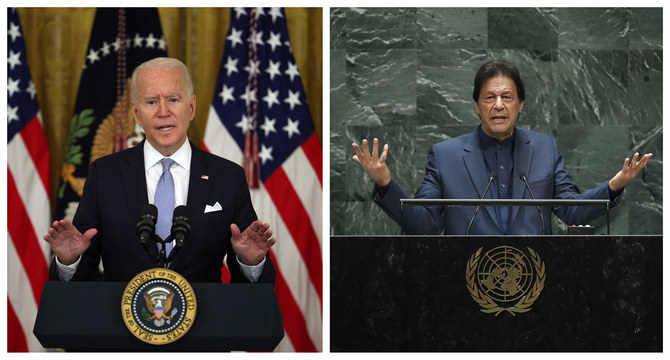
ISLAMABAD: Pakistani national security adviser Moeed Yusuf has complained in an interview with the Financial Times about Joe Biden’s failure to contact Prime Minister Imran Khan since being sworn in as president of the United States, saying Islamabad was struggling to “understand the signal” being sent by the lack of communication.
Yusuf’s comments come amid increasing violence in neighboring Afghanistan, where the Taliban have stepped up attacks ahead of a complete withdrawal of US forces from the war-battered country.
Washington is seeking Pakistan’s help to stop the Taliban taking over Afghanistan by force. The insurgent group has already captured swaths of territory across Afghanistan, with the government of Afghan president Ashraf Ghani openly accusing Pakistan of supporting the Taliban to secure its strategic interests in the region. Islamabad denies the accusations.
Washington has relied on Pakistan in the past to help bring senior Taliban leaders to the negotiating table and secure a deal to exit the country with few attacks on US soldiers. But despite calls from Khan to broaden US-Pakistan relations beyond Afghanistan, Biden has yet to call him since taking office this year.
“The president of the United States hasn’t spoken to the prime minister of such an important country who the US itself says is make-or-break in some cases, in some ways, in Afghanistan — we struggle to understand the signal, right?” Yusuf, Pakistan’s national security adviser, told the Financial Times in an interview at Pakistan’s embassy in Washington, published on Tuesday.
“We’ve been told every time that . . . [the phone call] will happen, it’s technical reasons or whatever. But frankly, people don’t believe it,” Yusuf added. “If a phone call is a concession, if a security relationship is a concession, Pakistan has options.”
A senior Biden administration official who was not named by the FT said: “There are still a number of world leaders President Biden has not been able to speak with personally yet. He looks forward to speaking with Prime Minister Khan when the time is right.”
Yusuf traveled to Washington as part of a delegation including the head of Pakistan’s ISI intelligence agency to discuss the Afghan crisis.
The perceived diplomatic affront the national security adviser spoke of marks the latest setback in US-Pakistan relations after the two nations’ cooperation during the ‘war on terror’ following the 9/11 attacks by Al-Qaeda, the militant group founded by Osama bin Laden.
In 2004, the US named Pakistan an official major non-Nato ally, spurred by Washington’s need for support to fight in Afghanistan. But US administrations have since regularly accused their ally of harboring Taliban insurgents, claims denied by Pakistan.
Under President Donald Trump’s administration, the US severed $2 billion in security assistance to Pakistan, with the then-president accusing Islamabad of “nothing but lies and deceit”. But after Trump made a deal with the Afghan Taliban that relied on help from Pakistan, he invited Khan to the White House.


![]()

Pakistan says struggling to understand ‘signal’ sent by Biden not calling PM Khan
Short Url
https://arab.news/gc346
Pakistan says struggling to understand ‘signal’ sent by Biden not calling PM Khan
- National security adviser says Pakistan told phone call delayed over “technical reasons … but frankly, people don’t believe it”
- A senior Biden administration official says Biden “looks forward to speaking with Prime Minister Khan when the time is right”
Latest updates


© 2026 SAUDI RESEARCH & PUBLISHING COMPANY, All Rights Reserved And subject to Terms of Use Agreement.