

Tunisian labor union urges new PM appointment to ease crisis

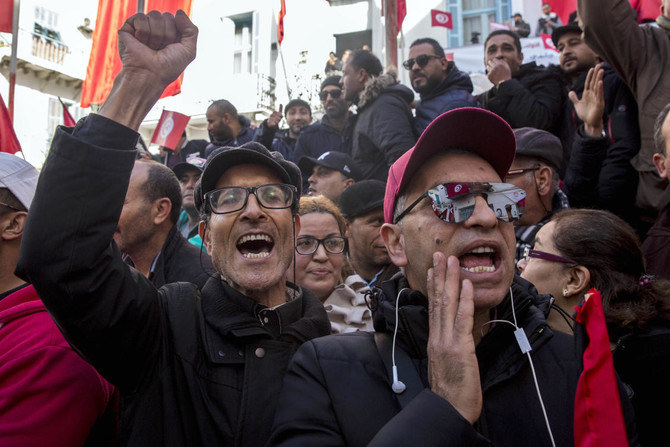
Supporters of the UGTT union, one of Tunisia’s most powerful political forces. (AP/File Photo)
Short Url
Updated 03 August 2021
Follow

Tunisian labor union urges new PM appointment to ease crisis

TUNIS: Tunisia’s powerful labor union urged the president on Tuesday to rapidly announce a new government that should be small and led by an experienced premier, after he seized executive control in a move his opponents called a coup.

President Kais Saied has defended his actions as constitutional and said he will govern alongside a new prime minister during an emergency period, but nine days after his intervention, he has yet to name one.

“We can’t wait 30 days for the announcement of a government,” said Sami Tahri, a spokesman for the UGTT union, one of Tunisia’s most powerful political forces.

UGTT chief Noureddine Taboubi said later on state television later on Tuesday that the cabinet should be small and headed by somebody with experience, sending a positive message to both Tunisians and international lenders.

“We must speed up the formation of the government to be able to face economic and health challenges,” he said.

Saied’s sudden intervention on July 25 appeared to have widespread public support but raised fears for the future of the democratic system that Tunisia adopted after its 2011 revolution that triggered the Arab Spring.

On Tuesday Saied removed Tunisia’s ambassador to Washington, the latest in a string of dismissals of senior and mid-ranking officials over the past week including several ministers. He did not immediately name a replacement.

He is also still to announce a roadmap to end an emergency period that he initially set at one month but later announced could be two months.

A source close to the presidential palace in Carthage said earlier that Saied might announce the new premier on Tuesday. Sources have told Reuters that Central Bank Governor Marouane Abassi and two former finance ministers, Hakim Hammouda and Nizar Yaich, are contenders.

Saied’s most powerful organized opponent, the moderate Islamist Ennahda party, has meanwhile been riven by internal splits over its response to the crisis and its longer-term strategy and leadership.

Tunisians had over the past decade grown ever more frustrated by economic stagnation, corruption and bickering among a political class that often seemed more focused on its own narrow interests than on national problems.

The coronavirus pandemic ripped through Tunisia over the past two months as the state vaccination effort crawled, leading at one point to the worst infection and death rates in Africa. Pandemic counter-measures last year hammered the economy.

On Monday Saied replaced the finance, agriculture and telecoms ministers after having said last week that “wrong economic choices” had cost the country.

On Sunday he said there were contacts with “friendly countries” for financial assistance. (Reporting by Tarek Amara, writing by Angus McDowall; Editing by William Maclean and Mark Heinrich)


A look at Ramadan and how Muslims observe the holy month

Updated 4 sec ago
Follow

A look at Ramadan and how Muslims observe the holy month

  • Ramadan is the ninth month of the Islamic lunar calendar; the month cycles through the seasons
  • Ramadan is followed by the Islamic holiday of Eid Al-Fitr
CAIRO: Observant Muslims the world over will soon be united in a ritual of daily fasting from dawn to sunset as the Islamic holy month of Ramadan starts. For Muslims, it’s a time for increased worship, religious reflection and charity. Socially, it often brings families and friends together in festive gatherings around meals to break their fast.
Ramadan is followed by the Islamic holiday of Eid Al-Fitr.
First day of Ramadan expected around Feb. 18-19
Ramadan is the ninth month of the Islamic lunar calendar; the month cycles through the seasons.
The start of the month traditionally depends on the sighting of the crescent moon. This year, the first day of Ramadan is expected to be on or around Feb. 18 or 19. The actual start date may vary among countries and Muslim communities due to declarations by multiple Islamic authorities around the globe on whether the crescent had been sighted or different methodologies used to determine the beginning of the month.
This year, the start of Ramadan is expected around the same time as Ash Wednesday, a solemn day of fasting and reflection that signals the start of Lent, the most penitential season of the church calendar for Catholics and many other Christians.
Fasting is one of the pillars of Islam
Fasting is one of the Five Pillars of Islam, along with the profession of faith, prayer, almsgiving and pilgrimage.
Muslims see various meanings and lessons in observing the fast.
It’s regarded as an act of worship to attain piety and one of submission to God. The devout see benefits, including practicing self-restraint, cultivating gratitude and empathizing with people who are poor and hungry.
The daily fast in Ramadan includes abstaining from all food and drink — not even a sip of water is allowed — from dawn to sunset, before breaking the fast in a meal known as “iftar” in Arabic.
Muslims typically stream into mosques for congregational prayers and dedicate more time to religious contemplation and the reading of the Qur’an, the Muslim holy book.
Charity is a hallmark of Ramadan. Among other ways of giving, many seek to provide iftar for those in need, distributing Ramadan boxes filled with pantry staples, handing out warm meals alongside such things as dates and juice or helping hold free communal meals.
Muslims eat a predawn meal, called “suhoor,” to hydrate and nurture their bodies ahead of the daily fast.
Exemptions from fasting
There are certain exemptions, such as for those who are unable to because of illness or travel. Those unable to fast due to being temporarily ill or traveling need to make up for the missed days of fasting later.
Cultural and social traditions associated with Ramadan
Muslims are ethnically and racially diverse and not all Ramadan traditions are rooted in religion. Some customs may transcend borders, while others can differ across cultures.
Many social rituals center on gathering and socializing after the daily fast. Some Muslims decorate their homes, put out Ramadan-themed tableware and centerpieces or throng to markets and Ramadan bazaars.
In Egypt, Ramadan is typically a festive time. Colorful lanterns, in different shapes and sizes, dangle from children’s hands and adorn homes. Ramadan songs may be played to welcome the month.
Ramadan’s soundscape in Egypt has traditionally included the predawn banging on drums by a “mesaharati” who roams neighborhoods, calling out to the faithful, sometimes by name, to wake them up for the suhoor meal.
New TV shows and communal meals
A lineup of new television series is another social fixture of the month in some countries, and advertisers compete for viewers’ attention.
In various regions, some Muslims worry that the month is getting commercialized, and say an emphasis on decorations, TV shows, outings or lavish iftar banquets can detract from Ramadan’s religious essence. Others say that a balance can be struck and that, in moderation, such rituals are part of the month’s festive spirit.
In Indonesia, Ramadan rituals vary across regions, reflecting the diversity of cultures. In deeply conservative Aceh province, animals are slaughtered during Meugang festivities, the meat cooked and shared with family, friends, poor people and orphans.
Hundreds of residents in Tangerang, a city outside the capital, Jakarta, flock to the Cisadane River to wash their hair with rice straw shampoo and welcome the fasting month with a symbolic spiritual cleansing.
Across the island of Sumatra, after evening prayers, many boys and girls parade through the streets, carrying torches and playing Islamic songs.
In the United States, where Muslims make up a racially and ethnically diverse minority, gathering at mosques and Islamic centers when possible for iftar meals and prayers provides many Muslim families with a sense of community. Some Muslims also organize or attend interfaith iftar meals.