

Pakistan State Oil denies making country’s costliest ever LNG purchase

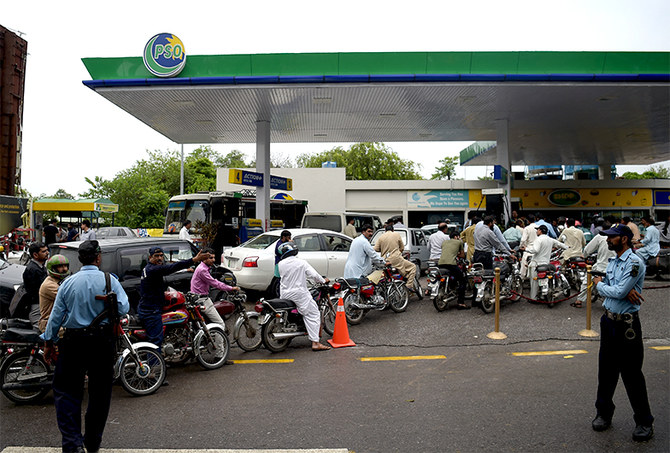
Pakistani commuters queue for fuel at a Pakistan State Oil (PSO) station in Islamabad on July 26, 2017. (AFP)
Short Url
Updated 03 August 2021
Follow

Pakistan State Oil denies making country’s costliest ever LNG purchase

  • Media reported that PSO purchased cargo of liquefied natural gas at $20.055 per unit, almost 27.9 percent of Brent
  • PSO says committed to safeguarding national interest, leaves no stone unturned to fuel country’s progress

ISLAMABAD: State-run Pakistan State Oil (PSO) said on Tuesday it had not purchased a cargo of liquefied natural gas (LNG) at $20.055 per unit, or almost 27.9 percent of Brent, as reported by local media.
Pakistan’s Dawn newspaper reported on Tuesday PSO had paid the highest price ever for an LNG cargo “not only in the country but perhaps the second highest summer purchase in the world.”
Last month, Pakistan LNG Limited (PLL), which handles LNG imports, said it had bought four cargoes for September delivery at around $15 per million British thermal units — the highest since the nation began imports in 2015.
“PSO has not awarded any cargo at $20.055,” PSO said in a statement on Twitter. “The bid received against the required delivery of August 29 and 30, 2021 was high, resulting in a price which was not acceptable to PSO and the tender was scrapped.”
“PSO is committed to safeguarding national interest and leaves no stone unturned to fuel the country’s progress,” PSO added.

However, Dawn reported on Tuesday that as a result of the expensive LNG cargoes acquired through the spot market by PSO and PPL, “the weighted average sale price for LNG (excluding GST) was notified by the Oil and Gas Regulatory Authority (Ogra) at $13.61 per MMBTU for August — up 5.5 percent over July prices that were already 25 percent expensive when compared to June.”
Last week, the Pakistani energy ministry said in a public statement the PLL board was “forced” to accept four LNG “spot” tenders at about $15 per MMBTU for September 2021 to avoid having to pay for replacement fuel (furnace oil), which was more expensive and would have resulted in 20 percent higher September power prices.
The energy ministry said diesel was an option but would have made electricity almost 50 percent more expensive.
After weighing different possibilities, the energy ministry said the country decided to opt for “the lesser of the two evils” and purchase the costly LNG.
Pakistan procures about one-third of its LNG through spot trading while the remaining two-third is done through long-term contracts.
Earlier this year, the government signed a long-term agreement with Qatar for additional 200 million cubic feet a day (MMCFD) of LNG, saying it had concluded the deal at about 31 percent lower rates than the previous government’s 2015 contract with Doha for 500mmcfd of gas.


World Bank president in Pakistan to discuss development projects, policy issues

Updated 01 February 2026
Follow

World Bank president in Pakistan to discuss development projects, policy issues

  • Pakistan, World Bank are currently gearing up to implement a 10-year partnership framework to grant $20 billion loans to the cash-strapped nation
  • World Bank President Ajay Banga will hold meetings with Pakistan Prime Minister Shehbaz Sharif and other senior officials during the high-level visit

ISLAMABAD: World Bank President Ajay Banga has arrived in Pakistan to hold talks with senior government officials on development projects and key policy issues, Pakistani state media reported on Sunday, as Islamabad seeks multilateral support to stabilize economy and accelerate growth.

The visit comes at a time when Pakistan and the World Bank are gearing up to implement a 10-year Country Partnership Framework (CPF) to grant $20 billion in loans to the cash-strapped nation.

The World Bank’s lending for Pakistan, due to start this year, will focus on education quality, child stunting, climate resilience, energy efficiency, inclusive development and private investment.

"World Bank President Ajay Banga arrives in Pakistan for a high-level visit," the state-run Pakistan TV Digital reported on Sunday. "During his stay, he will meet Prime Minister Shehbaz Sharif and other senior officials to discuss economic reforms, development projects, and key policy issues."

Pakistan, which nearly defaulted on its foreign debt obligations in 2023, is currently making efforts to stabilize its economy under a $7 billion International Monetary Fund (IMF) program.

Besides efforts to boost trade and foreign investment, Islamabad has been seeking support from multilateral financial institutions to ensure economic recovery.

“This partnership fosters a unified and focused vision for your county around six outcomes with clear, tangible and ambitious 10-year targets,” Martin Raiser, the World Bank vice president for South Asia, had said at the launch of the CPF in Jan. last year.

“We hope that the CPF will serve as an anchor for this engagement to keep us on the right track. Partnerships will equally be critical. More resources will be needed to have the impact at the scale that we wish to achieve and this will require close collaboration with all the development partners.”

In Dec., the World Bank said it had approved $700 million in ​financing for Pakistan under a multi-year initiative aimed at supporting the country's macroeconomic stability and service delivery.

It ‍followed a $47.9 ‍million World Bank grant ‍in August last year to improve primary education in Pakistan's most populous Punjab province.