

Pakistani Senate chairman first non-Arab parliamentary leader invited to address Arab Parliament

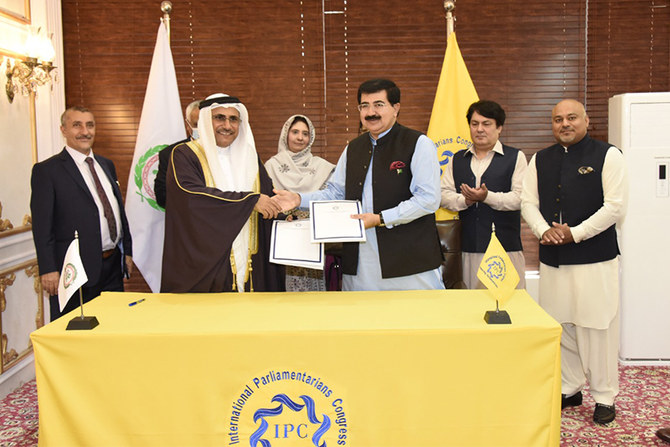
Arab Parliament speaker Adel Abdulrahman Al-Asoumi (second from left) shakes hand with Pakistan's Senate Chairman Sadiq Sanjarani (third from right) in Islamabad on August 2, 2021. (Photo courtesy: Pakistan Senate)
Short Url
Updated 03 August 2021
Follow

Pakistani Senate chairman first non-Arab parliamentary leader invited to address Arab Parliament

  • Arab Parliament delegation in Pakistan on five-day visit, meets Pakistani president, foreign minister, Senate chairman
  • Arab Parliament speaker invites Pakistan Senate chairman to address the legislative body’s next session in Cairo

ISLAMABAD: Arab Parliament speaker Adel Abdulrahman Al-Asoumi on Monday invited Pakistan Senate Chairman Muhammad Sadiq Sanjrani to attend and address the body’s next session in Cairo, the first time a non-Arab parliamentary leader has been invited to address the legislature.
The Arab Parliament is a legislative body of the Arab League, a 22-member organization of Arab countries established in 1945.
A delegation, led by the Arab Parliament speaker, began its first five-day visit to Islamabad on Sunday on the invitation of Sanjrani “to develop and strengthen parliamentary relations” with Pakistan.
“I consider this [invitation] an honor to be a great blessing for me. I will soon visit the Arab Parliament with a parliamentary delegation,” Sanjarani said while accepting the invitation.
Arab Parliament delegates on Monday also held separate meetings with the Pakistani president, Senate chairman and foreign minister, discussing bilateral cooperation, institutional ties and parliamentary diplomacy among other issues of mutual interest.
“Pakistan attaches special importance to its relations with Arab countries,” President Dr. Arif Alvi said in a meeting with the delegates, adding that the Pakistani people had a natural attachment to the people of Arab countries because of “common faith and culture.”
Alvi reiterated that Islamic countries should work together to change the world’s perceptions of Islamophobia.
“Challenges of terrorism and Islamophobia can be overcome through close cooperation,” he added.
Al-Asoumi informed the president that Pakistan was an “important country” for the Arab world, adding: “Economic development and social prosperity is our common commitment, and we will move forward with it.”
He said such exchanges of delegations were needed to further strengthen relations between Pakistan and the Arab world.
In his meeting with the visiting delegation, the Senate chairman said Pakistan was ready to join the Arab Parliament as an observer “because it is very important to us as it is a common platform of the Arab countries.”

The Pakistan Senate and Arab Parliament also signed a memorandum of understanding for cooperation between the two institutions through bilateral exchanges and training of parliamentarians.

In a meeting with the visiting delegation, Pakistani foreign minister Shah Mahmood Qureshi said Pakistan wanted peace and stability in the Middle East.
“As a founding member of the OIC, we are committed to playing a positive role in the unity of the Muslim world,” Qureshi said, adding that Pakistan considered a just solution to the Palestinian issue essential for peace in the Middle East.
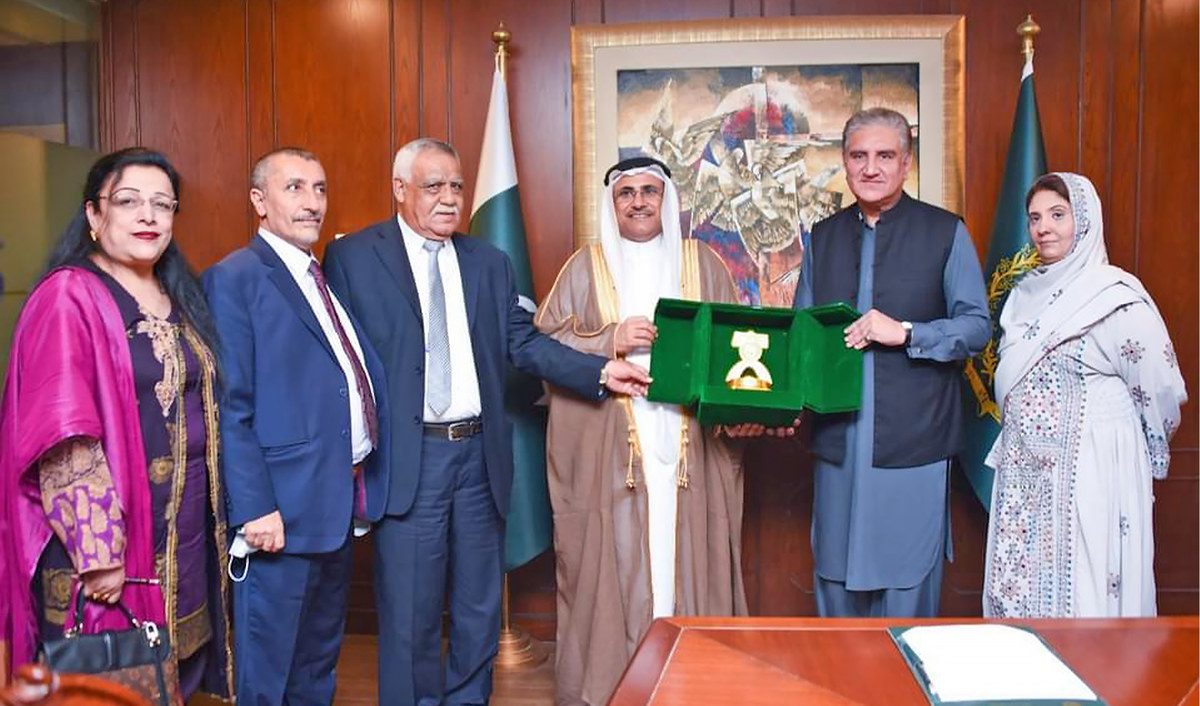


Pakistan's Foreign Minister, Shah Mahmood Qureshi (second right) present a souvenir to Arab Parliament speaker Adel Abdulrahman Al-Asoumi (third right) in Islamabad on August 2, 2021. (Photo courtesy: Senate Pakistan)


Pakistani court sentences TLP leader for 35 years over incitement against ex-chief justice

Updated 11 sec ago
Follow

Pakistani court sentences TLP leader for 35 years over incitement against ex-chief justice

  • The case stems from a 2024 speech targeting former Chief Justice of Pakistan Qazi Faez Isa over a blasphemy ruling
  • Conviction follows the government’s move to proscribe Tehreek-e-Labbaik Pakistan after clashes with police this year

ISLAMABAD: A Pakistani court this week sentenced a leader of the religio-political party Tehreek-i-Labbaik Pakistan (TLP) to 35 years’ imprisonment on multiple charges for inciting hate against former Chief Justice of Pakistan Qazi Faez Isa.

Peer Zaheer ul Hasan Bukhari made the remarks in a 2024 speech at the Lahore Press Club against the former chief justice for issuing a judgment in a case involving a man named Mubarak Sani under the blasphemy laws, a member of a minority religious community whose death sentence was overturned.

Authorities said Bukhari’s comments amounted to incitement to violence, after which police registered a case against him under various terrorism-related provisions as well as charges of inciting hatred.

The cleric was handed multiple jail terms on a range of charges, with the longest being 10 years of rigorous imprisonment, amounting to a total of 35 years.

“All the sections of imprisonment awarded to the convict shall run concurrently,” Anti-Terrorism Court Judge Arshad Javed said in a letter to the Kot Lakhpat Central Jail superintendent.

A collective fine of Rs600,000 ($,150) was also imposed on the TLP party leader under the provisions of the Anti-Terrorism Act.

The move follows Pakistan’s decision in October to ban the TLP and designate it a proscribed organization under the Anti-Terrorism Act after violent clashes between its supporters and law enforcement in Punjab.

The unrest erupted as demonstrators attempted to travel from Lahore to Islamabad, saying they wanted to stage a pro-Palestine rally outside the US Embassy.

However, officials said TLP supporters were armed with bricks and batons, arguing their intention was to stir violence similar to earlier marches toward the federal capital.

The clashes between TLP supporters and police resulted in the deaths of five people, including two policemen, and injured more than 100 officers and dozens of protesters.

Led by Saad Hussain Rizvi, the TLP is known for its confrontational street politics and mass mobilizations.

Since its emergence in 2017, the party has repeatedly organized sit-ins and marches toward Islamabad, often triggering violent confrontations and prolonged disruptions on major routes to the capital.