


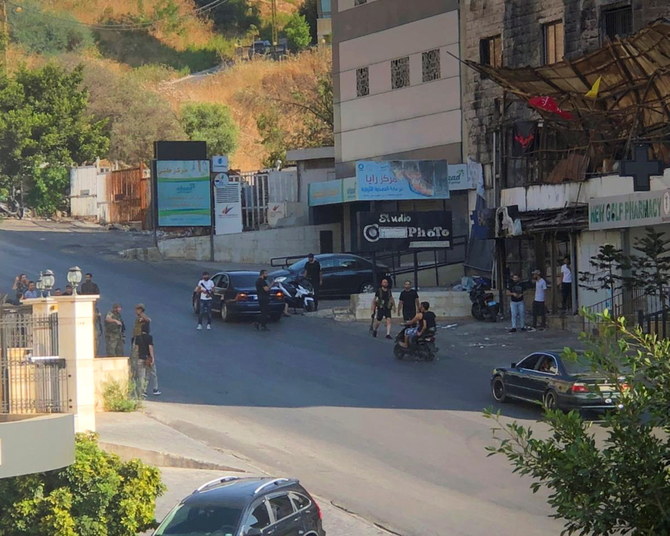

BEIRUT: A gunmen has caused deaths and carnage after opening fire at the funeral of a Hezbollah commander who was killed in a revenge shooting a day earlier.
The brother of Hassan Ghosn killed Ali Shibli, whom the Ghosn family has accused of killing their son.
Shibli was loyal to Hezbollah and had an armed group that boasts the support of the militia in Lebanon.
During Shibli’s funeral by his house in Khalde on Sunday afternoon, it was reported that there was an exchange of fire between the participants in the procession and other gunmen, which led to many deaths and injuries.
Shibli’s murder was committed in cold blood during his brother’s wedding party on Saturday night in the coastal area of Jiyeh.
The killer from the Ghosn family entered the garden where the party was taking place, approached the table where the victim was sitting and shot him with a pistol at close range.
Guests captured the crime while filming the party. The videos were widely circulated on social media.
Another guest, who was sitting next to Shibli, was injured in the accident.
Shibli died on the way to hospital from gunshot wounds to his chest.
It was reported that Shibli was shot a year after the killing of Hassan Ghosn, which had occurred over a dispute of removal of a religious banner which Ali Shibli had put atop a commercial center he owned in Khalde, at the southern entrance to Beirut.
FASTFACTS
• In recent years, clashes have flared between tribes loyal to the Future Movement political party and groups aligned with Hezbollah.
• Ali Shibli’s brother, Hussein, was killed in 2013 while fighting for Hezbollah in Syria. Reports suggest that Ali Shibli also fought in Syria.
This resulted in a clash between men from the Khalde clans and the Shibli family, leading to the death of Ghosn and two other men, Omar Ghazi Musa and Mahmoud Youssef Hadoul.
The family of Hassan Ghosn said in a statement on Saturday: “We did everything we could to demand the family’s right to punish the criminal Shibli in accordance with the provisions of the Lebanese Penal Code. However, our demands were (not) met (after) a whole year.”
The family declared that they were “putting themselves at the disposal of the judiciary.”
However, during Shibli’s funeral, armed men appeared and heavy shooting was reported in the Khalde area.
Hezbollah said it regretted the killing of Shibli, describing him as a “martyr.” The party called on the security and judicial agencies to confront the perpetrators and those who assisted them.
In recent years, clashes have flared between tribes loyal to the Future Movement political party and groups aligned with Hezbollah.
Ali Shibli’s brother, Hussein, was killed in 2013 while fighting for Hezbollah in Syria. Reports suggest that Ali Shibli also fought in Syria.
Meanwhile, activists circulated a video on social media showing protesters gathering in front of a residential building in the southern suburbs of Beirut. It was reported that Hezbollah’s liaison and coordination unit officer, Wafiq Safa, lives there, attracting the family members of people who were recently arrested by Hezbollah for their demonstrations against electricity and fuel shortages.
Ali Al-Amin, an opposition activist, told Arab News: “The protest in front of Safa’s house reveals two things: Either there is a conflict within the Hezbollah’s centers of power ... or that there is a conflict between the Amal movement and Hezbollah, which is manifested by the resentment we hear daily from people accusing the Amal movement of corruption.”
Al-Amin said: “Hezbollah is trying to ... distance itself from the accusations of corruption and wants to throw it on the Amal Movement.”
The activist added: “In the face of the severe economic crisis in the country, this crisis will inevitably explode in the face of Hezbollah.”
Also on Sunday, 19 members of the Albanian families who were detained in camps belonging to the Syrian Democratic Forces (SDF) in Syria traveled home from Beirut in the presence of Albanian Prime Minister Edi Rama.
Director General of General Security Maj. Gen. Abbas Ibrahim said: “This operation is a continuation of previous campaigns that were carried out at the request of the president of friendly Albania to recover a group of women and children who were detained for a long time in the SDF camps in northeastern Syria, after about two years of negotiatyions.”


