

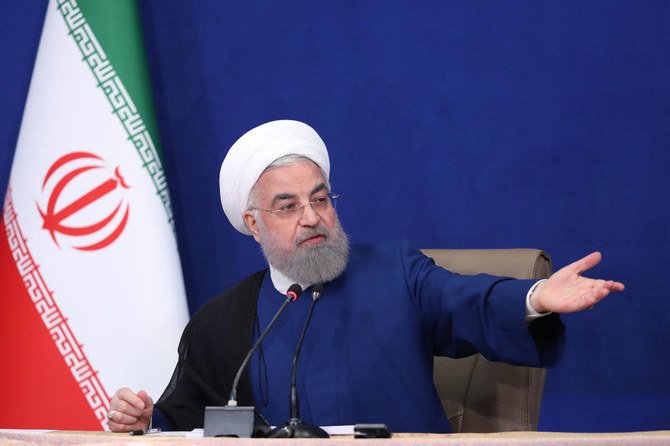

DUBAI: Iran’s outgoing president on Sunday acknowledged his nation at times “did not tell part of the truth” to its people during his eight-year tenure, as he prepares to leave office with his signature nuclear deal with world powers in tatters and tensions high with the West.
President Hassan Rouhani’s comments, aired on state television, come as officials in his government have appeared rudderless in recent months amid a series of crises ranging from the coronavirus pandemic to parching droughts fueling public protests.
After appearing just days earlier to be lectured by Supreme Leader Ayatollah Ali Khamenei about their failures in the nuclear negotiations, Rouhani’s remarks appeared aimed at acknowledging the problems his government faced in its waning hours. President-elect Ebrahim Raisi, a protégé of Khamenei, will be inaugurated Thursday.
“What we told people was not contrary to reality, but we did not tell part of the truth to people,” Rouhani said at his last Cabinet meeting as president. “Because I did not find it useful and I was afraid it would harm national unity.”
He did not elaborate on what he meant by his remarks. However, during his tenure, Iran’s paramilitary Revolutionary Guard mistakenly shot down a commercial airliner and killed 176 people onboard in January 2020, which the government refused for days to acknowledge until Western nations went public with their suspicions.
Rouhani, a relative moderate within Iran’s theocracy, insisted he and his officials did their best.
“If we have a defect, we apologize to the people and ask them for forgiveness and mercy,” Rouhani said.
He pointed to the country’s 2015 nuclear deal with world powers, which saw Iran agree to limit its enrichment of uranium in exchange for the lifting of economic sanctions. However, that deal now sits in tatters after then-President
Donald Trump unilaterally withdrew America from the accord in May 2018.
Rouhani blamed many of Iran’s current problems on Trump’s decision, which saw the value of the Islamic Republic’s rial currency crash. The president said that while Iran had plans to upgrade its armed forces after the expiration of a UN arms embargo in October 2020, it couldn’t due to its financial woes.
“We did not have the money to buy due to sanctions and not selling oil, but the contract is completely ready,” he said.


