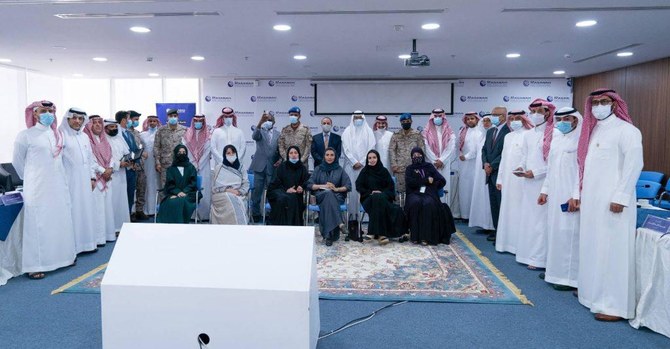

RIYADH: The International Institute for Iranian Studies (Rasanah) has released a book titled “Silent Victims … Iran and Recruitment of Child Fighters in the Middle East,” co-authored by the institute’s researchers Maj. Gen. (retired) Ahmed Al-Maimouni and Saad Al-Shahrani.
The book launch was attended by Yemeni Minister of Information, Culture and Tourism Moammar Al-Eryani, Director of Civil Military Operations in the Joint Forces Command Major General Abdullah Al-Habbabi, Spokesman for the Arab Coalition to Support Legitimacy in Yemen Brig. Gen. Turki Al-Maliki, and Chargé d’Affaires of Saudi Arabia to Yemen Abdullah Al-Ghunaim, in addition to officials, researchers and other interested parties.
Founder and President of Rasanah Dr. Mohammed S. Alsulami gave a speech in which he welcomed the attendees while talking about the book and how the idea to publish this book came about. Yemeni minister Al-Eryani addressed in his speech the violations committed by the Iranian-backed Houthi militia, and its recruitment of hundreds of thousands of children to threaten the security and stability of Yemen.
Al-Maimouni, who is the director of the studies and research center at the institute, spoke about the content of the book, which consists of six chapters, while Al-Shahrani gave a presentation on “The militarization of Iranian educational curricula.”
The 150-page book attempts to bring to focus the emergence of the phenomenon of child fighter recruitment in the Iranian strategy, the methods of recruiting children and the institutions embracing the idea of child fighter recruitment as one of the Iranian government’s tools since the beginning of the Iranian revolution to solidify the ideological tenets that serve its approach and support the continuation of its project.
The book focuses on the Iranian militias’ acts of embroiling child fighters in military conflicts that lead them to be killed and wounded, working against the interests of their homelands and destroying their future.
In the first chapter titled “Recruitment of Child Fighters in the Iranian Thought,” the book begins with casting light on the phenomenon of child fighter recruitment as an inhumane practice, discussing the genesis and motives of the militarization of Iranian Shiite young men, the methods and motives of recruitment and the psychological and social consequences endured by the recruited children.
Chapter Two, titled “Hezbollah and the Recruitment of Child Fighters in Lebanon,” is divided into “Hezbollah as a Tool for Disseminating the Tenets of the Iranian Revolution,” “Hezbollah’s Hidden Activities on the Recruitment of Child Fighters” and the “Impact of International Sanctions on Hezbollah and its Recruitment Operations.”
Chapter Three, “Iran Militias and the Recruitment of Child Fighters in Syria,” sheds light on the recruitment operations on the Syrian landscape and using foreign recruits from Pakistan and Afghanistan. It also discusses the Iranian militias and factions in Syria, the efforts of Iran and Hezbollah to advance child fighter recruitment in Syria and the Iranian soft policies to wrest control over Syrian society.
As for Chapter Four, titled “Shiite Militias and the Recruitment of Child Fighters in Iraq,” it touches on pushing Iraq into the spheres of Iran’s influence and the Iraqi-Iranian militias and child fighter recruitment. This reality was shaped by the Iraq-Iran war and what was known in the military corridors as “human waves” in order to make up for the superiority on the part of Iraq in weapons and military tactics. Most of these waves were made up of the youth and child fighters.
Chapter Five, titled “The Houthi Militia and Child Fighter Recruitment in Yemen,” spotlights the inception of the Houthi militia group, the influence of the Iranian approach on it and the Houthi methods of child recruitment. It then presents examples of cases of Houthi recruitment of children, outlining proposed mechanisms to address the phenomenon of child fighter recruitment in Yemen.
As for Chapter Six titled “Child Recruitment and Its Impacts in Light of International Law,” it surveys international legal resolutions criminalizing child recruitment, reveals the efforts of the international community aimed at protecting children and casts light on Iran being a focus of blame by the international community.
In the end, this book tracks the Iranian role in sponsoring militias that work actively in child recruitment on the battlefield and clarifies that this recruitment causes the children returning from the battlefield to experience psychological trauma and the inability to integrate back into civil society, which prompts them to embrace violence and resort to extremist methods.
Iran’s involvement has appeared unambiguously in supporting militias in the aforesaid countries ideologically, militarily, financially and politically, according to reports of media outlets and international organizations, in addition to accounts of those affected and their relatives on the tragedies they have suffered.