

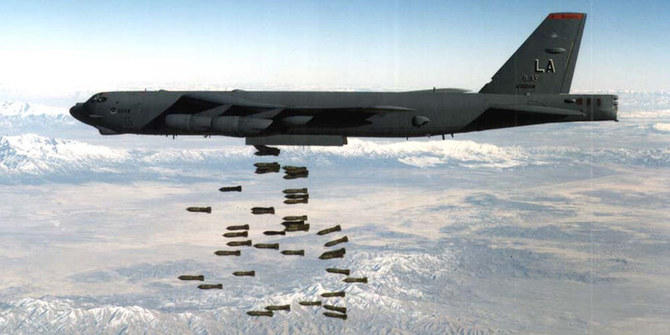


KABUL: A US B-52 bomber has pounded Taliban positions in Afghanistan’s western Herat province after the group gained ground near the area amid intense clashes with government forces, officials and lawmakers said on Saturday.
The strike took place on the outskirts of Herat city on Friday, with flights to and from the area suspended after increased violence near its airport.
“Unfortunately, all flights to Herat have been canceled due to the fighting and the information we have received suggest that a B-52 was used in the fighting yesterday (Friday) in Herat,” provincial lawmaker Habib Ur Rahman Pedram told Arab News.
No further details were given, such as the number of casualties or the scale of the attack.
Violence has surged across Afghanistan since May 1, when the Taliban launched a sweeping offensive as the US began its troop withdrawal after 20 years of occupation.
In recent weeks, the group has captured several districts and vital border crossings, with the Pentagon estimating that the group now control more than half of Afghanistan’s 419 district centers.
The Taliban have reportedly captured two border crossings in Herat, the second largest city after Kabul, located near the border with Iran and Turkmenistan.
Friday’s attack by the US military marks the second time in less than two weeks that it has deployed the long-range, nuclear-capable plane against the Taliban from distant bases after US-led troops cut vital air support for overstretched Afghan forces.
A B-52 was also sighted in Lashkar Gah, the provincial capital of southern Helmand province, and the scene of intense fighting between Taliban and government forces, “but appeared to have not carried out any attack on Friday,” Helmand lawmaker Mirwais Khadem told Arab News.
According to security sources from the adjacent Kandahar province, the heavily armed plane hit a group of Taliban fighters in Spin Boldak bordering Pakistan two weeks ago as well, “killing scores of them.”
Taliban spokesperson Zabihullah Mujahid could not confirm whether the B-52 was used to attack the group across Afghanistan.
BACKGROUND
• In recent weeks, Taliban have captured several districts and vital border crossings, with the Pentagon estimating that the group now control more than half of Afghanistan’s 419 district centers.
• The group has reportedly captured two border crossings in Herat, the second largest city after Kabul, located near the border with Iran and Turkmenistan.
But he told Arab News that the Taliban had “tightened the net on government forces around Herat city, in Lashkar Gah, and Kandahar city” in recent days.
Khadem confirmed Mujahid’s accounts, adding that the Taliban had taken over two districts within Lashkar Gah after “heavy fighting for successive days.”
“Government helicopters have hit the Taliban,” the lawmaker added. “People have been displaced and largely heading to Taliban-held areas as the situation in the city is not good.”
The US military in Afghanistan was unavailable for comment when contacted by Arab News on Saturday, while Afghan officials refused to discuss the decision to reinstate the B-52 to curb Taliban advances.
But Interior Ministry spokesman Mirwais Stanekzai told Arab News that “government forces had foiled Taliban’s attacks on the three cities and the enemy has suffered heavy losses.”
B-52 bombers played a crucial role in toppling the Taliban from power in late 2001, with the US using its bases in the Gulf to deploy the plane.
The strategy to deploy the B-52 appears to be a military necessity, as over-stretched Afghan troops are struggling to prevent the loss of more territory and provincial capitals to the Taliban and avoid the potential for renewed civil war without foreign forces to protect the Kabul government.
The clashes in Herat and Kandahar have forced tens of thousands of residents to flee to safer grounds, with government estimates placing the number of families displaced by the surge in violence since early May at more than 40,000.
During Friday’s fighting, the UN’s main compound in Herat came under attack by rocket-propelled grenades and gunfire, according to a statement from the United Nations Assistance Mission in Afghanistan.
“This attack against the United Nations is deplorable, and we condemn it in the strongest terms,” said Deborah Lyons, the UN secretary-general’s special representative for Afghanistan.
The halt of flights to Herat and the reuse of the B-52 were “worrying signs of an escalation in insecurity” across Afghanistan, according to security analyst and retired colonel Mohammad Hassan.
“It is getting worse day by day here,” he told Arab News. “The cancelation of flights to Herat and the fact that America has back started using B-52 are not good signs. It will cause more panic among people at large and shows the precariousness of the situation.”


