

Tunisia’s Ennahda puts off party meeting amid crisis

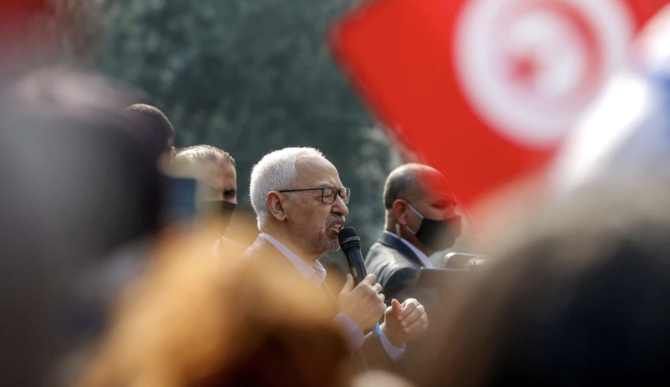
On Saturday Ghannouchi postponed a meeting of its Choura Council, the party's highest internal authority, shortly before it was due to take place. (Reuters/File Photo)
Short Url
Updated 31 July 2021
Follow

Tunisia’s Ennahda puts off party meeting amid crisis

  • Dozens of younger party members and some leaders called on Ghannouchi to resign

TUNIS: The head of Tunisia's biggest party, Ennahda, on Saturday postponed a meeting of its highest council after senior members called for his resignation over his handling of the political crisis, party sources said.

Rached Ghannouchi, who is also parliament speaker, has played a central role in Tunisia's democratic crisis this week after President Kais Saied seized executive authority.

The moves have caused the biggest crisis in Tunisian politics since the 2011 revolution that introduced democracy.

Saied's moves, which also included freezing parliament and dismissing the prime minister, have also thrown Ennahda into turmoil, leading to recriminations within the party over its strategy and leadership.

The party has been the most consistently powerful in Tunisia since the revolution, playing a role in backing successive coalition governments and has lost support as the economy stagnated and public services declined.

On Saturday Ghannouchi postponed a meeting of its Choura Council, the party's highest internal authority, shortly before it was due to take place, three party sources said.

Dozens of younger party members and some of its leaders including Samir Dilou, a parliament member, had called on Ghannouchi to resign, the sources said.

Ghannouchi has led Ennahda for decades, including from exile in Britain before the revolution, after which he returned to a tumultuous welcome at Tunis airport. He stood for election for the first time in 2019, winning a parliament seat and becoming speaker. 


GCC states ‘face reliance on Saudi Arabia for food imports’

Updated 06 March 2026
Follow

GCC states ‘face reliance on Saudi Arabia for food imports’

  • With 70 percent of food coming through Strait of Hormuz, analysts warn of inevitable shortages

DUBAI: Some Gulf states may have to rely on overland food deliveries from Saudi Arabia if the US-Israel-Iran war continues to disrupt shipping through the Strait of Hormuz and restrict regional airspace, analysts warned on Thursday.
The region is up to 90 percent dependent on food imports, and price surges and scarcity of some goods are expected.
“With over 70 percent of GCC foodstuffs being imported through the Strait of Hormuz, Gulf states face shortages if the war persists,” said Neil ​Quilliam of the Chatham House think tank. 
“While GCC countries have taken steps to diversify suppliers and ensure sufficient stores to withstand disruption, this can only last several months. At this point, price increases ​and longer lead times will start to hit the markets.”
Commodities analyst Ishan Bhanu said: “The biggest immediate effect will be due to the blockade of Jebel Ali in Dubai, serving about 50 million people. Qatar, Kuwait, Bahrain and Iraq effectively become landlocked and will depend on overland routes through Saudi Arabia.”
Bottlenecks are yet to show and the UAE has said its strategic reserves of vital goods cover four to six months of needs. It urged residents to report unjustified price increases through a dedicated hotline.
Supermarket staff ​throughout the Gulf said shelves remain largely stocked, though suppliers are taking longer to replenish certain products. Iran’s strikes on the Gulf since Saturday prompted panic buying in supermarkets, a dry run for what could come. 
“Perception of risk matters, and even if stocks are sufficient now, public runs on supermarkets can spook the public,” Quilliam said.