ISLAMABAD: The United States has added Pakistan to a list of countries that are implicated in the use of child soldiers over the past year, in a move that could lead to sanctions on military aid and a block on Islamabad participating in peacekeeping programs.
The US State Department said in its 2021 Trafficking in Persons (TIP) that Pakistan was among foreign governments identified during April 2020 to March 2021 that had “governmental armed forces, police, or other security forces, or government-supported armed groups that recruit or use child soldiers, as defined in the Child Soldiers Prevention Act.”
There was no immediate reaction from Pakistan on the move. This is the first time Pakistan has been put on the list. Other countries on this year’s list include Afghanistan, Iran, Iraq, Libya, Syria, Turkey and Yemen.
“Governments identified on the list are subject to restrictions, in the following fiscal year, on certain security assistance and commercial licensing of military equipment,” the state department said. “The CSPA prohibits assistance to governments that are identified in the list under the following authorities: International Military Education and Training, Foreign Military Financing, Excess Defense Articles, and Peacekeeping Operations, with exceptions for some programs undertaken pursuant to the Peacekeeping Operations authority.”
The CSPA also prohibits the issuance of licenses for direct commercial sales of military equipment to such governments.
“Beginning October 1, 2021, and effective throughout Fiscal Year 2022, these restrictions will apply to the listed countries, absent a presidential waiver, applicable exception, or reinstatement of assistance pursuant to the terms of the CSPA,” the State Department said.
Commenting on Turkey, the State Department said Turkey was providing “tangible support” to the Sultan Murad division in Syria, a faction of Syrian opposition that Ankara has long supported and a group that Washington said recruited and used child soldiers.
“With respect to Turkey in particular...this is the first time a NATO member has been listed in the child soldier prevention act list,” a State Department official said. “As a respected regional leader and member of NATO, Turkey has the opportunity to address this issue — the recruitment and use of child soldiers in Syria and Libya.”

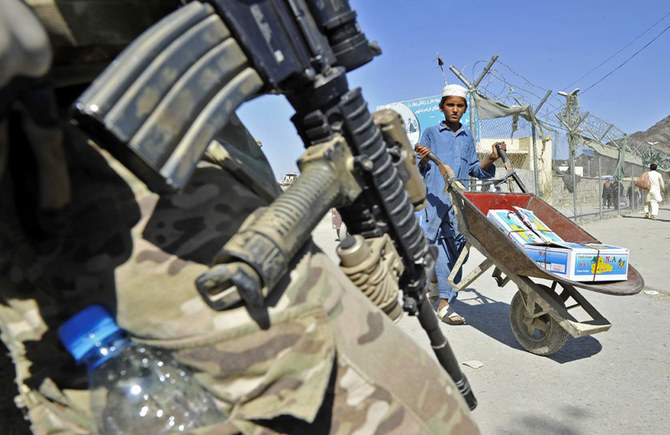
US adds Pakistan, Turkey to list of countries implicated in use of child soldiers
https://arab.news/gmkkh
US adds Pakistan, Turkey to list of countries implicated in use of child soldiers
- This is the first time Pakistan has been put on the list, others include Afghanistan, Iran, Iraq, Libya, Syria, Yemen
- Governments placed on listing subject to restrictions on security assistance, commercial licensing of military equipment
Pakistan, UK sign £35 million Green Compact to strengthen climate resilience
- Pakistan ranks among nations most vulnerable to climate change and has seen erratic changes in its weather patterns
- UK will help Pakistan mobilize climate finance, strengthen regulatory frameworks and develop bankable climate projects
ISLAMABAD: Pakistan and the United Kingdom (UK) have formalized a comprehensive climate partnership with the launch of a Green Compact that aims to enhance climate resilience, accelerate clean energy transition and scale up nature-based solutions, including mangrove conservation, Pakistani state media reported on Sunday.
The agreement, signed in Islamabad by Federal Minister for Climate Change and Environmental Coordination Dr. Musadik Malik and UK Minister for International Development Jennifer Chapman, unlocks £35 million in targeted support for green development and long-term climate action, according to Radio Pakistan broadcaster.
Pakistan ranks among nations most vulnerable to climate change and has seen erratic changes in its weather patterns that have led to frequent heatwaves, untimely rains, storms, cyclones, floods and droughts in recent years. In 2022, monsoon floods killed over 1,700 people, displaced another 33 million and caused over $30 billion losses, while another 1,037 people were killed in floods this year.
Mohammad Saleem Shaikh, a spokesperson for Pakistan’s Ministry of Climate Change, described the compact as a “decisive move toward action-oriented climate cooperation,” noting that its implementation over the next decade will be critical for Pakistan which regularly faces floods, heatwaves and water stress.
“The Compact is structured around five core pillars: climate finance and investment, clean energy transition, nature-based solutions, innovation and youth empowerment, and adaptation and resilience,” the report read.
“Under the agreement, the UK will work with Pakistan to mobilize public and private climate finance, strengthen regulatory frameworks for green investment, and develop bankable climate projects.”
Clean energy forms a central component of Pakistan’s transition, with Islamabad planning to expand solar and wind generation to reduce fossil fuel dependence, improve energy security and stabilize power costs, according to Shaikh.
“Renewable energy is now economically competitive, making the transition both environmentally and financially viable,” he was quoted as saying.
“Nature-based solutions, particularly large-scale mangrove restoration, will protect coastal communities from storm surges and erosion while enhancing biodiversity and carbon sequestration.”
Under the Compact, technical support, mentoring and access to investors will be provided to climate-smart startups and young innovators, reflecting Pakistan’s recognition of youth-led initiatives as central to future climate solutions.
On the occasion, Chapman, on her first official visit to Pakistan, underscored the urgency of climate action, highlighting the UK’s support for renewable energy, mangrove and ecosystem restoration, early-warning systems, climate budgeting and international investment flows into Pakistan.
Shaikh described the Green Compact as “a strategic turning point” in Pakistan–UK relations on climate change, saying its effective implementation is essential for Pakistan to meet its national climate targets.


