

Pakistan thanks Bahrain king for taking 'special care' of Pakistani expats

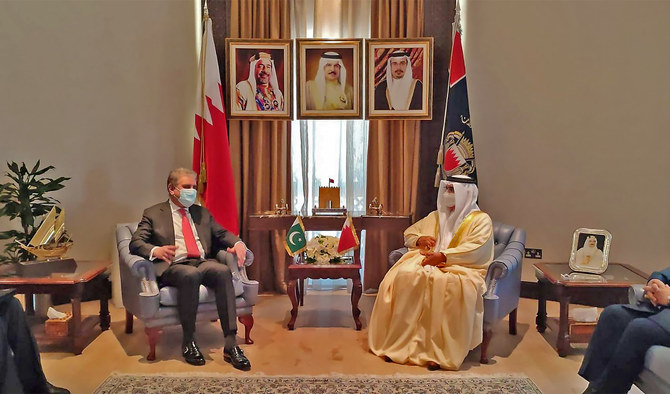
Pakistan's Foreign Minister, Shah Mahmood Qureshi (left), meets Bahrain Interior Minister Shaikh Rashid bin Abdullah Al Khalifa in Manama, Bahrain, on July 29, 2021. (Photo courtesy: APP)
Short Url
Updated 02 August 2021
Follow

Pakistan thanks Bahrain king for taking 'special care' of Pakistani expats

  • Pakistani FM is in Bahrain to lead second session of the Pakistan-Bahrain Joint Ministerial Commission
  • Both sides have agreed in principle to hold the next JMC meeting in Islamabad in 2022

ISLAMABAD: Pakistani Foreign Minister Shah Mahmood Qureshi met the king of Bahrain, Hamad bin Isa Al Khalifa, in Manama on Thursday and thanked him for his country’s “special care” for Pakistani expats. 

Qureshi is in Bahrain on a two-day visit that will conclude today, Thursday, leading Pakistan’s delegation in the second session of the Pakistan-Bahrain Joint Ministerial Commission (JMC).

“The Foreign Minister thanked the King of Bahrain for taking special care of Pakistanis living in Bahrain,” the Pakistani foreign office said in a statement. “The Foreign Minister congratulated the King of Bahrain on hosting the second meeting of the Pak-Bahrain Joint Ministerial Commission.”

It added:

“Pak-Bahrain Joint Ministerial Commission will help strengthen bilateral relations between the two countries, enhance bilateral trade, economic and multilateral cooperation.”

Qureshi also conveyed the best wishes of the Pakistani president and prime minister and invited the king of Bahrain to visit Pakistan.

Earlier in the day, Qureshi met Bahrain Interior Minister Shaikh Rashid bin Abdulla Al Khalifa and thanked his country for taking steps to aid Pakistani expats, saying strong defence ties between the two nations were a “source of support.”

Qureshi “appreciated the steps taken by the Bahraini government during the coronavirus pandemic to ensure that the Pakistani community in Bahrain did not face any traumatic situation,” the foreign office statement said, saying he also “lauded the steps taken by the Bahraini Ministry of Interior to facilitate the visa amnesty scheme, waiver of fines, extradition and repatriation of Pakistanis awaiting repatriation.”

“Referring to the strong defense and security ties between Pakistan and Bahrain, the Foreign Minister described them as a source of support,” the foreign office said. 

On Wednesday, the second meeting of the Bahrain-Pakistan Joint Ministerial Commission was held in Manama. 

“On the sidelines of JMC, an MoU between Bahrain Development Board and Board of Investment of Pakistan was also signed to promote bilateral investment between the two friendly countries,” a Pakistan foreign ministry statement said, adding that the two sides agreed in principle to hold the next JMC meeting in Islamabad in 2022.


Pakistan army chief assumes role as first Chief of Defense Forces, signaling unified command

Updated 5 sec ago
Follow

Pakistan army chief assumes role as first Chief of Defense Forces, signaling unified command

  • New role is held simultaneously with Gen Asim Munir’s existing position as Chief of Army Staff
  • It is designed to centralize operational planning, war-fighting doctrine, modernization across services

ISLAMABAD: Pakistan’s most senior military officer, Field Marshal Syed Asim Munir, formally took charge as the country’s first Chief of Defense Forces (CDF) on Monday, marking a structural change in Pakistan’s defense command and placing the army, navy and air force under a single integrated leadership for the first time.

The new role, held simultaneously with Munir’s existing position as Chief of Army Staff, is designed to centralize operational planning, war-fighting doctrine and modernization across the services. It reflects a trend seen in several advanced militaries where a unified command oversees land, air, maritime, cyber and space domains, rather than service-level silos.

Pakistan has also established a Chief of Defense Forces Headquarters, which Munir described as a “historic” step toward joint command integration.

In remarks to officers from all three forces after receiving a tri-services Guard of Honor at the General Headquarters (GHQ) in Rawalpindi, Munir said the military must adapt to new theaters of conflict that extend far beyond traditional ground warfare.

He stressed the need for “a formalized arrangement for tri-services integration and synergy,” adding that future war will involve emerging technologies including cyber operations, the electromagnetic spectrum, outer-space platforms, information warfare, artificial intelligence and quantum computing.

“He termed the newly instituted CDF Headquarters as historic, which will afford requisite integration, coherence and coordination to meet the dynamics of future threat spectrum under a tri-services umbrella,” the military quoted Munir as saying in a statement. 

The ceremony also included gallantry awards for Pakistan Navy and Air Force personnel who fought in Marka-e-Haq, the brief May 2025 conflict between Pakistan and India, which Pakistan’s military calls a model for integrated land, air, maritime, cyber and electronic combat. During his speech, Munir paid tribute to the personnel who served in the conflict, calling their sacrifice central to Pakistan’s defense narrative.

The restructuring places Pakistan closer to command models used by the United States, United Kingdom and other nuclear-armed states where a unified chief directs inter-service readiness and long-range war planning. It also comes at a time when militaries worldwide are re-engineering doctrine to counter threats spanning satellites, data networks, information space and unmanned strike capabilities.