

'Mural with a message': Pakistani truck artist on a mission to promote environmental protection

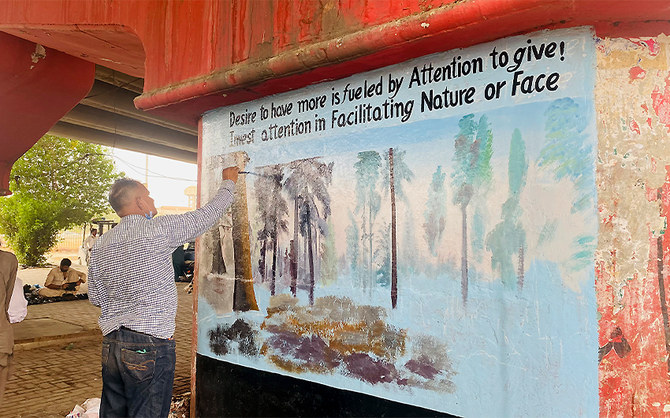
Pakistani truck artist Iqbal Sanam creates a mural to promote environmental protection in Karachi, Pakistan, on July 27, 2021. (AN Photo)
Short Url
Updated 28 July 2021
Follow

'Mural with a message': Pakistani truck artist on a mission to promote environmental protection

  • Iqbal Sanam says painting is an effective way to bring about social change, create awareness
  • Under new initiative, murals with climate change message being painted in busy areas of Karachi

KARACHI: A Pakistani artist on Tuesday scratched advertising posters from a pillar supporting a busy flyover in the port city of Karachi, and then began painting “a mural with a message” over the palimpsest.
Iqbal Sanam, a renowned truck artist who has painted murals around the world, including on the Berlin Wall, believes he can use his art to create awareness about social issues. These days, he wants to remind his fellow residents of Karachi about the dangers posed by climate change.
“This mural not only has trees but also plumes of smoke that are spreading across the jungle, endangering its greenery and wildlife,” Sanam told Arab News, describing the painting he was working on. “Its message is to preserve nature and protect forests and trees.”
“A painting with a message educates many,” the artist added. “We are reaching out to students, our future generation, along with the general public with the message of environmental protection since that can benefit our loved ones and the world at large.”
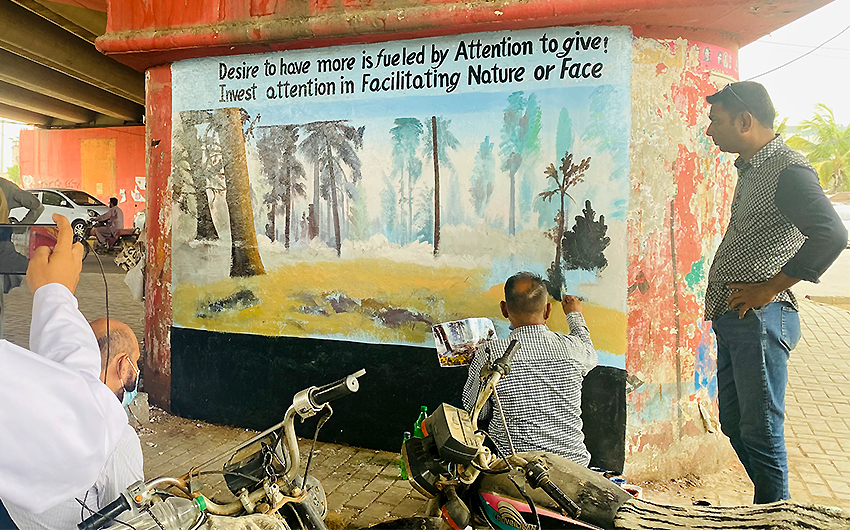


Jawad Ali, who works at a local hospital, takes photos of a mural near Karachi’s Civic Center, Pakistan, on July 27, 2021. (AN Photo) 

Tariq Khan, a director of the Sadequain Foundation, said Sanam’s mural was part of an initiative to paint bus stops, flyovers and education institutions with colorful artwork that would create awareness and lead people to reflect on the perils of climate change. 
“The first in the series of these murals was painted on a wall of Sir Syed Girls’ College about two days ago,” Khan said. “That depicted the adverse effect of climate change by highlighting how the melting of glaciers recently flooded parts of Germany.”
Another mural with a climate change message would next be painted near a crowded traffic signal at Ayesha Manzil, a busy area in Karachi, Khan said: “We have chosen places that are visited by large numbers of people to create greater awareness.”
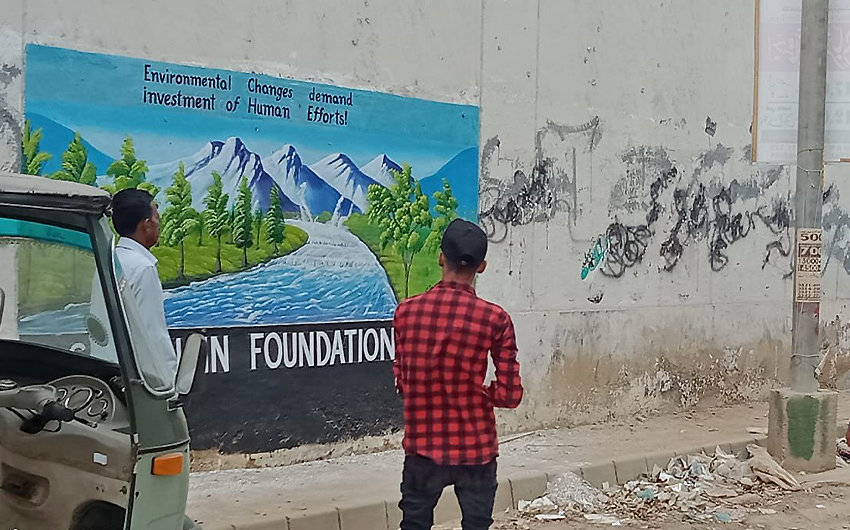


People look at a mural showing melting glaciers and floods that was recently painted on a wall of Sir Syed Girls’ College in Karachi, Pakistan, on July 27, 2021. (AN Photo)

Jawad Ali, who works at a local hospital, stopped to have a look at Sanam’s painting on his way to work. 
“Deforestation can have a drastic impact on our lives,” he told Arab News. “People should ponder over the message of this mural.”
Yousuf Rehman, who drives an autorickshaw, also pulled over to study the mural. 
“It is soothing to see such beautiful paintings,” he said, “instead of provocative slogans and ugly posters on the walls.”


Pakistan finance minister touts debt discipline, export focus at Davos panel

Updated 5 sec ago
Follow

Pakistan finance minister touts debt discipline, export focus at Davos panel

  • Aurangzeb says debt must fund exports, not consumption, for sustainable growth
  • He says Pakistan used fiscal buffers to respond to floods without external appeals

KARACHI: Pakistan’s Finance Minister Muhammad Aurangzeb said on Wednesday disciplined borrowing, export-led growth and careful debt management were central to stabilizing the country’s economy, as Islamabad looks to unlock new sources of growth amid rising global debt levels.

Speaking at a panel discussion on the sidelines of the World Economic Forum (WEF) in Davos, he said debt was not inherently harmful if used productively, but warned that emerging economies such as Pakistan could not afford to deploy borrowed funds for consumption.

“For countries like Pakistan, debt must be channeled into investments that generate exportable surplus,” Aurangzeb said, according to a statement circulated by the Finance Division. “It is not about the availability of debt or funding, but how wisely and effectively it is steered to create long-term economic value.”

Pakistan has been pursuing fiscal reforms as part of an International Monetary Fund-backed stabilization program, including cutting subsidies, broadening the tax base and restructuring state-owned enterprises, as the government seeks to restore macroeconomic stability and revive growth.

Aurangzeb said Pakistan had reduced its debt-to-GDP ratio to 70 percent from 75 percent, achieved a primary fiscal surplus and brought inflation down from a peak of 38 percent to single digits, allowing the central bank to cut its policy rate to 10.5 percent.

He also flagged ongoing debt-management reforms, including liability management operations and buybacks, and said Pakistan plans to enter China’s capital markets with its first Panda bond, structured as a green bond.

Addressing climate risks, Aurangzeb said building fiscal buffers had allowed Pakistan to respond to recent floods using domestic resources rather than international emergency appeals, underscoring the need for resilience in climate-vulnerable economies.

He added that public-private partnerships and capital markets were playing a growing role in financing development, citing a $3.6 billion syndicated financing for a major copper mining project expected to generate $2.8 billion in annual exports from 2028.

The finance minister is part of Pakistan’s delegation visiting Davos for the annual gathering of global leaders and investors.

The delegation is led by Prime Minister Shehbaz Sharif, who highlighted the country’s shift toward an export-driven growth model, with a focus on minerals, information technology, artificial intelligence and digital services, while speaking at a breakfast event on the sidelines of the forum.