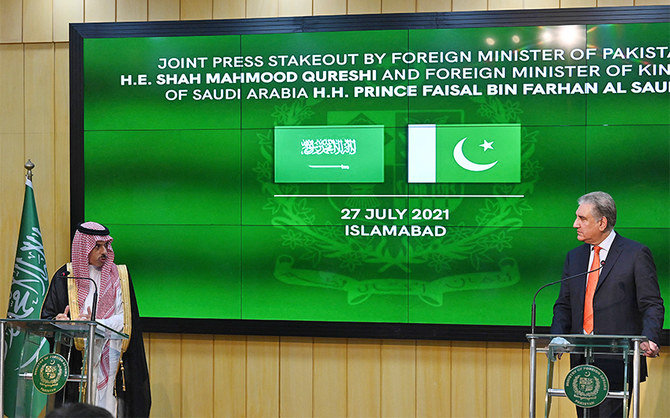
ISLAMABAD: Pakistan and Saudi Arabia have agreed to broaden their strategic relations by activating the Saudi-Pakistan Supreme Coordination Council (SPSCC), said the foreign ministers of the two countries during a joint news conference in Islamabad on Tuesday.
The council was set up to provide strategic direction to the bilateral relations of the two countries during Prime Minister Imran Khan’s three-day visit to Saudi Arabia in May.
“I am primarily here for the follow up of the visit of Prime Minister [Imran Khan] to Saudi Arabia in May 2021 in which we established the Saudi-Pakistan Supreme Coordination Council, a mechanism that we hope will be an important milestone in taking the relationship to a new level by institutionalizing it and exploring all the opportunities that it has to offer,” Saudi Foreign Minister Prince Faisal bin Farhan said during the news conference with his Pakistani counterpart Shah Mahmood Qureshi.
The Saudi foreign minister arrived in Islamabad in the morning for a day-long visit and held important meetings with Pakistani officials.
He also emphasized the importance of enhancing the economic ties between the two countries, saying it had been the main focus of his discussion with Qureshi prior to the joint news conference.
“We focused very much on the economic side of the relationship and on opportunities to expand it beyond the traditional areas of investment,” he told the media.
“We should encourage the business community of both countries to engage effectively,” he added.
The Saudi foreign minister maintained that security vital to economic prosperity, adding that the two countries had agreed to work together to ensure greater stability in their respective neighborhoods.
“We have agreed to work [together] on regional issues, whether it is Kashmir, Palestine or Yemen,” he said. “We will work together to ensure stability in both our regions.”
Prince Farhan said Pakistan and Saudi Arabia enjoyed a strong relationship that went back several decades.
“We have supported each other in many areas and will continue to do so,” he continued, adding that the kingdom valued the economic contribution of Pakistani diaspora while working to increase opportunities for its members.
“We are very proud of the contributions of the Pakistani community in the kingdom,” he said. “We are working to ease the challenges caused by the pandemic, and about 1.7 million Pakistanis have received free-of-cost vaccination in the kingdom as members of the community.”
The Pakistani foreign minister, meanwhile, told the media he had discussed the structure and working of the coordination council with his Saudi counterpart.
“We have decided that there will be a focal person at the Ministry of Foreign Affairs here and in Saudi Arabia … so we can have a structured and institutionalized way of evaluating progress in our bilateral relations,” he said.
Qureshi described the ties between the two countries as “historic,” saying that Pakistan and Saudi Arabia were “very comfortable” with the way their relationship was moving forward.
“What we are now focusing on our economic linkages through the enhancement of bilateral trade and promotion of investments,” he said.
Qureshi noted that Pakistan could contribute to Saudi Arabia’s Vision 2030, a national transformation plan introduced by Crown Prince Mohammed bin Salman.
“Our skilled and semi-skilled professionals can make [significant] contributions to Vision 2030,” he added.
He also thanked the kingdom for its “unwavering support” to Pakistan on matters relating to the Financial Action Task Force and on the issue of self-determination in Indian-administered Kashmir.
“The support we received from Saudi Arabia is phenomenal,” he said. “In the OIC [Organization of Islamic Cooperation], they [the Saudis] have shown clarity and consistency in supporting Pakistan on [Kashmir].”
He added the two sides had also discussed opportunities for Saudi investors who could benefit from the special economic zones created under the China-Pakistan Economic Corridor.
According to Reuters, Pakistan and Saudi Arabia also focused on how to ease COVID-19 travel restrictions, which, according to Qureshi, have stranded around 400,000 Pakistani workers back home.


![]()

Pakistan, Saudi Arabia agree to expand bilateral ties, activate supreme coordination council
Short Url
https://arab.news/c4jut
Pakistan, Saudi Arabia agree to expand bilateral ties, activate supreme coordination council
- Pakistani Foreign Minister Shah Mahmood Qureshi appreciates the kingdom’s ‘unwavering support’ to his country on FATF, Kashmir
- Saudi Foreign Minister Prince Faisal bin Farhan Al Saud says the two countries discussed ways to further strengthen their economic ties
Latest updates


© 2026 SAUDI RESEARCH & PUBLISHING COMPANY, All Rights Reserved And subject to Terms of Use Agreement.