ISLAMABAD: The Pakistan government on Monday warned overstaying foreign nationals either to leave the country by August 14 or apply online for a visa renewal or an extension so they could get a waiver on being fined.
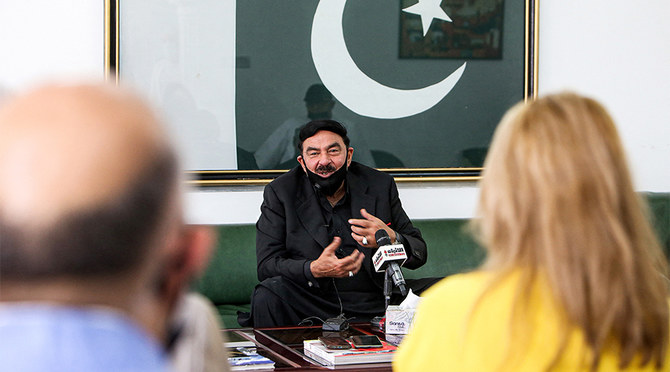
Federal Minister for Interior Sheikh Rashid Ahmed said thousands of foreign nationals who had been staying in Pakistan illegally for the last many years would be expelled from the country forcefully if they failed to abide by new rules.
“August 14 is the cut-off date for all foreigners staying illegally in Pakistan for the last many years,” the interior minister told reporters at a press conference in Islamabad, announcing that the government would waive the fine for overstaying in Pakistan if a foreign national opted to extend or renew their visas even after forty years.
The minister also announced a new system of the National Database and Registration Authority (NADRA) to purge the country of people with fake computerized national identity cards.
“I have directed chairman Nadra to introduce the new system within fourteen days,” he said.
In January, the interior minister announced canceling at least 200,000 fake identity cards fraudulently issued to Afghan nationals with the connivance of NADRA officials. NADRA denies the charge.
On Monday, the minister said that at least 39 NADRA officials had been dismissed from service in Karachi for involvement in issuing fake identity documents to foreign nationals, saying he would initiate a crackdown against corrupt officials in other parts of the country too.
Under the new policy, the minister said NADRA would send a text message to all those suspected of having fake identity cards and their responses would also be registered electronically to verify their data.
“Our goal is that nobody should misuse Pakistan’s identity card,” Ahmed said.

Pakistan orders ‘overstaying’ foreign nationals to leave by August 14
https://arab.news/v4kdt
Pakistan orders ‘overstaying’ foreign nationals to leave by August 14
- Interior minister asks them to apply online for visa renewal or extension to get a waiver on the fine
- Announces new NADRA system to purge Pakistan of fake computerized national identity cards
Pakistan, Qatar resolve to boost strategic, economic cooperation at Doha talks
- Both countries urge dialogue on Afghanistan amid renewed border tensions between Islamabad and Kabul
- Discussions focus on bilateral trade and investment, energy, defense, manpower and labor and culture
ISLAMABAD: Pakistan and Qatar on Tuesday agreed to deepen their strategic and economic cooperation during high-level talks between Prime Minister Shehbaz Sharif and his Qatari counterpart Sheikh Mohammed bin Abdulrahman bin Jassim Al Thani, Sharif’s office said.
Sharif visited Qatar along with a high-level delegation on the invitation of Qatari emir Sheikh Tamim bin Hamad Al Thani. The Pakistan premier also held meetings with Qatar’s trade and defense minister to discuss cooperation in various domains.
The visit came at a time when Pakistan is seeking closer economic engagement with Gulf partners amid its broader push to stabilize the economy and attract investment, while maintaining security and defense cooperation with key regional states.
During their meeting in Doha, PM Sharif and Qatar’s Sheikh Mohammed discussed bilateral relations and exchanged views on regional and international developments, according to the Pakistan prime minister’s office.
“They reaffirmed the strong brotherly relations between Pakistan and Qatar and expressed satisfaction at the growing momentum in political, economic and institutional ties,” Sharif’s office said.
“Discussions focused on enhancing cooperation in the fields of trade and investment, energy, defense, manpower and labor and culture, with both sides stressing the importance of their task force to accelerate cooperation in all these areas.”
Pakistan and Qatar maintain strong trade and investment ties. In 2022, the office of Qatar’s emir said the Qatar Investment Authority planned to invest $3 billion in Pakistan, targeting sectors including transport, aviation, education, health, media, technology and labor.
Nearly 300,000 Pakistanis live and work in Qatar, according to Pakistan’s foreign office, with many employed in health, education, engineering and public services, as well as construction and transport. The two countries engage through forums such as the Bilateral Political Consultations and the Joint Ministerial Commission.
Sharif and his Qatari counterpart also discussed regional issues, including developments in Gaza and broader Gulf security. PM Sharif appreciated Qatar’s constructive diplomatic efforts to promote dialogue and de-escalate tensions in the region, according to Sharif’s office.
The meeting reaffirmed the shared commitment to further strengthen the strategic partnership between Pakistan and Qatar and to remain in touch on current bilateral, regional and international issues.
DIALOGUE WITH AFGHANISTAN
Earlier, Sharif and Qatar’s Deputy PM Sheikh Saoud Al-Thani discussed the situation in Afghanistan and called for dialogue to support regional stability.
The meeting took place amid renewed tensions after Islamabad carried out airstrikes last week on what it described as Tehreek-e-Taliban Pakistan (TTP) targets inside Afghanistan. Kabul said the strikes killed civilians and vowed to respond to what it called a violation of its sovereignty.
“Regional developments were also discussed, in particular the situation in Iran and Afghanistan,” Sharif’s office said in a statement. “Both sides emphasized the importance of dialogue, de-escalation and collective efforts to promote peace and stability in the region.”
This was the second time in less than six months that Pakistan conducted airstrikes in Afghanistan. The last strikes triggered heavy, weeklong clashes between the neighbors along their border before Qatar and Turkiye mediated a ceasefire between them in Oct. last year.
Separately, Sharif held meetings with Qatar’s State Minister for Trade Dr. Ahmed bin Mohammed Al-Sayed and a delegation of the Qatar Businessmen Association (QBA), highlighting Pakistan’s investment-friendly reforms.
He invited QBA members to explore opportunities in infrastructure, logistics, energy, agriculture, technology and export-oriented manufacturing, his office said.


