Lebanese fleeing collapse at home seek security, salaries in UAE

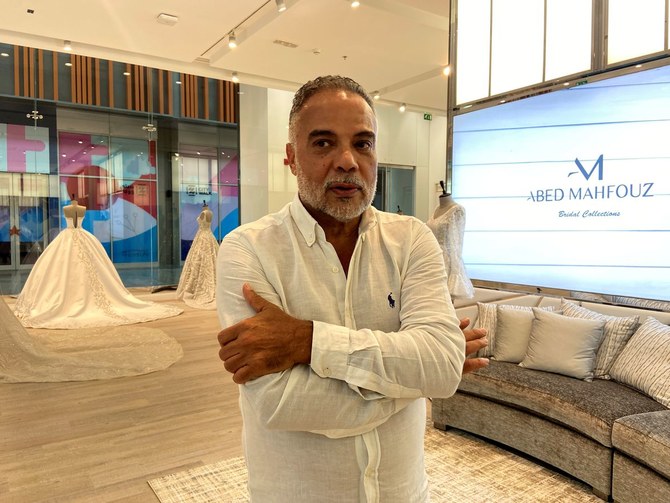
Lebanese bridal couture designer Abded Mahfouz poses for a photo at his shop in Dubai, United Arab Emirates, July 12, 2021. (Reuters)
Short Url
Updated 26 July 2021
Follow

Lebanese fleeing collapse at home seek security, salaries in UAE

  • Lebanon’s crisis has propelled more than half the population into poverty

DUBAI: Until a few months ago, 32-year-old Michelle Chaaya was a human resources professional at a multinational firm in Lebanon. Now she works as a bartender in Dubai, sending cash to her family back home where a financial crisis has left many destitute.
The United Arab Emirates has long been a destination for Lebanese businesses and professionals, propelled by instability in their tiny country.
Those who like Chaaya came to the UAE in the past year are leaving behind a Lebanon that was already in dire straits before a huge chemical blast tore through Beirut in August, exacerbating a financial meltdown that has seen the currency collapse and jobs vanish.
“After the explosion we felt like we were hopeless. So the first opportunity to travel outside Lebanon, I took it,” Chaaya said.
Fadi Iskanderani, one of Lebanon’s few paediatric surgeons who this month moved to Dubai, said the plummeting currency meant his wages had fallen by around 95 percent for the same workload.
Having trained overseas, he moved back to help rebuild his country after years of civil war. The decision to leave was heart-wrenching.
Lebanon’s crisis has propelled more than half the population into poverty, locked depositors out of bank accounts and worsened shortages of basic goods.
The country’s prized education and medical sectors have seen talent leave in droves: around 1,200 doctors are estimated to have left Lebanon.
Psychiatrist Joseph Khoury, who moved to Dubai this year with his family, said Lebanese doctors are filling entire departments at hospitals in the Gulf state.
“The pace of doctors coming from Lebanon is astonishing, ” Khoury said.
The UAE is stepping up efforts to attract and retain skilled workers as competition for talent heats up in the Gulf Arab region where countries are moving to diversify economies away from oil revenues.
The UAE, where visas for non-citizens are typically tied to employment, is offering certain investors and skilled professionals new long-term 5- or 10-year renewable residency visas — and even potential citizenship.
Abed Mahfouz, a Lebanese bridal couture designer, said he had been told he could apply for the so-called ‘golden visa’.
After the Beirut blast destroyed his business, Mahfouz re-opened this month in a luxury mall in Dubai, a tourism and trade hub that attracts the high-end customers he caters to.
“Dubai has taken the place of Beirut. What I have seen here (this mall) for the past week or 10 days is what I used to see in Lebanon 4-5 years ago: Customers, people shopping,” he said.
But unlike Lebanon’s professional elite, many younger people are struggling to land jobs in the UAE.
Soha, 28, came to Dubai to look for work after the bookshop cafe where she was employed in Beirut was damaged in the port explosion.
“You come from this tiny pool in Lebanon, so my CV looks like nothing, even though I feel like I’ve accomplished a lot,” said Soha, who declined to give her surname. She is rallying herself for more jobseeking in Dubai, a city that could give her the sense of safety she longs for.
“I just wanted to be sitting in a place where I have that peace of mind that something isn’t going to blow up at any minute.”


In southeast Pakistan, Ramadan brings Hindus and Muslims closer

Updated 10 March 2026
Follow

In southeast Pakistan, Ramadan brings Hindus and Muslims closer

MITHI: Partab Shivani, a Hindu in Muslim-majority Pakistan, has fasted on and off during Ramadan for years, but this time is different as he practices abstinence for the entire holy month.
Every year, he and his friends in the southeastern city of Mithi arrange iftar, when Muslims break their daily fast, to foster peace and solidarity between the two religions.
“I believe we need to promote interfaith harmony. First, we are humans — religions came later,” Shivani, a 48-year-old social activist, told AFP, adding that he also reads the teachings of the Buddha.
“His message is about peace and ending war. Peace can spread through solidarity and by standing with one another. Distance only widens the gap between people,” he added.
Ninety-six percent of Pakistan’s 240 million people are Muslim. Just two percent are Hindu, most of them living in rural areas of Sindh province where Mithi is located.
In Mithi itself, most of the 60,000 inhabitants are Hindu.
Many of the city’s Hindus also observe Ramadan and iftar has become a social gathering where people from both faiths happily participate.
“This has been a wonderful tradition of ours for a very long time,” said Mir Muhammad Buledi, a 51-year-old Muslim friend who attended Shivani’s iftar gathering.
“It is a beautiful example of harmony between the two communities.”
Like brothers
Discrimination against minorities runs deep in Pakistan.
Following the end of British rule in South Asia in 1947, the subcontinent was partitioned into mainly Hindu India and Muslim-majority Pakistan.
That triggered widespread religious bloodshed in which hundreds of thousands were killed and millions displaced.
According to the Human Rights Commission of Pakistan, freedom of religion or belief is under constant threat, with religiously motivated violence and discrimination increasing yearly.
State authorities, often using religious unrest for political gain, have failed to address the crisis, the independent non-profit says.
But such tensions are absent in Mithi.
“I am a Hindu but I keep all the fasts during this month,” said Sushil Malani, a local politician. “I feel happy standing with my Muslim brothers.
“We celebrate Eid together as well. This tradition in the region is very old.”
Restaurants and tea stalls are closed across Pakistan during Ramadan.
Ramesh Kumar, a 52-year-old Hindu man who sells sweets and savoury items outside a Muslim shrine, keeps his push cart covered and closed until iftar.
“There is no discrimination among us if someone is Muslim or Hindu. I have been seeing this since my childhood that we all live together like brothers,” he said.
Muslim shrine, Hindu caretaker
Locals say Mithi’s peaceful religious coexistence can be traced to its remote location, emerging from the sand dunes of the Tharparkar desert, which borders the modern Indian state of Rajasthan.
Cows — considered sacred in Hinduism — roam freely in Mithi city, as they do in neighboring India.
At two Sufi Muslim shrines in the middle of the city, Hindu families arrange meals, bringing fruit, meals and juices for their Muslim neighbors to break their fasts.
“We respect Muslims,” said Mohan Lal Malhi, a Hindu caretaker of one of the shrines.
Mohan said his parents and elders taught him to respect people regardless of religion or color, and the traditions pass from one generation to the next.
Local residents said both communities consider their social relationships more important than their religious identity.
“You will see a (Sikh) gurdwara, a mosque, and a shrine standing side by side here,” Mohan said. “The atmosphere of this area teaches humanity.”