ISLAMABAD: Prime Minister Imran Khan’s special assistant on the Middle East, Tahir Mahmood Ashrafi, on Monday welcomed Saudi Arabia’s decision to resume the Umrah pilgrimage for international visitors, halted earlier due to the coronavirus pandemic.
According to Saudi media, the Kingdom has decided to resume International Umrah from the first of the Islamic month of Muharram, likely to fall on August 10 this year.
“We welcome the decision of resumption Umran for foreign pilgrims and whatever mechanism Saudi government will devise, Pakistan will follow that,” Ashrafi told Arab News. “Pakistani ministry of religious affairs and [Saudi] Ministry of Hajj and Umrah have contacts and if there will be any issues, both will coordinate on that.”
Media reports suggested COVID-19 vaccinations would be mandatory for all pilgrims.
Hundreds of thousands of Pakistanis would visit Saudi Arabia every year, mainly for Umrah and Hajj, before the COVID-19 pandemic.
Umrah is a pilgrimage which can be undertaken at any time of the year, in contrast to Hajj, which has specific dates according to the Islamic lunar calendar.
Saudi Arabia closed its borders last February to foreign Umrah pilgrims, and in March stopped its own citizens and residents from taking part. Last July, it allowed a limited number of domestic pilgrims to perform the Hajj. This year too, Saudi Arabia restricted the annual Hajj pilgrimage to its own citizens and residents for the second year running in response to the coronavirus pandemic.


Pakistan welcomes resumption of Umrah for foreign pilgrims from August 10

https://arab.news/m4879
Pakistan welcomes resumption of Umrah for foreign pilgrims from August 10

- Says will follow whatever mechanism Saudi government devises
- Pakistani religious affairs and Saudi Hajj ministries coordinating

Qatar, Pakistan resolve to boost strategic, economic cooperation at Doha talks
- Both countries urge dialogue on Afghanistan amid renewed border tensions between Islamabad and Kabul
- Discussions focus on bilateral trade and investment, energy, defense, manpower and labor and culture
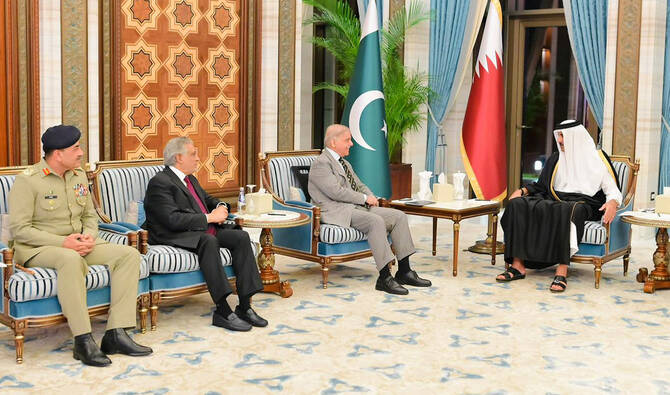
ISLAMABAD: Pakistan and Qatar on Tuesday agreed to deepen their strategic and economic cooperation during high-level talks between Prime Minister Shehbaz Sharif and his Qatari counterpart Sheikh Mohammed bin Abdulrahman bin Jassim Al Thani, Sharif’s office said.
Sharif visited Qatar along with a high-level delegation on the invitation of Qatari emir Sheikh Tamim bin Hamad Al Thani. The Pakistani premier also held meetings with Qatar’s trade and defense ministers to discuss cooperation in various domains.
The visit came at a time when Pakistan is seeking closer economic engagement with Gulf partners amid its broader push to stabilize the economy and attract investment, while maintaining security and defense cooperation with key regional states.
During their meeting in Doha, PM Sharif and Qatar’s Sheikh Mohammed discussed bilateral relations and exchanged views on regional and international developments, according to the Pakistan prime minister’s office.
“They reaffirmed the strong brotherly relations between Pakistan and Qatar and expressed satisfaction at the growing momentum in political, economic and institutional ties,” Sharif’s office said.
“Discussions focused on enhancing cooperation in the fields of trade and investment, energy, defense, manpower and labor and culture, with both sides stressing the importance of their task force to accelerate cooperation in all these areas.”
Pakistan and Qatar maintain strong trade and investment ties. In 2022, the office of Qatar’s emir said the Qatar Investment Authority planned to invest $3 billion in Pakistan, targeting sectors including transport, aviation, education, health, media, technology and labor.
Nearly 300,000 Pakistanis live and work in Qatar, according to Pakistan’s foreign office, with many employed in health, education, engineering and public services, as well as construction and transport. The two countries engage through forums such as the Bilateral Political Consultations and the Joint Ministerial Commission.
Sharif said he had productive discussions with Qatar’s emir, Sheikh Tamim bin Hamad Al Thani, on how the two sides could transform their brotherly ties into mutually beneficial economic relationships.
“We also took stock of the regional situation,” he said on X. “Pakistan and Qatar will continue to work together for peace and stability in the region and beyond.”
DIALOGUE WITH AFGHANISTAN
Earlier, Sharif and Qatar’s Deputy PM Sheikh Saoud Al-Thani discussed the situation in Afghanistan and called for dialogue to support regional stability.
The meeting took place amid renewed tensions after Islamabad carried out airstrikes last week on what it described as Tehreek-e-Taliban Pakistan (TTP) targets inside Afghanistan. Kabul said the strikes killed civilians and vowed to respond to what it called a violation of its sovereignty.
“Regional developments were also discussed, in particular the situation in Iran and Afghanistan,” Sharif’s office said in a statement. “Both sides emphasized the importance of dialogue, de-escalation and collective efforts to promote peace and stability in the region.”
This was the second time in less than six months that Pakistan conducted airstrikes in Afghanistan. The last strikes triggered heavy, weeklong clashes between the neighbors along their border before Qatar and Turkiye mediated a ceasefire between them in Oct. last year.
Separately, Sharif held meetings with Qatar’s State Minister for Trade Dr. Ahmed bin Mohammed Al-Sayed and a delegation of the Qatar Businessmen Association (QBA), highlighting Pakistan’s investment-friendly reforms.
He invited QBA members to explore opportunities in infrastructure, logistics, energy, agriculture, technology and export-oriented manufacturing, his office said.