Monsoon rains displace thousands in the Philippines

1 / 3
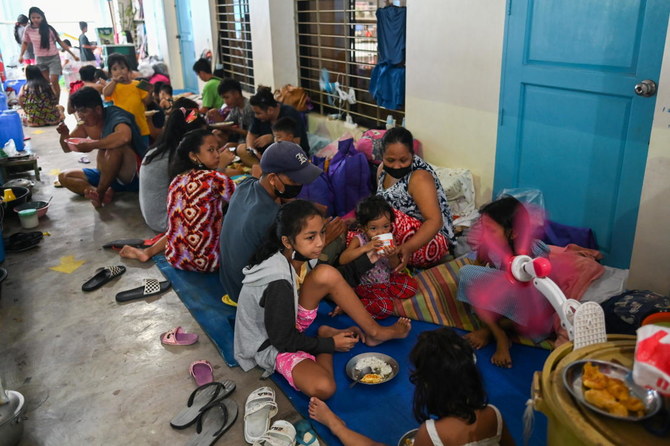
Residents have a meal after being evacuated at a school amid heavy rains that caused flooding in some areas in Marikina city, Metro Manila, Philippines, July 24, 2021. (Reuters)
2 / 3
A child leans on her mother after being evacuated at a school following heavy rains that caused flooding in some areas in Marikina city, Metro Manila, Philippines, July 24, 2021. (Reuters)
3 / 3
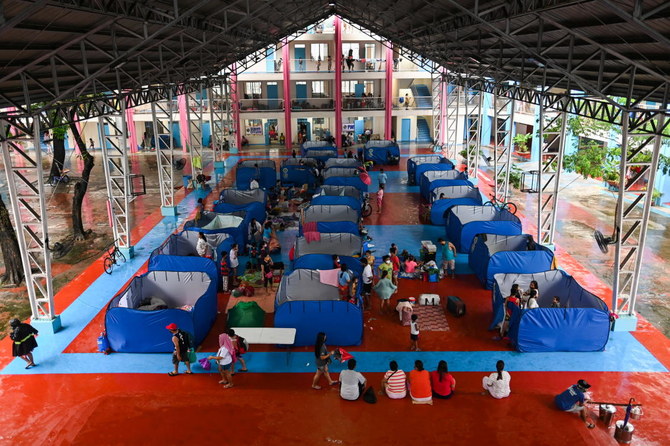
Residents seek temporary shelter at a school following heavy rains that caused flooding in some areas in Marikina city, Metro Manila, Philippines, July 24, 2021. (Reuters)
Short Url
Updated 25 July 2021
Follow

Monsoon rains displace thousands in the Philippines

  • Health officers are on standby to monitor the situation in evacuation centers, official says

MANILA: Thousands of residents remain in evacuation centers across Luzon island in the Philippines, where days of torrential monsoon rains intensified by typhoon In-fa have caused flooding in many low-lying areas.
Authorities said that at least three people were reported dead and five others injured, while the rains had destroyed 109 houses and 374 others had been damaged.
Data released by the National Disaster Risk Reduction and Management Council (NDRRMC) on Sunday showed that 19,521 families or 87,493 people from 212 villages in the capital region (Metro Manila) and outlying provinces were affected by the heavy rains.
Of the total affected population, some 6,064 families composed of 24,798 people were forced to flee their homes, the majority of them seeking shelter in evacuation centers.
Amid concerns that evacuation sites could become epicenters of COVID-19 infections, officials said that steps were being undertaken to prevent this.
“We organize the national government agencies into response clusters,” NDRRMC executive director Ricardo Jalad told Arab News. 
“Concerned with augmenting the capacities of local government units in the management of evacuation centers is the camp coordination and management cluster with the Department of Social Welfare and Development (DSWD) as lead agency,” said the official.
“To prevent the spread of COVID-19, school classrooms are used and we make sure that it will be one family for one classroom. In other evacuation centers, modular partitions or tents are used with one family getting one tent,” Jalad said.
Mark Timbal, NDRRMC spokesperson, said those tasked to oversee the evacuation of affected residents were following a set of guidelines that took the COVID-19 pandemic into consideration.
“So, prior to the evacuees actually leaving their homes, they have to wear a face mask and face shield. In the evacuation centers upon their arrival, if the local government unit has available antigen rapid test kits they can implement the testing as well,” Timbal told Arab News.
“Part of the initial assessment for the evacuees is that if there is someone who is exhibiting symptoms of respiratory disease or flu-like symptoms, they’re not allowed to go to evacuation centers but instead they are brought to an isolation facility or the nearest hospital depending on the situation of the patient,” he added.
In the evacuation centers, Timbal said that local government units (LGUs) had been briefed to make sure that there was only one family in one room or tent so that physical distancing could be observed. “And there should be no overcrowding in evacuation centers,” Timbal said.
He explained that there was now also a maximum number of people allowed per evacuation center.
“The number that has been pre-identified by the local government already considers social distancing requirements. So that if that number is already reached, the excess evacuees will be brought to an alternative facility,” Timbal said.
Health officers are also on standby to monitor the situation in evacuation centers so that they can immediately address any possible case of COVID-19 infection, as well as conduct contract tracing.
Timbal said that, so far, there had been no reports of an evacuee exhibiting symptoms of COVID-19.
However, LGUs have been told to ensure that strict monitoring continues, and that if anyone displays symptoms they should be immediately isolated for the protection of the other evacuees.
For those who have lost their house, Timbal said that the government had a program to provide them with funds and construction materials.
The military and police have deployed their personnel to assist in relief operations for people displaced by extreme weather conditions in the Cordilleras, Central Luzon and MIMAROPA (Mindoro, Marinduque, Romblon, and Palawan).


US allows oil majors to broadly operate in Venezuela, new energy investments

Updated 14 February 2026
Follow

US allows oil majors to broadly operate in Venezuela, new energy investments

  • Treasury Department issues general license allowing Chevron, BP, Eni, Shell and Repsol to operate oil and gas operations in Venezuela
  • Move is the most significant relaxation of sanctions on Venezuela since US forces captured and removed President Nicolas Maduro

WASHINGTON: The US ​eased sanctions on Venezuela’s energy sector on Friday, issuing two general licenses that allow global energy companies to operate oil and gas projects in the OPEC member and for other companies to negotiate contracts to bring in fresh investments. The move was the most significant relaxation of sanctions on Venezuela since US forces captured and removed President Nicolas Maduro last month.
The Treasury Department’s Office of Foreign Assets Control issued a general license allowing Chevron, BP, Eni, Shell and Repsol to operate oil and gas operations in Venezuela. Those companies still have offices in the country and stakes in projects, and are among the main partners of state-run ‌company PDVSA.
The authorization ‌for the oil majors’ operations requires payments for royalties and Venezuelan ​taxes ‌to ⁠go through ​the US-controlled ⁠Foreign Government Deposit Fund.
The other license allows companies around the world to enter contracts with PDVSA for new investments in Venezuelan oil and gas. The contracts are contingent on separate permits from OFAC.
The authorization does not allow transactions with companies in Russia, Iran, or China or entities owned or controlled by joint ventures with people in those countries.
The licenses “invite American and other aligned companies to play a constructive role in supporting economic recovery and responsible investment, ” the US State Department said in a release. Additional authorizations may be issued “as necessary,” it said.
A spokesperson for Chevron, ⁠the only US oil firm currently operating in Venezuela, said the company welcomed ‌the new licenses.
“The new General Licenses, coupled with recent changes ‌in Venezuela’s Hydrocarbons Law, are important steps toward enabling the further development ​of Venezuela’s resources for its people and for advancing ‌regional energy security,” the spokesperson said in a statement.
Eni said it is assessing the opportunities in ‌Venezuela that the authorization opens up.

Oil law reform

The US licenses follow a sweeping reform of Venezuela’s main oil law approved last month, which grants autonomy for foreign oil and gas producers to operate, export and cash sale proceeds under existing joint ventures with PDVSA or through a new production-sharing contract model.
The US has had sanctions on Venezuela since ‌2019 when President Donald Trump imposed them during his first administration. Trump is now seeking $100 billion in investments by energy companies in Venezuela’s oil and gas sector. ⁠US Energy Secretary Chris Wright ⁠said on Thursday, during his second day of a trip to Venezuela, that oil sales from the country since Maduro’s capture have hit $1 billion and would hit another $5 billion in months.
Wright said the US will control the proceeds from the sales until Venezuela stands up a “representative government.” Since last month, the Treasury issued several other general licenses to facilitate oil exports, storage, imports and sales from Venezuela. It also authorized the provision of US goods, technology, software or services for the exploration, development or production of oil and gas in Venezuela.
The Venezuelan government expropriated assets of Exxon Mobil and ConocoPhillips in 2007 under then-President Hugo Chavez. The Trump administration is trying to get those companies to invest in Venezuela as well. At a meeting at the White House with Trump last month, Exxon Mobil CEO Darren Woods said Venezuela was “uninvestable” at ​the moment.
Wright said on Thursday that Exxon, ​which no longer has an office in Venezuela, is in talks with the government there and gathering data about the oil sector. Exxon did not immediately comment.