

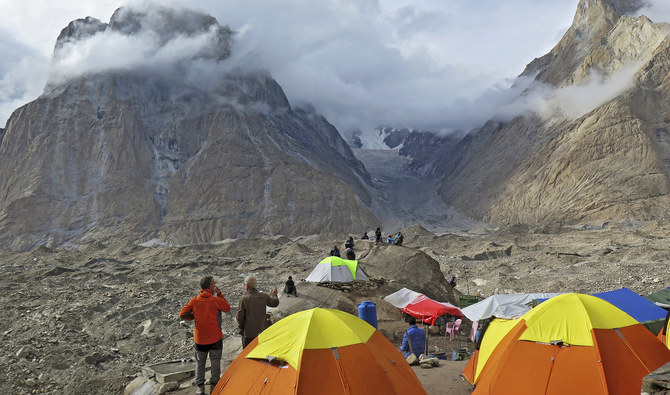

KHAPLU, GILGIT-BALTISTAN: Over one million tourists have visited the scenic Gilgit-Baltistan region in Pakistan’s north since May, officials say, as tourism reopens in Pakistan despite persisting coronavirus fears.
The mountainous northern region of Gilgit-Baltistan is Pakistan’s favorite tourism destination and was listed by Forbes among the ten “coolest places” to visit in 2018.
Bordering Afghanistan and China, Gilgit-Baltistan’s economy is largely dependent on tourism and was badly hit last year as outbreaks of COVID-19 and travel curbs deterred tourists from flocking to the region’s glacial lakes, valleys and 8000-meter-plus peaks.
Global tourism suffered its worst year ever in 2020, with the sector shrinking in value by an estimated $4.5 trillion in the pandemic’s wake, according to World Travel & Tourism Council (WTTC) figures.
The scale of recovery in 2021 still hangs in the balance, though emerging market nations have moved to slowly open the tourism sector.
“This year, we have opened the sector from early May,” Iqbal Hussain, a director at the Gilgit-Baltistan Tourism Department, told Arab News last week. “We have recorded one million tourists till July 15.”
In 2020, the sector had opened for less than three months, between August and October, and some 600,000 people had visited, Hussain said.
Despite the improved numbers this year so far, the spectre of another lost tourism season still haunts the region, as coronavirus cases have once again started to surge, and authorities are scrambling to impose health rules and standard operating procedures (SOPs).
In mid-July, a coronavirus positivity rate of 16 percent was recorded in Gilgit-Baltistan. Lagging vaccination rates in the region have added to pressure.
“Due to COVID-19, we are facing a lot of challenges,” Hussain said. “Some 60-70 percent of people are directly linked with this sector. To continue socio-economic activities, it’s very important to open the tourism sector with the implementation of SOPs.”
Ahead of the Eid Al-Adha holiday, Pakistan’s central pandemic response body, the NCOC, made vaccination certificates mandatory for tourists to book hotels in Azad Kashmir and other northern regions in the country.
“We are trying to implement SOPs at all entry points like airports,” Dr. Shah Zaman, the focal person for pandemic response in Gilgit-Baltistan, said, saying the COVID-19 positivity rate had been increasing in the region since last week.
But this has not deterred travel-hungry visitors like retired Pakistan Air Force official Muhammad Saleem Khan, who told Arab News the extended Eid Al-Adha holiday was the first time he finally got to see Gilgit-Baltistan.
“I have visited many countries of the world, but this time, this is my first visit to Gilgit-Baltistan,” the 71-year-old tourist said. “It’s such a beautiful place.”
Sidra Humayun, 29, said she had come with her family to tour the region only for a week but decided to stay longer: “Our plan was to return after one week, but after coming here we have decided to celebrate Eid Al-Adha here.”
And many who visit vow to return.
“I have visited GB many times. And I am here again because it’s a beautiful place,” said Taimur Shahid, a 31-year-old-tourist from Karachi. “The mountains are majestic and it’s a wonderful place to come and skip city life. And each time you get here, you feel lucky. Inshallah, I will come again.”


