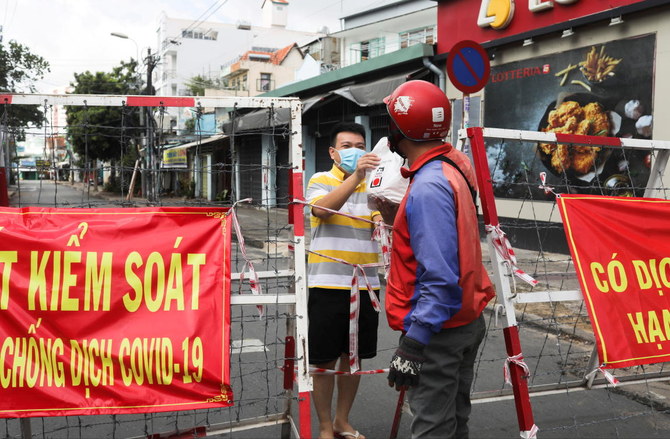
HANOI, Vietnam: Vietnam announced a 15-day lockdown in the capital Hanoi starting Saturday as a coronavirus surge spread from the southern Mekong Delta region.
The lockdown order, issued late Friday night, bans the gathering of more than two people in public. Only government offices, hospitals and essential businesses are allowed to stay open.
Earlier in the week, the city had suspended all outdoor activities and ordered non-essential businesses to close following an increase in cases. On Friday, Hanoi reported 70 confirmed infections, the city’s highest, part of a record 7,295 cases in the country in the last 24 hours.
Nearly 5,000 of them are from Vietnam’s largest metropolis, southern Ho Chi Minh City, which has also extended its lockdown until Aug. 1.
In the latest wave of COVID-19 since April, Vietnam has recorded over 83,000 infections and 335 deaths.
A meeting of the National Assembly that opened in Hanoi on Tuesday with 499 delegates is going ahead, although it was shortened to 12 from the original 17 days.
The delegates have been vaccinated, are regularly tested for the coronavirus and are traveling in a bubble, and are isolated at hotels, according to the National Assembly.

Vietnam locks down capital Hanoi for 15 days as COVID-19 cases rise
https://arab.news/vcrzr
Vietnam locks down capital Hanoi for 15 days as COVID-19 cases rise
- The lockdown order, issued late Friday night, bans the gathering of more than two people in public
- In the latest wave of COVID-19 since April, Vietnam has recorded over 83,000 infections and 335 deaths
Hong Kong begins national security trial of Tiananmen vigil group
- Three government-vetted judges will preside over the trial, which is expected to last 75 days
HONG KONG: Hong Kong’s High Court began hearing on Thursday a landmark national security trial of the three former leaders of a now disbanded group that organized annual vigils marking Beijing’s 1989 Tiananmen Square crackdown on pro-democracy protesters.
Once legal in China-ruled Hong Kong, such public commemorations were hailed as a symbol of the Asian financial hub’s relative freedom, compared to mainland China.
“Justice resides in the hearts of the people, and history will bear witness,” said Tang Ngok-kwan, a former senior member of the disbanded group, the Hong Kong Alliance in Support of Patriotic Democratic Movements of China.
He was among dozens who braved cold weather to queue outside the court building, which was tightly guarded by scores of police officers and vehicles.
The events on June 4, 1989, when Chinese troops opened fire to end student-led protests, are not publicly discussed in China, which treats the date as taboo and allows no public remembrance.
Blocked in 2020 over COVID-19 curbs, the Hong Kong memorials have never resumed since China imposed a tough national security law that year. Several June 4 monuments, such as the “pillar of shame,” have also been removed from the city’s universities.
Under that law, Lee Cheuk-yan, 68, Albert Ho, 74, and Chow Hang-tung, 40, three former leaders of the group, now face charges of “inciting subversion of state power” that carry punishments of up to 10 years in jail.
Chow and Lee, one of the city’s veteran democratic leaders, pleaded not guilty, while Ho, also a former chairman of the city’s largest opposition Democratic Party, pleaded guilty.
The trial is among the last of several such major cases, with Chow, the former vice chair of the group, held on remand for more than 1,500 days after being denied bail.
Subverting state power a key question in trial
In an opening statement, prosecutors said the case centered on whether the Alliance’s publicly stated goal of “ending one-party rule” constituted illegally inciting others to carry out acts aimed at subverting state power.
The other key focus of the case was whether such acts amounted to “overthrowing or undermining” China’s system of government, they added.
In the past, the Alliance has said it hoped to see a democratic China and was not aiming to destroy the Chinese Communist Party (CCP) but to see it contest free elections.
Rights groups and some foreign governments have criticized such national security cases against prominent democrats as a weaponization of the rule of law to silence dissent.
“This case is not about national security – it is about rewriting history and punishing those who refuse to forget the victims of the Tiananmen crackdown,” said Sarah Brooks, the Asia deputy director of rights group Amnesty International.
Beijing says Hong Kong’s national security law was necessary to restore order after sometimes violent protests rocked the former British colony for months in 2019.
Detained since September 2021, Chow, a Cambridge-educated barrister, is one of the few democratic campaigners still speaking out against the Chinese Communist Party’s crackdown.
She has represented herself in court and challenged prison rules.
“The state can lock up people but not their thinking, just as it can lock up facts but not alter truth,” she told Reuters in an interview.
Last November, the High Court rejected Chow’s bid to terminate the trial.
On Wednesday, the judges said the court would rely on evidence and legal principles, adding that it “will not allow trials to become a tool for political repression ... or an abuse of judicial procedures,” as Chow claimed.


