

Shorn of glitz, Tokyo Olympics begin in shadow of pandemic

1 / 19
Saudi Arabia's delegation enters the Olympic Stadium during Tokyo 2020 Olympic Games opening ceremony's parade of athletes, in Tokyo on July 23, 2021. (AFP)
2 / 19
Saudi Arabia's delegation enters the Olympic Stadium during Tokyo 2020 Olympic Games opening ceremony's parade of athletes, in Tokyo on July 23, 2021. (AFP)
3 / 19
Saudi Arabia's delegation enters the Olympic Stadium during Tokyo 2020 Olympic Games opening ceremony's parade of athletes, in Tokyo on July 23, 2021. (AFP)
4 / 19
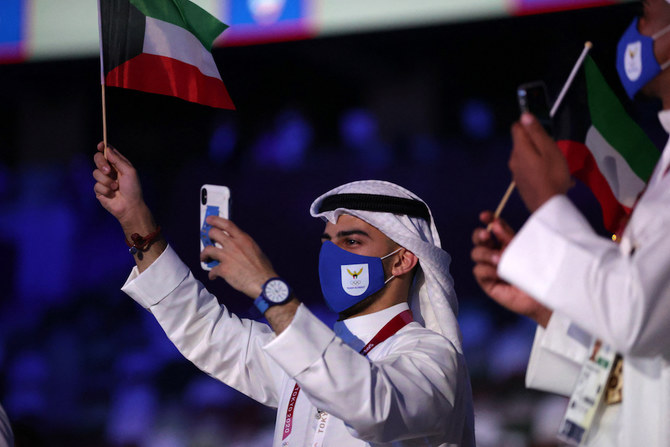
Kuwait's delegation enters the Olympic Stadium during Tokyo 2020 Olympic Games opening ceremony's parade of athletes, in Tokyo on July 23, 2021. (AFP)
5 / 19
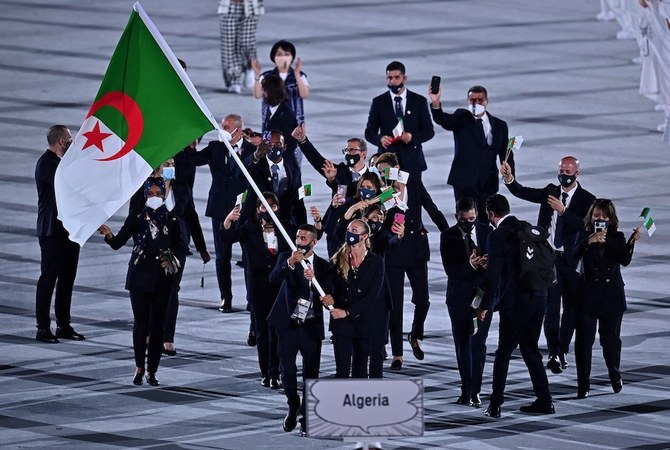
Algeria's delegation enters the Olympic Stadium during Tokyo 2020 Olympic Games opening ceremony's parade of athletes, in Tokyo on July 23, 2021. (AFP)
6 / 19
The opening ceremony of the Tokyo Olympics took place on Friday in a nearly empty stadium after a year-long pandemic postponement. (AFP)
7 / 19
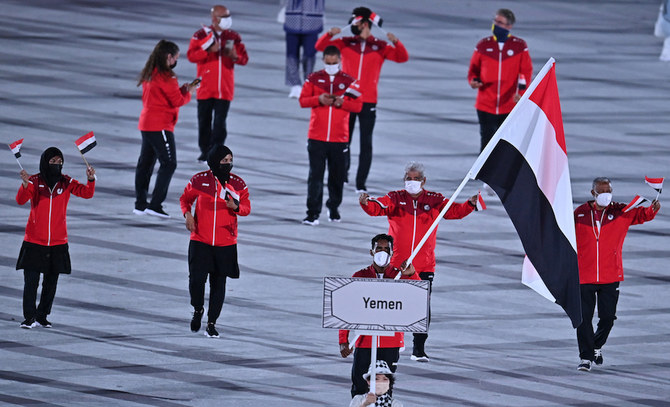
Yemen's delegation enters the Olympic Stadium during Tokyo 2020 Olympic Games opening ceremony's parade of athletes, in Tokyo on July 23, 2021. (AFP)
8 / 19
Iran's delegation enters the Olympic Stadium during Tokyo 2020 Olympic Games opening ceremony's parade of athletes, in Tokyo on July 23, 2021. (AFP)
9 / 19
Egypt's delegation enters the Olympic Stadium during Tokyo 2020 Olympic Games opening ceremony's parade of athletes, in Tokyo on July 23, 2021. (AFP)
10 / 19
Kuwait's delegation enters the Olympic Stadium during Tokyo 2020 Olympic Games opening ceremony's parade of athletes, in Tokyo on July 23, 2021. (AFP)
11 / 19
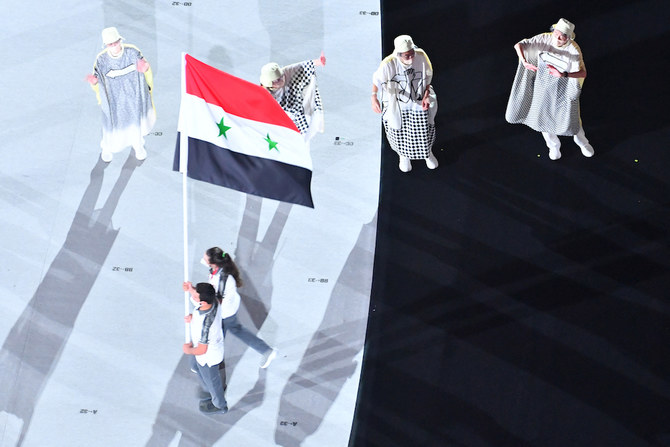
Syria's delegation enters the Olympic Stadium during Tokyo 2020 Olympic Games opening ceremony's parade of athletes, in Tokyo on July 23, 2021. (AFP)
12 / 19
Egypt's delegation enters the Olympic Stadium during Tokyo 2020 Olympic Games opening ceremony's parade of athletes, in Tokyo on July 23, 2021. (AFP)
13 / 19
Oman's delegation enters the Olympic Stadium during Tokyo 2020 Olympic Games opening ceremony's parade of athletes, in Tokyo on July 23, 2021. (AFP)
14 / 19
Sudan's delegation enters the Olympic Stadium during Tokyo 2020 Olympic Games opening ceremony's parade of athletes, in Tokyo on July 23, 2021. (AFP)
15 / 19
Iraq's delegation enters the Olympic Stadium during Tokyo 2020 Olympic Games opening ceremony's parade of athletes, in Tokyo on July 23, 2021. (AFP)
16 / 19
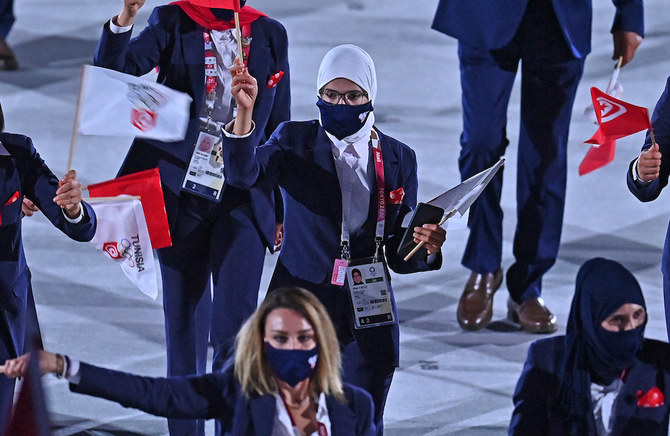
Tunisia's delegation enters the Olympic Stadium during Tokyo 2020 Olympic Games opening ceremony's parade of athletes, in Tokyo on July 23, 2021. (AFP)
17 / 19
The opening ceremony of the Tokyo Olympics took place on Friday in a nearly empty stadium after a year-long pandemic postponement. (AFP)
18 / 19
The opening ceremony of the Tokyo Olympics took place on Friday in a nearly empty stadium after a year-long pandemic postponement. (AFP)
19 / 19
The opening ceremony of the Tokyo Olympics took place on Friday in a nearly empty stadium after a year-long pandemic postponement. (AFP)
Short Url
Updated 24 July 2021
Follow

Shorn of glitz, Tokyo Olympics begin in shadow of pandemic

  • Rower Husein Alireza, sprinter Yasmine Al-Dabbagh carry Saudi flag at inauguration
  • Just a few hundred officials and dignitaries were in the stands of the 68,000-seat venue

TOKYO: Japan’s global superstar Naomi Osaka on Friday lit the Olympic cauldron to mark the start of Tokyo 2020, in an opening ceremony shorn of glitz and overshadowed by a pandemic but defined by hope, tradition and gestures of diversity. Postponed by a year due to the coronavirus, the Games are being held without spectators in a city under a COVID-induced state of emergency, as many other parts of the globe also still struggle with a resurgence of cases.

Athletes, the vast majority wearing masks, paraded through an eerily silent National Stadium.

Just a few hundred officials and dignitaries were in the stands of the 68,000-seat venue, including French President Emmanuel Macron, US First Lady Jill Biden, and Japan's Emperor Naruhito, who will declare the Games open.

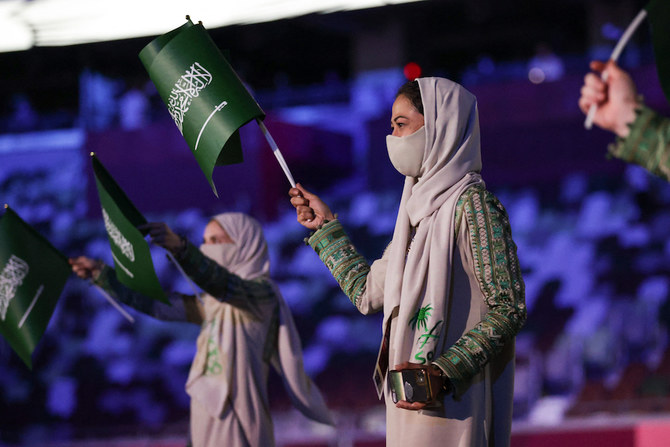
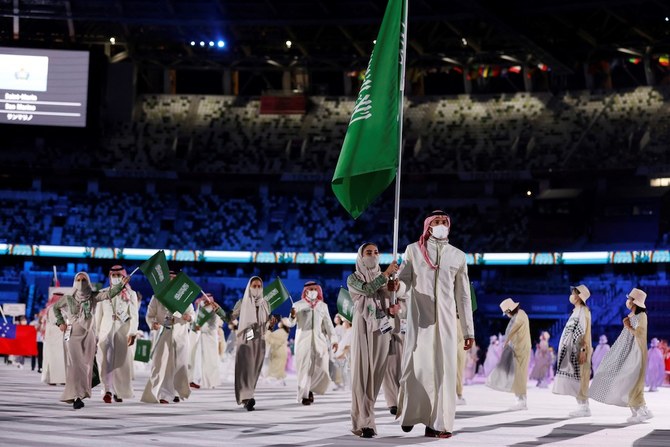
Saudi rower Husein Alireza and 100-meter sprinter Yasmine Al-Dabbagh carried the Kingdom’s flag at the opening ceremony.

The Olympics have faced opposition in Japan over fears the global gathering of 11,000 athletes could trigger a super-spreader event, and is taking place under strict virus measures.
Overseas fans are banned for the first time in the history of the Games, and domestic spectators can only watch events at a handful of venues.

READ MORE

Saudi rower Husein Alireza and 100 meter sprinter Yasmine Al-Dabbagh were chosen to carry the Kingdom’s flag at the opening ceremony of the 2020 Olympic Games in Tokyo on Friday. More here.

Masked athletes

Athletes, support staff and media are subject to strict COVID-19 protocols, including regular testing and daily health checks.
The restrictions made for an opening ceremony that was far from the usual exuberant celebration.

Every athlete entered the stadium wearing a mask, and the national delegations of athletes marching around the stadium were far smaller than usual, ranging from just a handful of people to a few dozen.

The ceremony wove together references to both Japan's traditional crafts and its globally adored video games, with athletes entering to theme music from famed titles.
“Today is a moment of hope. Yes, it is very different from what all of us had imagined,” IOC President Thomas Bach said. “But let us cherish this moment because finally we are all here together.”
“This feeling of togetherness — this is the light at the end of the dark tunnel of the pandemic,” Bach declared.

Biggest Saudi delegation
This is the first time in Olympic Games history that participating nations could nominate a male and a female athlete to carry their flags.
Karate star Tarek Hamdi will be the flag bearer during the closing ceremony on Aug. 8.
Saudi Arabia has sent its largest-ever Olympic delegation to the games in Japan. 
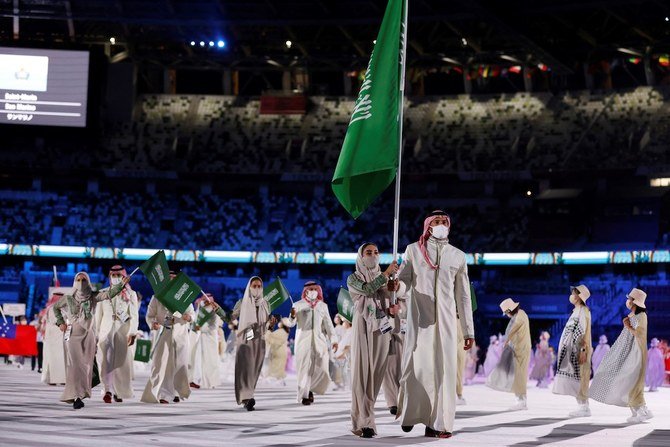


Saudi Arabia's delegation enters the Olympic Stadium during Tokyo 2020 Olympic Games opening ceremony's parade of athletes, in Tokyo on July 23, 2021. (AFP)

It includes 11 individual athletes plus the country’s under-23 football team. They will compete in nine sports, surpassing the country’s record of six at the Athens Olympics in 2004.
Mostly masked athletes waved enthusiastically to thousands of empty seats and to a world hungry to watch them compete but surely wondering what to make of it all. 
Some athletes marched socially distanced, while others clustered in ways utterly contrary to organizers’ hopes. The Czech Republic entered with other countries even though its delegation has had several positive COVID tests since arriving.

Polls have consistently shown Japanese people are opposed to holding the Games during the pandemic, but hundreds of people still gathered outside the stadium and cheered as the fireworks exploded overhead.
Mako Fukuhara arrived six hours before the ceremony to grab a spot.
"Until now it didn't feel like the Olympics, but now we are by the stadium, it feels like the Olympics," she told AFP as people snapped selfies nearby.
Inside, fewer than 1,000 dignitaries and officials were in the stands, and in a sign of how divisive the Games remain, several top sponsors including Toyota and Panasonic did not attend the ceremony.
Small groups of protesters demonstrated against the Games outside the stadium as the ceremony began, but their chants were drowned out as the music started.
Tokyo is battling a surge in virus cases, and is under emergency measures that means bars and restaurants must shut by 8:00 pm and cannot sell alcohol.
Olympic officials have put a brave face on the unusual circumstances, with IOC chief Thomas Bach insisting cancelling the Games was never on the table.
There are also hefty financial incentives in play. Insiders estimate the IOC would have been on the hook for around $1.5 billion in lost broadcasting revenues if the Games had been cancelled.
The pandemic has not been the only hiccup in preparations though, with scandals ranging from corruption during the bidding process to plagiarism allegations over the design of the Tokyo 2020 logo.
The controversies kept coming right up to the eve of the Games, with the opening ceremony's director sacked on Thursday for making a joke referencing the Holocaust in a video more than two decades ago.
When the full programme of sport begins on Saturday, a new generation of Olympic stars are looking to shine after a decade dominated by the likes of Usain Bolt and Michael Phelps.
US swimmer Caeleb Dressel could target seven gold medals, and in track and field, 400 metre hurdlers Karsten Warholm of Norway and the USA's Sydney McLaughlin are among those hoping to emerge as household names.
In gymnastics, Simone Biles will attempt to crown her dazzling career by equalling Larisa Latynina's record of nine Olympic gold medals.
New Olympic sports will also be on display in Tokyo, with surfing, skateboarding, sport climbing and karate all making their debut.

(With AFP)


‘20 years of engagement’ — inaugural Formula 4 championship success signals bright future for motorsport in Saudi Arabia

Updated 03 February 2026
Follow

‘20 years of engagement’ — inaugural Formula 4 championship success signals bright future for motorsport in Saudi Arabia

  • Peter Thompson, founder of the Formula 4 Saudi Arabian Championship and Meritus.GP team principal, spoke about the Kingdom’s first motorsport academy and his hopes for the future

RIYADH: Last year welcomed the inaugural season of the FIA-certified Aramco Formula 4 Saudi Arabian Championship.

The series, which aims to provide the first step on the ladder towards Formula 1, was the culmination of years of collaboration between various investors and partners, led by the Kingdom’s first motorsport academy, Meritus.GP.

The championship’s mission?

To produce local driving talent, strengthen Saudi national race engineering capabilities and advance motorsport in alignment with the objectives of Saudi Vision 2030.

Five Saudi drivers emerged, with standout victories by Omar Al-Dereyaan and Faisal Al-Kabbani, both from Riyadh. Other graduates included race winner Oscar Wurz, who has since won the 2025 Central European Formula 4 Championship.

Arab News spoke with Peter Thompson, founder of Formula 4 Saudi Arabia and Meritus.GP, about the season’s success and his hopes for the future.

How did Meritus.GP build the Formula 4 Saudi Arabian Championship?

The Formula 4 Saudi Arabian Championship was the result of more than 20 years of engagement, exploration and groundwork in Saudi Arabia, in anticipation of a potential FIA-certified junior single-seater championship in the Kingdom.

Long before the first Formula 1 Saudi Arabian Grand Prix, we were on the ground exploring circuit development opportunities, assessing infrastructure readiness and evaluating whether Saudi Arabia could host a round of one of the Asian championships operated by the team. Throughout this period, we maintained long-standing relationships within Saudi motorsport circles including former Meritus.GP driver Raad Abduljawad and his brother Mohammed Abduljawad.

A defining moment came with the introduction of Formula 1 to Saudi Arabia. The Jeddah Corniche Circuit quickly became a visible symbol of this ambition, providing confidence that Saudi Arabia could support not only Formula One, but also a structured ladder of junior single-seater racing.

When did Meritus.GP receive formal institutional approval to begin Formula 4 Saudi Arabia?

More than three years of focused groundwork preceded the first race. During this period there was no formal government mandate, no guaranteed institutional backing and no commercial certainty that the project would proceed or be viable.

Then, in December 2022, a formal No-Objection Letter was issued by the Saudi Automobile and Motorcycle Federation, under the leadership of its then-CEO Sattam Al-Hozami, which allowed the project to progress from concept to reality.

Recognizing the benefits F4 would bring to the Kingdom, Mohammed Abduljawad became an investor in June 2023, and Formula 4 Saudi Arabia moved into full delivery mode.

What were the objectives of the proposal presented to Saudi Aramco?

The proposal positioned Aramco Formula 4 Saudi Arabia as a long-term national development platform aligned with Vision 2030.

Its objectives included creating a structured FIA driver pathway from grassroots to Formula One, as well as developing Saudi engineers, mechanics and officials in motorsports.

How did the championship support Saudi drivers, and what was the impact on local talent?

A core objective of Formula 4 Saudi Arabia was to create a genuine, fair and internationally credible environment in which Saudi racers could develop.

Saudi drivers competed alongside international peers under identical technical and sporting conditions, allowing performance and development to be measured objectively.

They ended up achieving race wins, podium finishes and measurable progress across the season, demonstrating that when provided with the right structure, Saudi talent can compete at international level. 

How has Formula 4 Saudi Arabia engaged with Saudi education and skills development?

Education and skills transfer formed an important part of the championship’s wider mission.

During the season, Meritus.GP engineers and senior staff visited Saudi education and research institutions such as KAUST, Alfaisal University, University of Tabuk and the Japanese College in Jeddah to discuss career pathways in motorsport engineering, data analysis, and systems integration. These engagements were designed to connect academic study with real-world high-performance engineering environments.

What level of investment was required and how did you ensure equality of performance?

Approximately $6.5 million was invested prior to the first event.

Was there any pre-season training to help Saudi drivers prepare?

During August and September 2023 Saudi drivers participated in a structured pre-season academy program at Meritus.GP’s training facility in Sepang, Malaysia.

What role did sports psychology and driver well-being play in the championship?

Driver well-being and mental performance were treated as integral components of driver development.

Formula 4 Saudi Arabia appointed a dedicated sports psychologist to support drivers throughout the season, focusing on mental preparation, confidence building, coping strategies, performance consistency and adaptation to high-pressure racing environments.