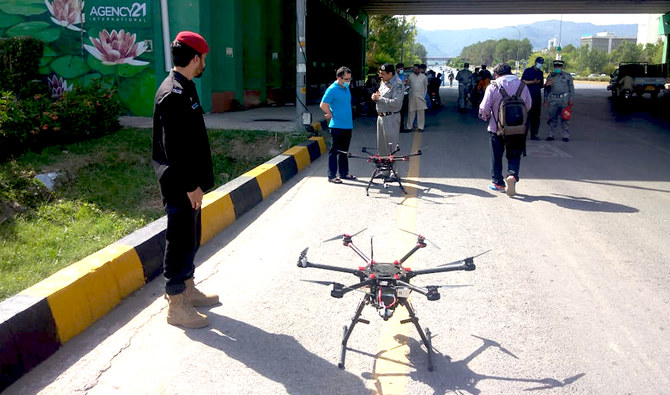
ISLAMABAD: Traffic accidents kill over 30,000 people in Pakistan annually due to speeding, drowsy driving, low visibility and poor condition of roads, transport officials have said, with authorities now using drones and other technology to monitor traffic and bring down fatal crashes on national highways.
Earlier this week, thirty people were killed and 74 injured when a passenger bus and truck collided in Punjab province.
Fatal road accidents are common in Pakistan, where traffic rules are rarely followed and roads in many rural areas are in poor condition.
Buses are a dominant mode of transportation in the South Asian nation of 220 million people, accounting for 91 percent of the country’s passenger traffic and 96 percent of freight traffic. The national highways, 3.7 percent of the entire road network, carry 80 percent commercial traffic.
Traffic accidents reached 30,046, or 2.42 percent of total deaths in 2018 in Pakistan, according to the World Health Organization’s “Global Status Report on Road Safety,” which ranked the country at 95 for road safety.
“We have increased vigilance and enforcement on the highways to prevent road accidents, and we have been successful in bringing down fatal accidents by 25 percent last year,” Abdul Saboor, a director for roads and transport at the Ministry of Communications, told Arab News, saying law enforcement agencies were using drones to monitor and regulate 135,000 kilometers of highways across the country.
Drone cameras deployed on highways have the capacity to monitor road traffic in the radius of six kilometers while law enforcement officials had also increased ticketing for rash drivers, Saboor said.
He listed speeding, driver fatigue and dozing and low visibility in cloudy weather as the main causes of road accidents in Pakistan.
“Our road infrastructure is one of the best in Asia for all kinds of traffic,” Saboor said. “We are now working on driver training and education along with the companies to minimize chances of accidents.”
According to WHO’s Global status report on road safety 2018, the number of annual road traffic deaths has reached 1.35 million, with bad traffic injuries now the leading killer of people aged 5-29 years.
Sumera Nazir, chairperson of the Institute of Road Safety Traffic Environment, said driver negligence and lack of training were the main causes of major accidents on Pakistani highways.
“Around 90 percent of fatal road accidents are the direct result of human error and driver carelessness that can be averted with the help of education and training,” she told Arab News, urging the government to arrange road safety and driving training for potential drivers before issuing licenses.
“The ratio of road accidents in Pakistan is one of the highest in the world and this has been turning into a pandemic,” she said. “Our law enforcement needs to come up with innovative ways to ensure road safety for all users.”


![]()

Pakistan employs drones to monitor traffic as road accidents kill over 30,000 people annually
Short Url
https://arab.news/jngd4
Pakistan employs drones to monitor traffic as road accidents kill over 30,000 people annually
- Traffic accidents are causing 2.42 percent of total deaths in Pakistan, one of the highest rates in the world
- Experts say government should improve driver licensing system as 90 percent accidents result from human error
Latest updates


© 2026 SAUDI RESEARCH & PUBLISHING COMPANY, All Rights Reserved And subject to Terms of Use Agreement.