TOKYO: Tokyo hit another six-month high in new COVID-19 cases on Thursday, one day before the Olympics begin, as worries grow of a worsening of infections during the Games.
Thursday’s 1,979 new cases are the highest since 2,044 were recorded on Jan. 15.
Prime Minister Yoshihide Suga, who is determined to hold the Olympics, placed Tokyo under a state of emergency on July 12, but daily cases have sharply increased since then.
The emergency measures, which largely involve a ban on alcohol sales and shorter hours for restaurants and bars, are to last until Aug. 22, after the Olympics end on Aug. 8.
Japan has reported about 853,000 cases and 15,100 deaths since the pandemic began, most of them this year. Still, the number of cases and deaths as a share of the population are much lower than in many other countries.
The Olympics, delayed for a year by the pandemic, begin Friday. Spectators are banned from all venues in the Tokyo area, with limited audiences allowed at a few outlying sites.
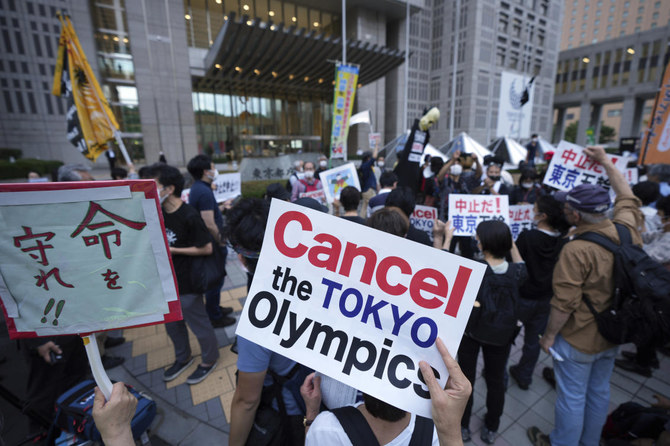
Suga’s government has been criticized for what some say is prioritizing the Olympics over the nation’s health. His public support ratings have fallen to around 30 percent in recent media surveys, and there has been little festivity ahead of the Games. On Thursday, the director of the opening ceremony, Kentaro Kobayashi, was dismissed over a past Holocaust joke.
In Olympics-related diplomacy, Suga is to meet with US first lady Jill Biden on Thursday and have dinner at the state guest house. Earlier in the day, he was visited by World Health Organization Director-General Tedros Adhanom Ghebreyesus.
Also Thursday, Emperor Naruhito received a courtesy visit from International Olympic Committee President Thomas Bach at the Imperial Palace.
Experts say virus infections among unvaccinated people younger than age 50 are rising sharply.
Japan’s vaccinations began late and slowly, but the pace picked up in May as the government pushed to accelerate the drive before the Olympics, though the pace has since slowed due to a shortage of imported vaccines.
About 23 percent of Japanese are fully vaccinated, way short of the level believed necessary to have any meaningful effect on reducing the risk in the general population.
Experts warned on Wednesday that infections in Tokyo are likely to continue to worsen in coming weeks.

Tokyo new virus cases near 2,000 a day before Olympics open
Short Url
https://arab.news/jzf2d
Tokyo new virus cases near 2,000 a day before Olympics open
- Japan’s vaccinations began late and slowly, but the pace picked up in May
Australia to ban citizen from returning to country under rarely-used terror laws
- They were briefly freed on Monday before being turned back by Damascus for holding inadequate paperwork
SYDNEY: Australia said on Wednesday it would temporarily ban one of its citizens held in a Syrian camp from returning to the country, under rarely-used powers aimed at preventing terror activity.
Thirty-four Australians in a northern Syrian facility holding families of suspected Daesh militants are expected to return home after their release was conditionally approved by camp authorities.
They were briefly freed on Monday before being turned back by Damascus for holding inadequate paperwork.
Australia has already said it would not provide any assistance to those held in the camp, and is investigating whether any individuals posed a threat to national security.
“I can confirm that one individual in this cohort has been issued a temporary exclusion order, which was made on advice from security agencies,” Home Affairs Minister Tony Burke said in a statement on Wednesday.
Security agencies have not yet advised that other members of the group meet the legal threshold for a similar ban, he added.
Introduced in 2019, the legislation allows for bans of up to two years for Australian citizens over the age of 14 that the government believes are a security risk.
Prime Minister Anthony Albanese said on Wednesday some members of the cohort, that includes children, had aligned themselves with a “brutal, reactionary ideology and that seeks to undermine and destroy our way of life.”
“It’s unfortunate that children are caught up in this, that’s not their decision, but it’s the decision of their parents or their mother,” he added.
News of the families’ possible return has caused controversy in Australia, where support for the right-wing, anti-immigration One Nation party has surged in recent months.
A poll this week found One Nation’s share of the popular vote at a record high of 26 percent, above the combined support for the traditional center-right coalition currently in opposition.
Thirty-four Australians in a northern Syrian facility holding families of suspected Daesh militants are expected to return home after their release was conditionally approved by camp authorities.
They were briefly freed on Monday before being turned back by Damascus for holding inadequate paperwork.
Australia has already said it would not provide any assistance to those held in the camp, and is investigating whether any individuals posed a threat to national security.
“I can confirm that one individual in this cohort has been issued a temporary exclusion order, which was made on advice from security agencies,” Home Affairs Minister Tony Burke said in a statement on Wednesday.
Security agencies have not yet advised that other members of the group meet the legal threshold for a similar ban, he added.
Introduced in 2019, the legislation allows for bans of up to two years for Australian citizens over the age of 14 that the government believes are a security risk.
Prime Minister Anthony Albanese said on Wednesday some members of the cohort, that includes children, had aligned themselves with a “brutal, reactionary ideology and that seeks to undermine and destroy our way of life.”
“It’s unfortunate that children are caught up in this, that’s not their decision, but it’s the decision of their parents or their mother,” he added.
News of the families’ possible return has caused controversy in Australia, where support for the right-wing, anti-immigration One Nation party has surged in recent months.
A poll this week found One Nation’s share of the popular vote at a record high of 26 percent, above the combined support for the traditional center-right coalition currently in opposition.
© 2026 SAUDI RESEARCH & PUBLISHING COMPANY, All Rights Reserved And subject to Terms of Use Agreement.


