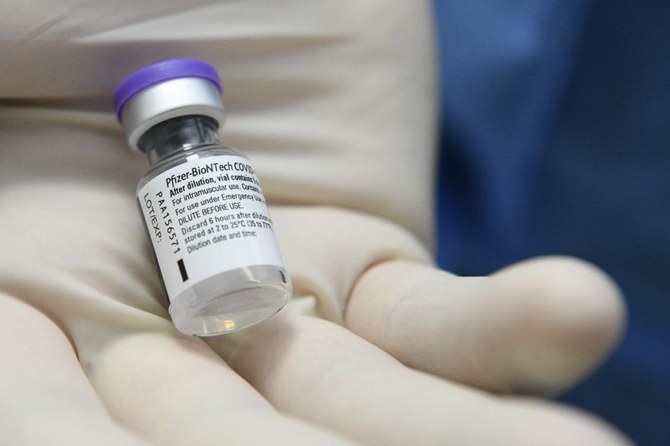
FRANKFURT: Covid-19 vaccine makers BioNTech and Pfizer on Wednesday said they had found a South African partner to produce their jab locally, the first such deal on the African continent.
The move comes amid growing criticism of vaccine inequality that has seen poor countries fall behind richer ones in the race to protect people from the coronavirus.
Under the agreement, Cape Town-based Biovac will complete the last step in the manufacturing process of the Pfizer/BioNTech vaccine, known as “fill and finish,” the companies said in a statement.
The project will take time to get off the ground however, with the first African-finished vaccines not expected before 2022.
Once up and running, Biovac is set to churn out more than 100 million doses annually that will be distributed to the 55 countries in the African Union.
“This is a critical step forward in strengthening sustainable access to a vaccine in the fight against this tragic, worldwide pandemic,” said Biovac chief executive officer Morena Makhoana.
The “technical transfer, on-site development and equipment installation activities will begin immediately,” the statement added.
The coronavirus vaccine developed by BioNTech and its US partner Pfizer, based on mRNA technology, was the first to be approved in the West late last year.
Studies have shown it is highly effective against Covid-19, including against newer and more contagious virus variants.
With the vaccine rollouts well under way in the West, and supply even outstripping demand in some countries, calls have grown for pharma companies to waive patents on their life-saving jabs.
This has been fiercely opposed by the companies themselves and countries like Germany, whose Chancellor Angela Merkel says suspending intellectual property rights could stifle innovation and would not resolve the lack of manufacturing capacity in the short term.
She has instead argued for licensing agreements and partnerships between vaccine makers and local firms, an approach taken by BioNTech, a German company.
“We aim to enable people on all continents to manufacture and distribute our vaccine while ensuring the quality of the manufacturing process and the doses,” said Ugur Sahin, BioNTech’s co-founder and CEO.
Pfizer/BioNTech said they have so far shipped more than one billion COVID-19 vaccine doses to more than 100 countries or territories, including through the global Covax vaccine-sharing program.
The Covax scheme, backed by the World Health Organization and heavily relied on by African countries, has delivered far fewer doses than expected so far however.
The WHO estimated earlier this month that only two percent of the African population, around 16 million people, were fully vaccinated.
South Africa has the highest number of Covid-19 cases and deaths in Africa, recording more than 2.3 million infections and over 67,000 deaths.
The country is currently battling a brutal third wave of the pandemic, fueled by a lack of vaccines, public fatigue with Covid restrictions and the rise of the highly contagious Delta variant.
South African President Cyril Ramaphosa last month announced a plan to turn his country into an mRNA vaccine hub, saying Africans “cannot continue to rely on vaccines that are made outside of Africa because they never come.”

Pfizer/BioNTech to produce Covid-19 vaccine in S.Africa
https://arab.news/gjvyu
Pfizer/BioNTech to produce Covid-19 vaccine in S.Africa
- The first African-finished vaccines is not expected before 2022 however
Trump says Greenland will ‘work out’ after Denmark fails to bridge gap
- Trump has appeared emboldened on Greenland — which he views as in the US backyard — since ordering a deadly January 3 attack in Venezuela that removed president Nicolas Maduro
WASHINGTON, United States: US President Donald Trump held open the possibility Wednesday for a resolution on his designs over Greenland after Denmark’s top diplomat said he failed to change the administration’s mind on wanting to conquer the island.
The foreign ministers of Denmark and Greenland, an autonomous territory under Copenhagen’s sovereignty, met at the White House with Vice President JD Vance and Secretary of State Marco Rubio in a meeting the visitors had requested to clear up “misunderstandings” after Trump’s bellicose language toward the fellow NATO member.
Trump, speaking after the meeting which he did not attend, for the first time sounded conciliatory on Greenland, acknowledging Denmark’s interests even if he again said he was not ruling out any options.
“I have a very good relationship with Denmark, and we’ll see how it all works out. I think something will work out,” Trump said without explaining further.
He again said Denmark was powerless if Russia or China wanted to occupy Greenland, but added: “There’s everything we can do.”
Danish Foreign Minister Lars Lokke Rasmussen, speaking after leaving the White House, said a US takeover of Greenland was “absolutely not necessary.”
“We didn’t manage to change the American position. It’s clear that the president has this wish of conquering over Greenland,” Lokke told reporters.
“We therefore still have a fundamental disagreement, but we also agree to disagree.”
He said the issue was “very emotional” for the people of Greenland and Denmark, a steadfast US ally whose troops died alongside Americans in Afghanistan and, controversially, Iraq.
“Ideas that would not respect territorial integrity of the Kingdom of Denmark and the right of self-determination of the Greenlandic people are, of course, totally unacceptable,” Lokke said.
He nonetheless said the tone was “constructive” and said the sides would form a committee that would meet within weeks to see if there was possible headway.
Referring to the British prime minister who trumpeted his diplomacy with Hitler, Lokke said, “I am not a Chamberlain to say “Peace for our time,” but we must seize the opportunities that present themselves.”
Mocking tone
While the talks were underway, the White House posted on X: “Which way, Greenland man?“
The post included a drawing of two dogsleds — one heading toward the White House and a huge US flag, and the other toward Chinese and Russian flags over a lightning-bathed Kremlin and Great Wall of China.
Neither country has claimed Greenland, and Lokke said no Chinese ship had been spotted there in a decade and that there were no major Chinese investments.
Denmark promised ahead of the meeting to ramp up its military presence further in the vast, sparsely populated and strategically located island.
Trump has derided recent Danish efforts to increase security for Greenland as amounting to “two dogsleds.” Denmark says it has invested almost $14 billion in Arctic security.
Denmark also announced immediate military exercises that will include aircraft, vessels and soldiers, with Sweden also participating.
In another show of solidarity with Denmark following Trump’s threats, Germany and France both said Wednesday they will send troops to Greenland. German’s defense ministry said it would send a 13-person team.
Signs of relief
On the quiet streets of the capital Nuuk, red and white Greenlandic flags flew in shop windows, on apartment balconies, and on cars and buses, in a show of national unity during the talks.
Ivaana Egede Larsen, 43, said she felt relief that the meeting appeared to be cordial.
“I am more calm now, and I feel more safe. I had felt very much unsafe lately,” she said.
In Copenhagen, Thomas Fallesen, 56, voiced similar sentiments.
“They are now at least talking together instead of talking through the press. I think it’s a very positive thing,” he said.
Vance, who slammed Denmark as a “bad ally” during an uninvited visit to Greenland last year, is known for a hard edge, which was on display when he publicly berated Ukrainian President Volodymyr Zelensky in the Oval Office last February.
Wednesday’s meeting, however, was closed to the press, meaning there was no on-camera confrontation.
Trump has appeared emboldened on Greenland — which he views as in the US backyard — since ordering a deadly January 3 attack in Venezuela that removed president Nicolas Maduro.


