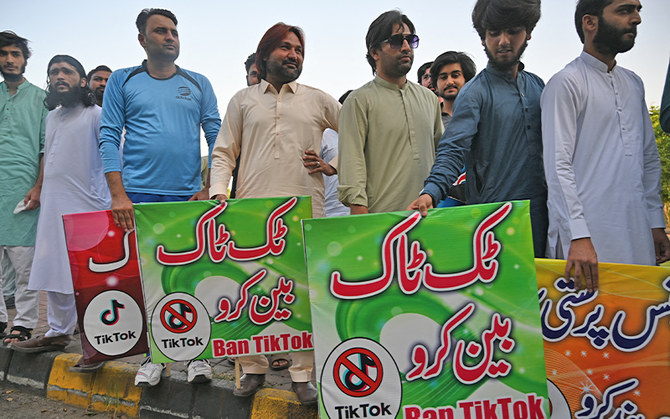
ISLAMABAD: The Pakistan Telecommunication Authority on Wednesday announced it had blocked video-sharing app TikTok, the fourth time the platform has been banned in the South Asian nation over “inappropriate content.”
Earlier this month, Pakistani authorities blocked the popular TikTok app after a court ruling on a private citizen’s petition that accused the company of promoting obscenity.
“In the light of relevant provisions of Prevention of Electronic Crimes Act 2016, PTA has blocked access to TikTok App and website in the country,” PTA said on Twitter. “The action has been taken due to continuous presence of inappropriate content on the platform and its failure to take such content down.”
Last month, TikTok said it had taken down more than six million videos from the app in Pakistan over three months.
Wildly popular among Pakistani youth, the Chinese-owned app has been shut down by authorities several times in the last year over “immoral content.”
Last month, the Sindh High Court ordered the Pakistan Telecommunication Authority to suspend the services of the video-sharing site on a citizen’s petition who said he was aggrieved by “immorality and obscenity” on the app. PTA blocked the app on June 30.
The ban was reversed after four days after PTA assured the court that the app’s content would be monitored.
On March 11, the Peshawar High Court had ordered the app be blocked in the country based on a petition alleging it had obscene content.
Last October, PTA blocked TikTok for similar reasons, but reversed its decision after 10 days saying the company’s owners, China-based ByteDance, had agreed to moderate content in Pakistan.

TikTok blocked in Pakistan, again, over ‘inappropriate content’
https://arab.news/ggc82
TikTok blocked in Pakistan, again, over ‘inappropriate content’
- Pakistan telecoms regulator says app and website banned for failure to take down obscene content
- Last month, TikTok said it had removed more than six million videos from the app in Pakistan in three months
IMF says has made ‘considerable progress’ as Pakistan funding talks continue
- Discussions covered the impact of the Middle East conflict on Pakistan, balance of payments and external financing needs
- Pakistan’s program implementation under a $7 billion program remained broadly aligned with authorities’ commitments, IMF says
KARACHI: The International Monetary Fund (IMF) has made “considerable progress” in talks with Pakistan over its funding facilities, the Fund said late Wednesday, adding that discussions will continue in the coming days.
The IMF mission, led by Iva Petrova, had started talks with Pakistani officials on the third review of a $7 billion Extended Fund Facility (EFF) multi-year program and for the second review of the $1.4 billion Resilience and Sustainability Facility (RSF) from Feb. 25 to Mar. 11, according to the IMF.
The mission observed that Pakistan’s program implementation under the EFF remained broadly aligned with the authorities’ commitments through end-Feb., with both sides making progress on policies, including fiscal consolidation, a sufficiently tight monetary policy and advancing energy sector reforms.
“While considerable progress was made in the discussions, these will continue in the coming days, including to more fully assess the impact of recent global developments on Pakistan’s economy and the EFF-supported program,” the IMF quoted Petrova as saying.
Both EFF, secured in Sept. 2024, and the RSF, secured in May 2025, are key programs crucial for stabilizing Pakistan’s fragile economy. The IMF team was in the country to assess fiscal performance, energy-sector reforms, and external financing needs before approving the next disbursement.
The ongoing IMF engagement is seen as vital for Pakistan as geopolitical tensions and rising global oil prices pose renewed risks for its economic recovery.
The IMF mission observed that Islamabad paid “particular attention” to deepening structural reforms and made “good progress” in the implementation of their agenda to strengthen climate resilience, including through the completion of reform measures under the RSF.
“Discussions also covered the impact of the conflict in the Middle East on Pakistan’s economic outlook, the balance of payments and external financing needs amid volatile and rising energy prices and tighter global financial conditions,” Petrova said, adding:
“The IMF team and the authorities will continue these discussions with a view to conclude them in the coming days.”


