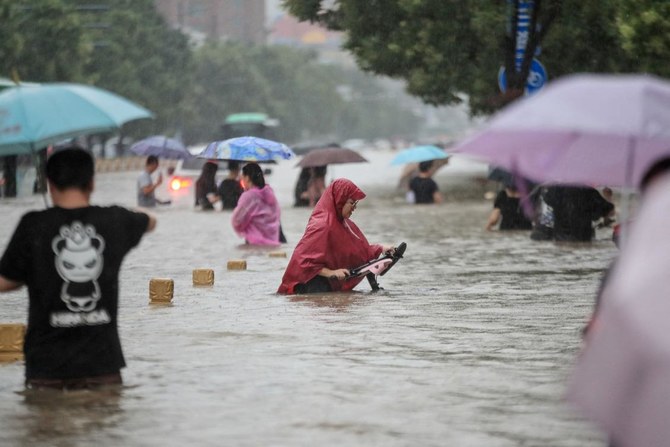
BEIJING: Large swathes of China’s central Henan province were under water on Wednesday, with at least a dozen people dead in its capital Zhengzhou after the city was drenched by what weather watchers said was the heaviest rain in 1,000 years.
With more rain forecast across Henan for the next three days, the government of Zhengzhou, a city of over 12 million on the banks of the Yellow River, said 12 people were reported to have died in a flooded subway line, while more than 500 were pulled to safety.
Video on social media on Tuesday showed commuters chest-deep in murky floodwaters on a train in the dark and an underground station turned into a large, churning pool.
“The water reached my chest,” a survivor wrote on social media. “I was really scared, but the most terrifying thing was not the water, but the diminishing air supply in the carriage.”
Due to the rain, the authorities halted bus services, as the vehicles are powered by electricity, said a Zhengzhou resident surnamed Guo, who spent the night at his office.
“That’s why many people took the subway, and the tragedy happened,” Guo said.
From the evening of Saturday until late Tuesday, 617.1 millimeters (mm) of rain fell in Zhengzhou, about 650 kilometers southwest of Beijing. That’s almost on par with Zhengzhou’s annual average of 640.8mm.
The amount of rainfall in Zhengzhou witnessed over the three days was one seen only “once in a thousand years,” local media cited meteorologists as saying.
The lives of millions of people in Henan, a province with a population of around 100 million, have been upended in an unusually active rainy season that has led to the rapid rise of a number of rivers in the vast Yellow River basin.
Many train services across Henan, a major logistics hub in central China, have been suspended. Many highways have also been closed and flights delayed or canceled.
Roads in a dozen cities have been severely flooded.
“Flood prevention efforts have become very difficult,” President Xi Jinping said on Wednesday, addressing the situation in a statement broadcast by state television.
Dozens of reservoirs and dams also breached warning levels.
Local authorities said the rainfall had caused a 20-meter breach in the Yihetan dam in Luoyang city west of Zhengzhou, and that the dam “could collapse at any time.”
In Zhengzhou, the local flood control headquarters said the city’s Guojiazui reservoir had been breached but there was no dam failure yet.
About 100,000 people in the city have been evacuated to safe zones.
Taiwanese technology giant Foxconn operates a plant on the outskirts of Zhengzhou, next to the city’s airport, that assembles iPhones for Apple. It said there was no direct impact on its facility, but had activated an emergency response plan.
SAIC Motor, China’s largest automaker, said logistics at its Zhengzhou plant would see some short-term impact, while Japan’s Nissan said production at its Zhengzhou factory had been temporarily suspended.
Zhengzhou’s transportation system remained paralyzed, with schools and hospitals cut off by waterlogging. Some children have been trapped in their kindergartens since Tuesday.
Residents caught in the flood had taken shelter in libraries, cinemas and even museums.


Central China’s Henan province swamped after heaviest rain in 1,000 years
https://arab.news/9dzz4
Central China’s Henan province swamped after heaviest rain in 1,000 years

- The lives of millions of people in Henan have been upended in an unusually active rainy season


US designates Afghanistan as ‘state sponsor of wrongful detention’
- “The Taliban continues to use terrorist tactics, kidnapping individuals for ransom or to seek policy concessions,” Rubio says
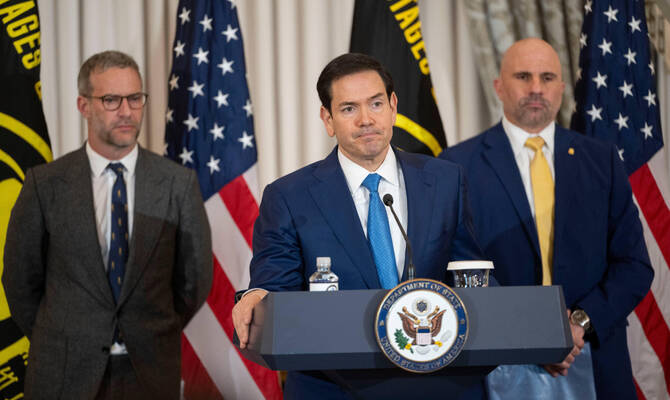
WASHINGTON, United States: US Secretary of State Marco Rubio announced Monday he has designated Afghanistan as a “State Sponsor of Wrongful Detention,” demanding Taliban authorities release two Americans and commit to ending its “hostage diplomacy.”
The move comes just over a week after Iran became the first country added to Washington’s new “wrongful detention” blacklist.
President Donald Trump in September signed an executive order that created the blacklist, similar to designations by the United States on terrorism.
“The Taliban continues to use terrorist tactics, kidnapping individuals for ransom or to seek policy concessions,” Rubio said in a statement.
He said it was “not safe for Americans to travel to Afghanistan because the Taliban continues to unjustly detain our fellow Americans and other foreign nationals.”
“The Taliban needs to release Dennis Coyle, Mahmoud Habibi, and all Americans unjustly detained in Afghanistan now and commit to cease the practice of hostage diplomacy forever,” he added.
Habibi, an Afghan-American businessman, previously served as Afghanistan’s director of civil aviation.
He was arrested in August 2022 in Kabul along with dozens of other employees of his telecommunications company, according to US authorities.
The State Department has issued a reward of $5 million for information leading to Habibi’s return.
Coyle is an academic from Colorado who worked for two decades in Afghanistan before being detained in January 2025, according to the James Foley Foundation.