

Iran orders week-long shutdown in Tehran amid fifth COVID wave

1 / 3
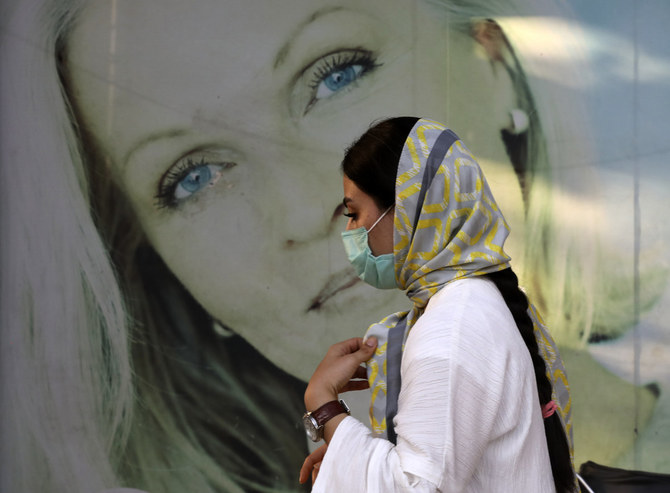
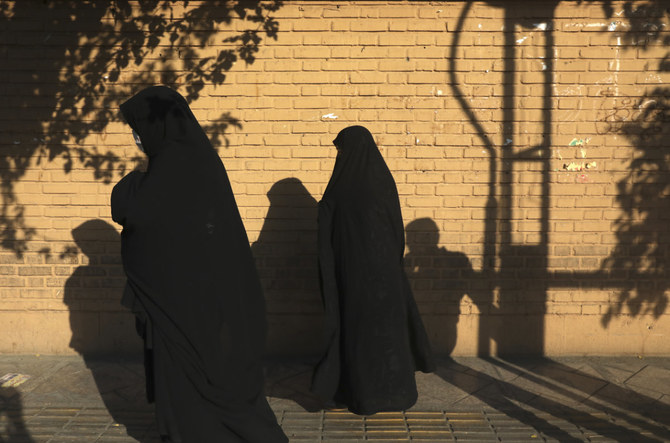
Tehran and its surroundings went into a week-long lockdown amid another surge in the pandemic. (AP Photo/Vahid Salemi)
2 / 3
Tehran and its surroundings went into a week-long lockdown amid another surge in the pandemic. (AP Photo/Vahid Salemi)
3 / 3
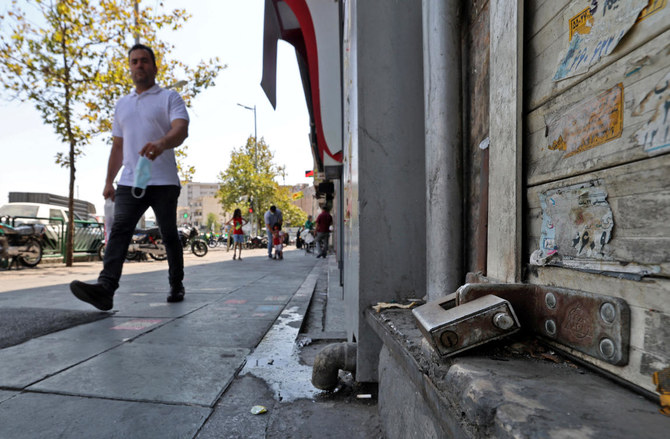
The lockdown affects Tehran and Alborz provinces, with only essential businesses allowed to stay open. (AFP)
Short Url
Updated 21 July 2021
Follow

Iran orders week-long shutdown in Tehran amid fifth COVID wave

  • The lockdown affects Tehran and Alborz provinces
  • Iran, the hotspot of the pandemic in the Middle East, reported 27,444 new cases on Tuesday

JEDDAH: The Iranian regime imposed a one-week lockdown in Tehran and the neighboring Alborz province on Tuesday amid a record daily number of COVID-19 cases.

Health chiefs reported 27,444 new cases on Tuesday, breaking the record of 25,582 on April 14. The death toll rose by 250 to 87,624.

Iranians are already enduring the deadliest coronavirus outbreak in the Middle East, with more than 3.5 million cases.

Authorities have admitted that the official figures do not account for all cases, and President Hassan Rouhani has warned of a “fifth wave” driven by the aggressive delta variant.

The national virus taskforce ordered all but essential businesses to close for the next six days, the first time such a step has been taken.

Iran has so far avoided imposing a full nationwide lockdown, instead imposing limited measures such as temporary travel bans and business closures.

Offices, banks, shopping malls, cinemas and sports facilities in Tehran were all closed on Tuesday. There was limited traffic and the streets were almost empty of pedestrians.

Mehdi, an employee at a trade company, was skeptical the restrictions would curb infections.

“It won’t be effective,” he said. “If people stay at home and don’t go anywhere, it might — but as soon as there’s a holiday, everyone starts traveling.”

Iran celebrates the Eid Al-Adha holiday on Wednesday.

The new restrictions include a ban on road travel between Tehran and Alborz provinces. Traffic police blocked roads leading north to popular holiday destinations on Tuesday, but there was heavy traffic on Monday night as residents tried to leave the capital.

Iran has pinned its hopes on vaccinations to help combat the pandemic, but its inoculation campaign since early February has progressed slowly.

Just over 6.9 million people have received a first dose, and only 2.3 million people have received the necessary two jabs from a population of 83 million.

Crippled by US sanctions that have made it difficult to transfer money to foreign companies, Iran says it is struggling to import vaccines.

Health authorities have approved the emergency use of two locally produced vaccines, with the only mass-produced one, COVIran Barekat, still in short supply.

The regime has been accused on social media of mismanagement over the slow vaccination drive.

Moslem, a car mechanic in Tehran, said he believed vaccinations were the only real solution. “But it is not being done,” he said.

(With Reuters)


Iran FM criticizes Israel for ‘doctrine of domination’

Updated 8 sec ago
Follow

Iran FM criticizes Israel for ‘doctrine of domination’

  • Doctrine allows Israel to expand its military arsenal while pressuring other countries in the region to disarm
  • His remarks came a day after renewed nuclear talks with Washington in Oman
DOHA: Iran’s Foreign Minister Abbas Araghchi on Saturday criticized what he said was a “doctrine of domination” that allows Israel to expand its military arsenal while pressuring other countries in the region to disarm.
His remarks came a day after renewed nuclear talks with Washington, with previous talks collapsing when Israel launched an unprecedented bombing campaign against Iran last June that triggered a 12-day war.
Araghchi was speaking at the Al Jazeera Forum conference in Qatar but made no reference to Friday’s talks with the United States.
“Israel’s expansionist project requires that neighboring countries be weakened: militarily, technologically, economically and socially,” Araghchi said.
“Under this project Israel is free to expand its military arsenal without limits ... Yet other countries are demanded to disarm. Others are pressured to reduce defensive capacity. Others are punished for scientific progress,” he added.
“This is a doctrine of domination.”
During the 12-day war Israel targeted senior Iranian military officials, nuclear scientists and sites as well as residential areas, with the US later launching its own attacks on key nuclear facilities.
Iran responded at the time with drone and missile attacks on Israel, as well as by targeting the largest US military base in the Middle East, located in Qatar.
On Friday, Araghchi led the Iranian delegation in indirect nuclear talks with US Middle East envoy Steve Witkoff in Muscat.
The top Iranian diplomat later described the atmosphere as having been “very positive,” while US President Donald Trump said the talks were “very good,” with both sides agreeing to proceed with further negotiations.
The talks followed threats from Washington and its recent deployment of an aircraft carrier group to the region following Iran’s deadly crackdown on anti-government protests last month.
The United States has sought to address Iran’s ballistic missile program and its support for militant groups in the region — issues which Israel has pushed to include in the talks, according to media reports.
Tehran has repeatedly rejected expanding the scope of negotiations beyond the nuclear issue.