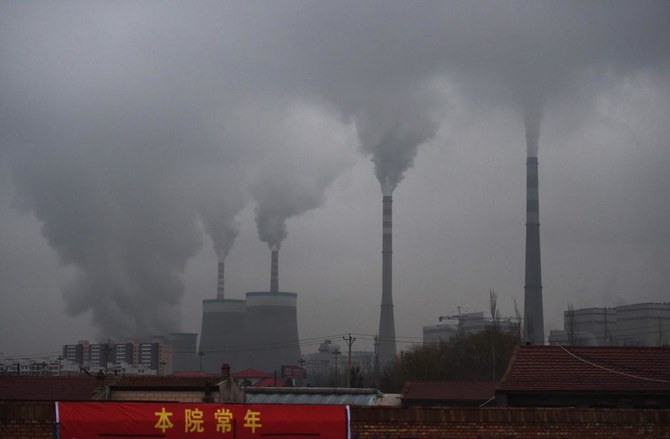
RIYADH: Rising consumption in the wake of the COVID-19 pandemic is set to drive greenhouse gas emissions to all-time highs, the International Energy Agency said on Tuesday.
“We estimate that full and timely implementation of the economic recovery measures announced to date would result in CO2 emissions climbing to record levels in 2023, continuing to rise thereafter,” it said.
Governments worldwide have allocated around $380 billion on clean energy measures as of the second quarter of 2021 — representing about 2 percent of the total fiscal support in response to COVID-19, the Paris based body said in a report.
It coincides with a major push by global oil companies to reduce emissions and invest in the renewables sector.
The IEA estimates that government spending and new policies put in place since last year are expected to add an extra $350 billion a year to clean energy and electricity network spending between 2021 and 2023.
Although this represents an increase of 30 percent over the levels seen in recent years it is still only 35 percent of the amount envisaged by the IEA Sustainable Recovery Plan to put the world on track for net-zero emissions by 2050.
“Since COVID-19 crisis erupted, many governments may have talked about the importance of building back better for a cleaner future, but many of them are yet to put their money where their mouth is,” said IEA Executive Director Fatih Birol.
The IEA said investment proposals from G20 nations would likely meet about 60 percent of the spending needed to allow the Paris temperature goals to be attainable.
Among developing nations, that dropped to 20 percent.
Last month the IEA published its clean investment report, which found that annual green investment would need to rise to more than $1 trillion by 2030 from less than $150 billion in 2020 if the world is to reach carbon neutrality by 2050.

Pandemic rebound to push emissions to all time high says IEA
https://arab.news/wsfr5
Pandemic rebound to push emissions to all time high says IEA
- It coincides with a major push by global oil companies to reduce emissions and invest in the renewables sector
Qatar CPI falls in January, annual inflation rises 2.28%
JEDDAH: Qatar’s consumer price index climbed 2.28 percent in January from a year earlier, official data showed, while registering a 2.22 percent drop from the previous month.
The decline from December was led by an 11.97 percent drop in recreation and culture prices, alongside decreases in miscellaneous goods and services, restaurants and hotels, clothing, food and housing-related costs, Qatar News Agency reported, citing data from the National Planning Council.
This was followed by miscellaneous goods and services at 3.46 percent, restaurants and hotels at 1.90 percent, clothing and footwear at 1.15 percent, food and beverages at 0.59 percent, and housing, water, electricity, gas, and other fuels at 0.17 percent.
Qatar’s inflation remains relatively contained compared with wider global price swings, helped by stable housing costs and government subsidies. Across the region, trends are mixed, with Saudi inflation easing to 1.8 percent in January while Egypt’s annual rate slowed to 10.1 percent even as monthly prices jumped.
“The annual increase, comparing January 2026 with the same month in 2025, was driven by rises in eight groups,” QNA reported, noting that the largest year-on-year increases were seen in miscellaneous goods and services, which rose 12.40 percent.
Price increases were observed in the transport group at 0.54 percent, followed by communication at 0.32 percent and health at 0.27 percent. Furniture and household equipment rose 0.20 percent and education edged up 0.06 percent, while tobacco recorded no change.
This was followed by recreation and culture at 4.90 percent and clothing and footwear at 3.25 percent. Food and beverages rose 2.87 percent, furniture and household equipment 2.37 percent, education 2.08 percent, housing and utilities 1.21 percent, and communication 0.40 percent.
In contrast, QNA further reported, three groups saw annual declines: restaurants and hotels, down 2 percent; health, down 1.38 percent; and transport, down 0.48 percent, while the tobacco group remained unchanged.
“When calculating the CPI for January 2026 excluding the housing, water, electricity, gas, and other fuels group, the index reached 114.57 points, down by 2.65 percent compared with December 2025, and up by 2.51 percent compared with January 2025,” the QNA report added.
The index — which tracks inflation across 12 main expenditure groups covering 737 goods and services — is based on 2018 as the reference year, drawing on the Household Income and Expenditure Survey conducted in 2017–2018.