

Majority of COVID-19 misinformation came from 12 people

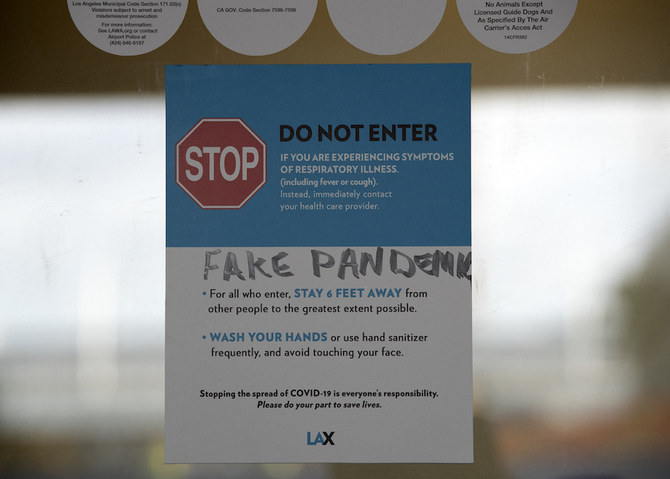
A sign about stopping the spread of COVID-19, the words "fake pandemic" written on it, is posted at Los Angeles International Airport (LAX) during the outbreak of the novel coronavirus. (File/AFP)
Short Url
Updated 20 July 2021
Follow

Majority of COVID-19 misinformation came from 12 people

  • The CCDH called on Facebook, Instagram, Twitter and YouTube to completely remove all content from the disinformation dozen

LONDON: The Center for Countering Digital Hate (CCDH) released a report on Monday citing that the vast majority of anti-vaccine misinformation and conspiracy theories regarding coronavirus disease (COVID-19) originated from just 12 people.

The CCDH report found that 12 online personalities, dubbed the “disinformation dozen,” have a combined 59 million followers across multiple social media platforms, with Facebook having the largest number of followers. 

The report further suggests that the disinformation dozen are responsible for 73 percent of all anti-vaccine content on Facebook despite the vaccine being deemed safe by the US government and drug regulators. 

The disinformation dozen include doctors who practice pseudoscience, a bodybuilder, a wellness blogger, a religious zealot, and, most notably, Robert F. Kennedy Jr., the nephew of former US President John F. Kennedy.

Kennedy Jr. has previously linked vaccines to autism and 5G broadband cellular networks to the COVID-19 pandemic. He has since been removed from Instagram but not from Facebook. 

The CCDH called on Facebook, Instagram, Twitter and YouTube to completely remove all content from the disinformation dozen who are believed to have been instrumental in creating vaccine hesitancy in the US. 

The report comes shortly after US President Joe Biden blamed the spread of COVID-19 misinformation on social media and said platforms like Facebook are “killing people.”

Meanwhile, Facebook on Saturday defended itself against Biden’s claims and asserted that it should not be blamed for the US missing its vaccine goals.


Media watchdog urges probe after gunmen attack home of Pakistani journalist

Updated 27 February 2026
Follow

Media watchdog urges probe after gunmen attack home of Pakistani journalist

  • Ihsan Khattak’s home came under fire by gunmen in February
  • CPJ, 17 rights groups say legal and other changes causing ‘fear’

LONDON: Media watchdog the Committee to Protect Journalists on Friday urged Pakistani authorities to investigate a shooting attack on the home of journalist Ihsan Khattak.

On Feb. 12, at about 9:45 p.m., unidentified gunmen opened fire on the main gate of Khattak’s house in Kotka Jandar Khel village in Khyber Pakhtunkhwa’s Bannu district. The assailants fled and Khattak was not injured.

“Pakistani authorities must thoroughly investigate the attack on Ihsan Khattak’s home, identify the gunmen, and hold them to account,” said the CPJ’s Asia-Pacific Director Beh Lih Yi.

“Khyber Pakhtunkhwa has become increasingly dangerous for journalists and this type of brazen intimidation cannot stand. Journalists must be able to work safely so they can provide the public with information.”

Khattak, a Bannu-based correspondent for ARY News and former president of the Bannu Press Club, has faced threats before.

On Feb. 5, three armed men on a motorbike followed him from a reporting assignment, forcing him to speed away in his car, he told the CPJ.

In 2017, after receiving threats from an unknown caller, he relocated to Islamabad. He said the threats resumed after he returned to Bannu in 2023.

Bannu Deputy Inspector General of Police Sajjad Khan told the CPJ that an investigation had been opened into the shooting and that police were committed to ensuring journalists’ security.

The incident comes as the CPJ and 17 other press freedom and human rights groups this week urged Prime Minister Shehbaz Sharif to take urgent steps to “uphold the country’s constitutional and international obligations” to protect media freedom.

They warned that recent legal and institutional changes, combined with “persistent failures” to hold perpetrators accountable, have deepened a climate of fear for journalists.

Pakistan, ranked 158th in the 2025 press freedom index, is considered one of the world’s most dangerous countries for journalists, with growing self-censorship, digital controls and widespread impunity for attacks on media workers.

The appeal also follows a sharp escalation in regional tensions: on Friday, Pakistan said it had carried out strikes on Taliban government forces in several Afghan cities — its first direct attacks on its former allies —describing the situation as “open war.”