


DUBAI: Carlos Ghosn, the fugitive motor-industry mogul, wants to stand trial in a country he regards as more neutral than Japan, he told Arab News.
Ghosn, who fled Tokyo 18 months ago, said: “I think the end of it has to be in a trial, but a trial that takes place in a country which has no stake in what is being tried. The only thing I’m asking is for a jurisdiction to be fair and neutral and not to be politically motivated. That’s all.”
In the course of a wide–ranging interview, the former boss of Japan’s Nissan and France’s Renault talked of how he was “abandoned” by the French government after it “surrendered” to Japan; his advice on how Lebanon — where he is currently seeking refuge from international law enforcement — can get out of its dire economic and political crisis; and his views on the Vision 2030 reform strategy in Saudi Arabia.
In conversation on the “Frankly Speaking” series of video interviews with leading policymakers and business people, he also gave his view on the intense rivalry between Nissan and Toyota in the Middle East.
Ghosn’s most savage criticism was of the Japanese legal system, after he was arrested and imprisoned on charges of financial irregularity at the Nissan Motor Co., where he was chairman.
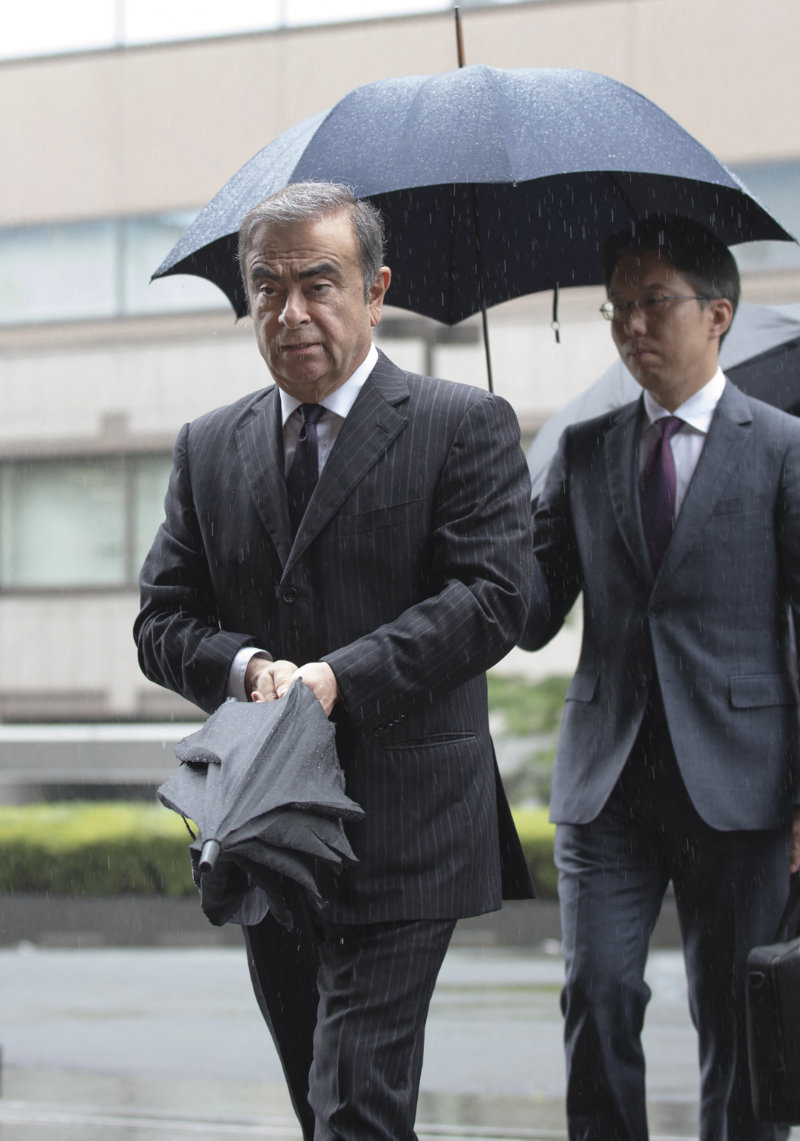
Carlos Ghosn arrives for a pre-trial hearing at the Tokyo District Court in Tokyo on June 24, 2019. (Kazuhiro Nogi / AFP file)
“Prosecutors prevailed 99.4 per cent of the time, which is unheard of and unseen, quite frankly. Even though I’d been living in Japan for 18 years, I never suspected this kind of score,” he said.
“But having gone through the system and seeing the kind of intimidation — confession seeking, pressures, violation of human rights etc. — I am even surprised that they get only 99.4 per cent of confessions. I wonder how the other 0.6 per cent were able to resist when you look at the arsenal of arguments and things that they put against you.”
Japan’s justice system has been labeled “hostage justice” by the UN, he said, adding: “I’m ready to go to Japan the day they change their ‘hostage justice’ system.”
He said that he “felt bad” for people on trial in Japan, including his former lawyer, Greg Kelly. “I was lucky to be able to get out before the systems locked me down for God knows how many years, but I feel bad for Greg Kelly,” he said.
Japanese prosecutors charged Ghosn with a variety of financial crimes, including inflating his salary, but he said his remuneration had been agreed by the Nissan board of directors on several occasions. “I deduced from this that they were happy, particularly knowing that dividends were paid, the company was growing, the company was profitable,” he said.
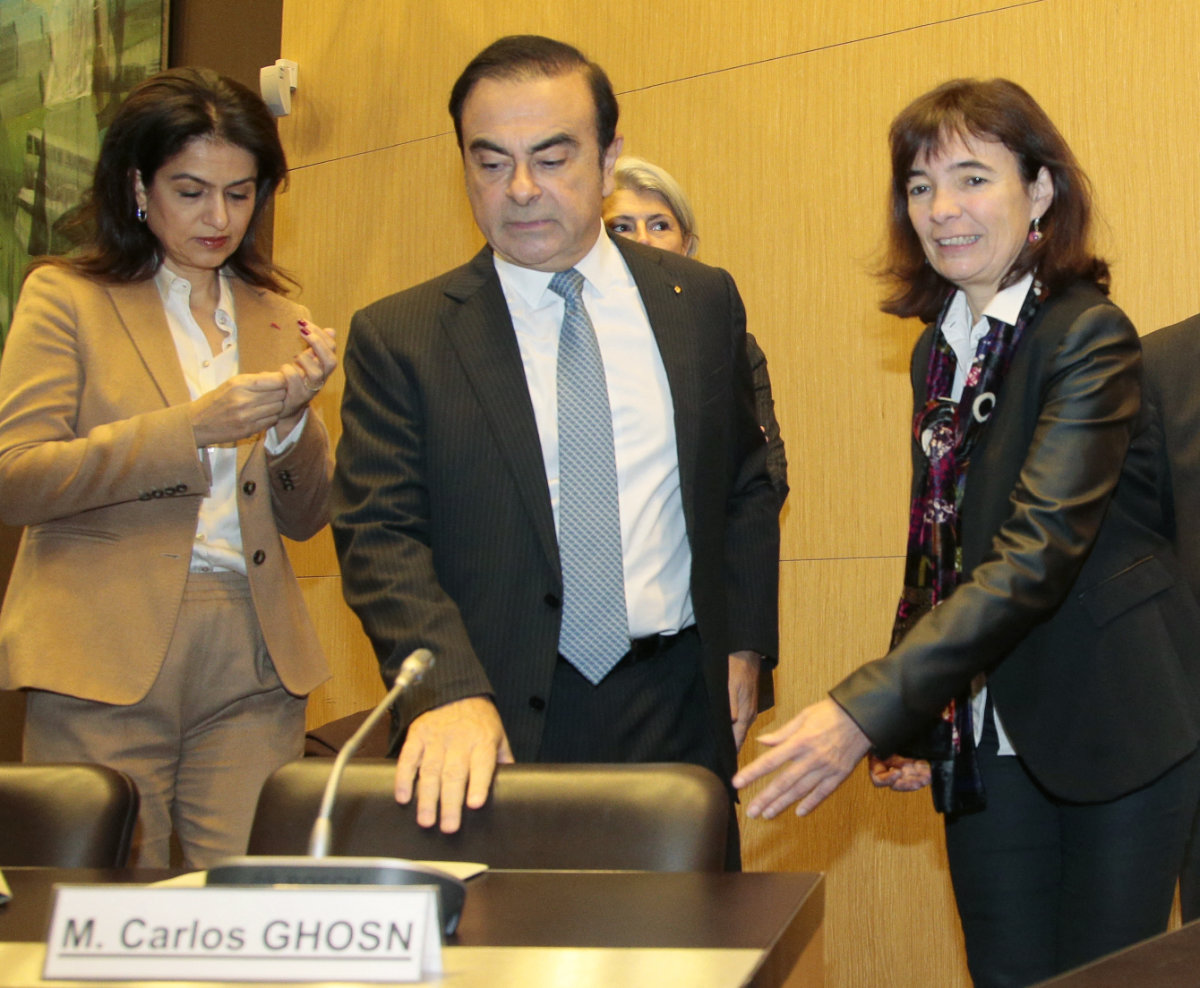
French carmaker Renault CEO Carlos Ghosn arrives on Feb. 17, 2016 at the French National Assembly, before addressing the Economical and Financial commissions during a hearing. (AFP file)
Ghosn — a French citizen as well as holding Lebanese and Brazilian nationality — was also scathing about the actions of the government of President Emmanuel Macron, which appeared to want to appease Tokyo over the future of the Nissan–Renault alliance.
“Instead of somehow getting good support, I was just abandoned, after two or three weeks of obvious conflict between France and Japan,” he said.
“But then the French surrendered, and they said it very clearly — you know we want to preserve the good relationship between Japan and France, we want to preserve the good relationship between Nissan and Renault, and we trust that Japanese justice will solve this problem with Carlos Ghosn,” he said.
Ghosn has lived in Lebanon since December 2019 with his wife Carole, and is subject to a “red notice” from Interpol at the request of the Japanese government. Lebanon does not extradite citizens.
“Lebanon asked for Japan to transmit the accusation and the charges so they could look into them and eventually try me in Lebanon. But Japan has refused to do so,” he said.
Although there was “zero chance” of him becoming involved directly in Lebanese politics, including considering any offer to become the next president, Ghosn said that he was aware of “the misery brought on the country by the financial collapse, the economic recession with all its social consequences.”
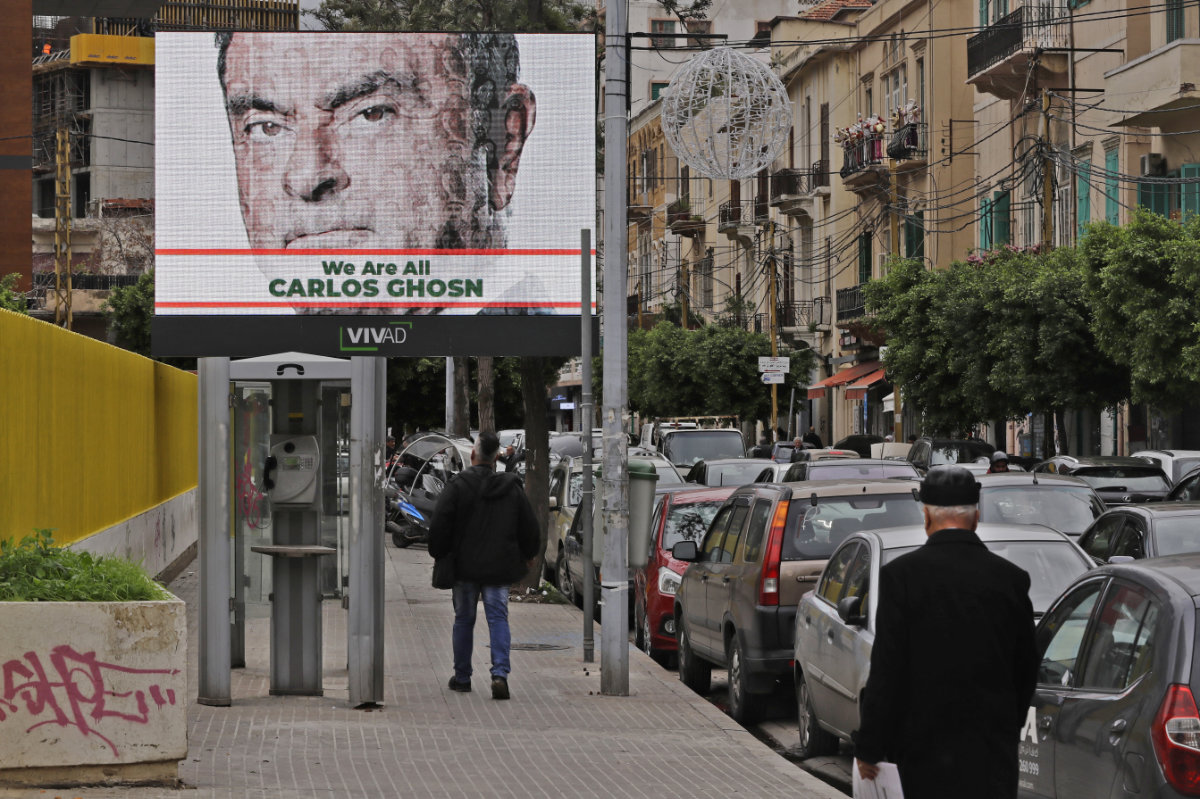
A portrait of ousted Nissan chairman Carlos Ghosn is seen on a publicity billboard in his support at a street in Beirut on December 6, 2018. (Joseph Eid / AFP)
He would “support, help, guide, advise whoever is interested to limit the suffering that people around us are going through,” he said.
“Having turned around many companies, I know by practice that whatever solution you bring when you have to turn around a company, or a country, five percent is the strategy, and 95 percent is execution,” he said. “So somehow those who will save the country are those who are in power and put in power by the Lebanese people, because frankly, the methods and the strategy to get out are pretty simple, and they have been (tried) in many countries (and) many companies.”
He also offered his view on the Vision 2030 reform strategy in Saudi Arabia. “I think that makes a lot of sense — transforming a country from being overly reliant on a couple of resources, to have different sources of revenues, and different sources of income, and different sorts of activity for employment,” he said.
Ghosn cautioned that the challenge for Saudi policymakers lies in the implementation of that strategy. “The success of this depends on how disciplined it’s is going to be — the execution, how focused (it is) going to be, the people in charge of delivering on this, and how serious they’re going to be about gathering the maximum level of talents into transforming the reality of Saudi Arabia.
“Saudi Arabia is a very rich country. It benefits from a lot of resources, but I think the people in charge of the country know that it’s not going to last forever. So, in my opinion they’re doing the right thing and I hope that will be successful,” he said.
From his perspective as a global expert in the motor business, he said that the difference between the Nissan business and the dominant Toyota operation in the Kingdom lay in the strength of the distribution network Toyota has built there in partnership with the Abdul Latif Jameel group.
“They have probably one of the best distributors in the world located in Saudi Arabia, so it’s going to be very difficult to fight if they (Nissan) don’t have people even approaching this level now,” he said.
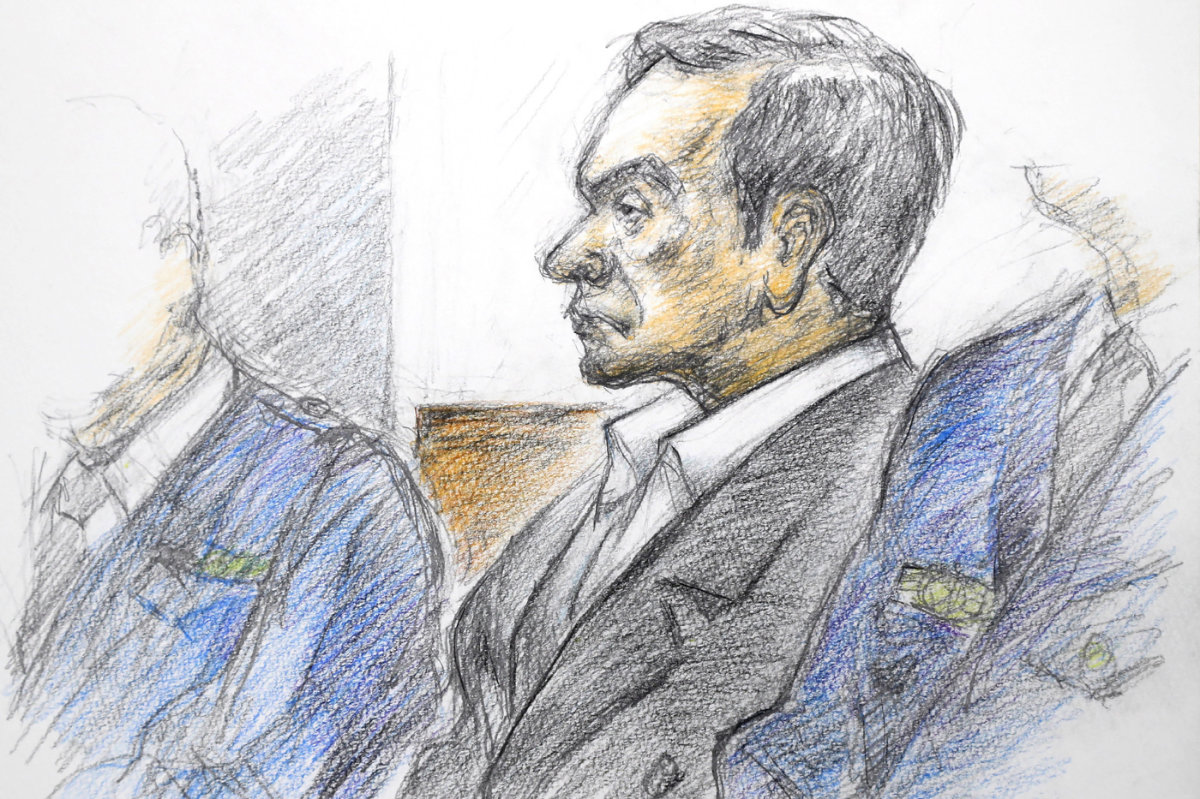
This courtroom sketch illustrated by Masato Yamashita depicts former Nissan chairman Carlos Ghosn attending his hearing at the Tokyo district court on January 8, 2019. (JIJI PRESS via AFP/file)
He added that he thought the Nissan–Renault–Mitsubishi alliance, which he was developing in the global motor industry, was doomed to fall apart.
“Frankly everything I’m seeing today makes me see the alliance as a zombie — that means it looks like it’s living matter, but in fact, inside nothing is happening. So, I’m not very optimistic when it comes to the future of this alliance. I hope I’m wrong but I will bet you that within the next five years this whole thing is going to totally unravel,” he said.
Ghosn cooperated in the making by Saudi media company MBC of a full–length documentary, “The Last Flight,” describing his dramatic escape from Japan in a large musical-instrument box on board a private jet, and analyzing the events leading up to it, which was released last week.
“I think there was a clear motivation from MBC to do it. They were the first one to come to me and say we would like your cooperation to do something like this, and they were very straightforward and honest about it,” he said.
Ghosn is planning further publicity initiatives, on top of legal action against his former employers.
“I want to leave something in order to help re-establish my reputation, on top of what I’ll be doing from a legal point of view. But I have no intention to come back to the high-flying life I had before,” he said.
_____________________
• Twitter: @frankkanedubai


