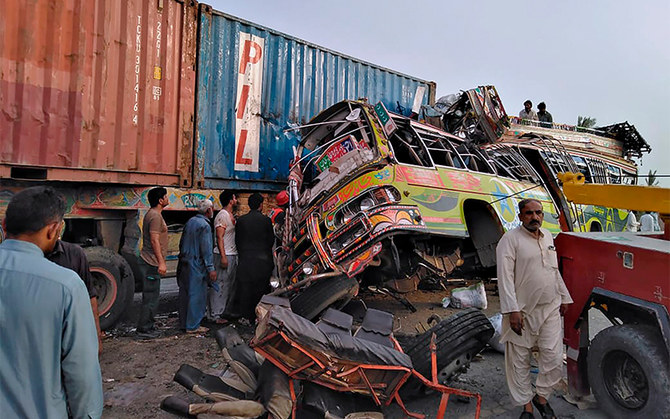
Bus crashes in Pakistan, killing 33 people and injuring 40 

Residents and rescue workers at the site of a deadly bus accident near Dera Ghazi Khan, Pakistan, on July 19, 2021. (Photo courtesy: Punjab Province's Emergency Service Rescue 1122 via AP)
Short Url
Updated 19 July 2021
Follow

Bus crashes in Pakistan, killing 33 people and injuring 40 

  • Speeding bus was carrying mostly laborers traveling home for the Eid holiday 
  • It rammed into a container truck on a busy highway in central Pakistan on Monday 

MULTAN: A speeding bus carrying mostly laborers traveling home for a major Muslim holiday rammed into a container truck on a busy highway in central Pakistan on Monday, killing at least 33 people and injuring 40, police and rescue officials said.
The bus had left the city of Sialkot and was traveling on Taunsa Road; its destination was the city of Dera Ghazi Khan in eastern Punjab province, said senior police officer Hassan Javed. The exact cause of the accident is still under investigation, he said.
Rescuers transported the dead and injured to a nearby hospital. According to Sher Khan who was in charge of the rescue team at the site, some of the injured were in critical condition. He said the bus driver was among the 33 killed in the accident.
Khan said the passengers were traveling to their home district of Rajanpur to celebrate the upcoming Eid Al-Adha feast.
TV footage and photos circulating on social media showed rescuers trying to pull out bodies from the badly mangled bus. In one image, some of the injured are seen sitting near the bus, waiting for medical help.
Pakistan’s Information Minister Fawad Chaudhry expressed his condolences on Twitter and advised public transport drivers to be more careful of the lives of the people they have been entrusted with.
“When will we as a nation realize that the violation of traffic rules is fatal,” he said.
Deadly accidents are common in Pakistan due to poor road infrastructure and disregard for traffic laws.


Pakistan says IMF has not imposed new conditions under $7 billion bailout

Updated 4 sec ago
Follow

Pakistan says IMF has not imposed new conditions under $7 billion bailout

  • Finance ministry says measures cited as ‘new conditions’ are phased extensions of reforms already agreed
  • Media described steps like civil servants’ asset disclosures and sugar industry deregulation as new demands

ISLAMABAD: Pakistan said on Sunday some of the reform measures mentioned in the media and linked to the International Monetary Fund (IMF) bailout program are not “new conditions” imposed by the lender but extensions of commitments already agreed under the arrangement.

Local media and social platforms have described a series of IMF-linked structural benchmarks as fresh conditions under the $7 billion loan for Pakistan in recent weeks. News reports published and broadcast in India also mentioned 11 measures under the loan, describing them as new IMF demands imposed on the country.

“The Ministry of Finance has clarified the intent, context, and continuity of reform measures under Pakistan’s IMF Extended Fund Facility (EFF) program, particularly in response to recent commentary regarding so-called ‘new conditions,’” said an official statement circulated in Islamabad.

“The purpose is to reaffirm that the measures referenced are part of a phased, medium-term reform agenda agreed with the IMF, many of which are extensions or logical progressions of reforms already initiated by the Government of Pakistan,” it added.

The ministry said the EFF is designed to support medium-term structural reforms implemented in a sequenced manner, with each program review building on prior actions to meet policy objectives agreed at the outset.

It provided detailed clarification on 11 measures that had been characterized as new conditions, including public disclosure of asset declarations of civil servants, strengthening the operational effectiveness of the National Accountability Bureau, empowering provincial anti-corruption bodies through access to financial intelligence and facilitating foreign remittances.

Other measures cited included the development of the local currency bond market, deregulation of the sugar industry, a comprehensive reform roadmap for the Federal Board of Revenue, a medium-term tax reform strategy, phased privatization of power distribution companies, regulatory reforms to strengthen corporate compliance and contingency measures to address potential revenue shortfalls.

The ministry said several of these reforms had been embedded in the Memorandum of Economic and Financial Policies (MEFP), a document detailing mutually agreed commitments, dating back to May 2024 and March 2025, including pledges related to tax policy, governance, energy sector restructuring and revenue mobilization.

“During discussions and negotiations with the IMF, the Government of Pakistan presents its planned policy reform initiatives,” the statement added. “Where the IMF assesses that these initiatives contribute to the agreed program objectives, they are incorporated into the MEFP.”

“As a result,” it continued, “many of the structural benchmarks and actions included in the latest MEFP are derived from reforms already undertaken or initiated by the Government of Pakistan, rather than being externally imposed or newly introduced conditions.”

The statement noted the measures outlined in the latest MEFP represent “continuity, sequencing and deepening of Pakistan’s agreed reform agenda” under the IMF loan, rather than the “imposition of abrupt or unprecedented conditions.”