

OPEC+ members agree to raise output by 400,000 barrels a day from August

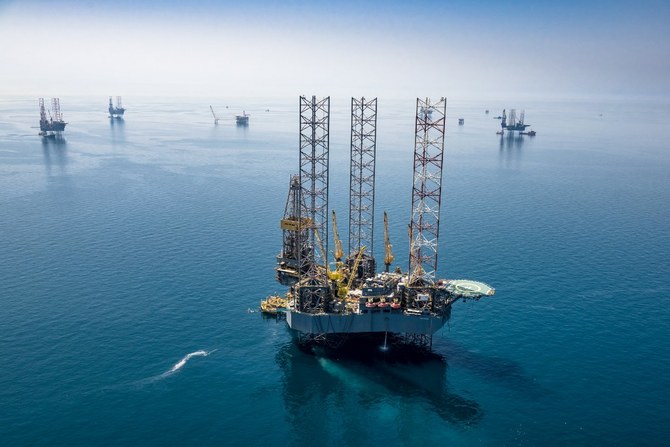
The OPEC+ group agreed new production allocations from May 2022. (Aramco/File)
Short Url
Updated 19 July 2021
Follow

OPEC+ members agree to raise output by 400,000 barrels a day from August

  • Special meeting also saw agreement on new baseline levels, extension of current strategy until the end of 2022

DUBAI: OPEC+, the oil producers alliance led by Saudi Arabia and Russia, has agreed a schedule of output increases to meet growing demand as the global economy recovers from the pandemic recession.

A special meeting arranged in Vienna endorsed the plans, which will see an extra 400,000 barrels a month come on to world markets from the beginning of next month, and will allow some producers — including Saudi Arabia and the UAE — to increase the baseline from which they calculate production.

The deal will also extend the current OPEC+ alliance beyond its original term next April until at least the end of 2022. “OPEC+ is here to stay,” Prince Abdul Aziz bin Salman, the Saudi energy minister, told journalists after the deal was announced.

We are working with the UAE, and we see eye to eye with them.

Prince Abdul Aziz bin Salman, Saudi energy minister

On the negotiations that ended the deadlock of last week when an OPEC+ meeting was canceled, the prince said: “Consensus-building is an art.”

The successful conclusion will allay suggestions in some quarters of a split in OPEC+ ranks. Suhail Al-Mazrouei, the energy minister of the UAE, said: “I can confirm the UAE is committed to OPEC+ and will always work with it and within it. We’ll always remain very good friends.”

Prince Abdulaziz underlined the unity in the group when he read a message from Alexander Novak, deputy prime minister of Russia and OPEC+ co-chairman, which stated that Russia was “ready to support anything” the Saudi minister said to the meeting.

“There is no way to demonstrate trust any more than this,” the prince said.

Opinion

This section contains relevant reference points, placed in (Opinion field)

Under the new terms, output will increase by 400,000 barrels per month until the full production cut of 5.8 million barrels is returned to global markets.

The regime of monthly meetings of OPEC+ ministers to monitor global markets will continue until the end of next year, but the producers hope to be able to phase out all cuts by September 2022, OPEC+ said.

In addition, the baseline calculations for production adjustment will be reassessed, and new ones will take effect from next May.

The UAE will see its baseline rise from 3.17 million barrels per day (bpd) to 3.5 million bpd — satisfying its main concern about the new proposals. Saudi Arabia and Russia will both see their baselines rise from 11 million bpd to 11.5 million bpd. Iraq and Kuwait will also be allowed to produce more.

OPEC+ said that there was an “ongoing strengthening of market fundamentals, with oil demand showing clear signs of improvement and OECD stocks falling as the economic recovery continued in most parts of the world as vaccination programs accelerated.”

I can confirm the UAE is committed to OPEC+.

Suhail Al-Mazrouei, UAE energy minister

The meeting also stressed the “critical importance” of adhering to full conformity with the new levels, and compensating by the end of September for any past overproduction. Compliance in June was once again historically high, at 113 percent.

The Saudi and UAE ministers stressed that they were working together on the strategy to advance energy transition via the adoption of renewables and other cleaner fuels and technologies. “We are working with the UAE, and we see eye to eye with them. We’re going about it in exactly the same way,” Prince Abdulaziz said.

The deal — which ends a period of uncertainty in global oil markets — was welcomed by energy experts.

Robin Mills, chief executive of Qamar Energy consultancy, told Arab News: “This is a good deal for OPEC+. It holds the deal together and addresses the baseline issue for the future from all the countries that had issues. The countries that didn’t get baseline increases probably couldn’t have used them anyway.”

International oil markets last traded on Friday, with Brent ending at $73.30 per barrel. The next OPEC+ meeting, the 20th time the alliance ministers have met, will take place on Sept. 1.


First EU–Saudi roundtable on critical raw materials reflects shared policy commitment

Updated 16 January 2026
Follow

First EU–Saudi roundtable on critical raw materials reflects shared policy commitment

RIYADH: The EU–Saudi Arabia Business and Investment Dialogue on Advancing Critical Raw Materials Value Chains, held in Riyadh as part of the Future Minerals Forum, brought together senior policymakers, industry leaders, and investors to advance strategic cooperation across critical raw materials value chains.

Organized under a Team Europe approach by the EU–GCC Cooperation on Green Transition Project, in coordination with the EU Delegation to Saudi Arabia, the European Chamber of Commerce in the Kingdom and in close cooperation with FMF, the dialogue provided a high-level platform to explore European actions under the EU Critical Raw Materials Act and ResourceEU alongside the Kingdom’s aspirations for minerals, industrial, and investment priorities.

This is in line with Saudi Vision 2030 and broader regional ambitions across the GCC, MENA, and Africa.

ResourceEU is the EU’s new strategic action plan, launched in late 2025, to secure a reliable supply of critical raw materials like lithium, rare earths, and cobalt, reducing dependency on single suppliers, such as China, by boosting domestic extraction, processing, recycling, stockpiling, and strategic partnerships with resource-rich nations.

The first ever EU–Saudi roundtable on critical raw materials was opened by the bloc’s Ambassador to the Kingdom, Christophe Farnaud, together with Saudi Deputy Minister for Mining Development Turki Al-Babtain, turning policy alignment into concrete cooperation.

Farnaud underlined the central role of international cooperation in the implementation of the EU’s critical raw materials policy framework.

“As the European Union advances the implementation of its Critical Raw Materials policy, international cooperation is indispensable to building secure, diversified, and sustainable value chains. Saudi Arabia is a key partner in this effort. This dialogue reflects our shared commitment to translate policy alignment into concrete business and investment cooperation that supports the green and digital transitions,” said the ambassador.

Discussions focused on strengthening resilient, diversified, and responsible CRM supply chains that are essential to the green and digital transitions.

Participants explored concrete opportunities for EU–Saudi cooperation across the full value chain, including exploration, mining, and processing and refining, as well as recycling, downstream manufacturing, and the mobilization of private investment and sustainable finance, underpinned by high environmental, social, and governance standards.

From the Saudi side, the dialogue was framed as a key contribution to the Kingdom’s industrial transformation and long-term economic diversification agenda under Vision 2030, with a strong focus on responsible resource development and global market integration.

“Developing globally competitive mineral hubs and sustainable value chains is a central pillar of Saudi Vision 2030 and the Kingdom’s industrial transformation. Our engagement with the European Union through this dialogue to strengthen upstream and downstream integration, attract high-quality investment, and advance responsible mining and processing. Enhanced cooperation with the EU, capitalizing on the demand dynamics of the EU Critical Raw Materials Act, will be key to delivering long-term value for both sides,” said Al-Babtain.

Valere Moutarlier, deputy director-general for European industry decarbonization, and directorate-general for the internal market, industry, entrepreneurship and SMEs at European Commission, said the EU Critical Raw Materials Act and ResourceEU provided a clear framework to strengthen Europe’s resilience while deepening its cooperation with international partners.

“Cooperation with Saudi Arabia is essential to advancing secure, sustainable, and diversified critical raw materials value chains. Dialogues such as this play a key role in translating policy ambitions into concrete industrial and investment cooperation,” she added.