

Egypt seeks global push in Ethiopian dam talks

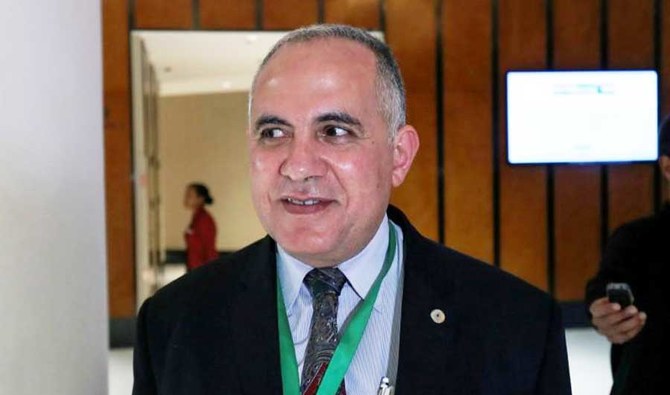
Egyptian Minister of Water Resource and Irrigation, Mohamed Abdel-Aty. (Reuters file photo)
Short Url
Updated 18 July 2021
Follow

Egypt seeks global push in Ethiopian dam talks

  • Egypt and Sudan ‘would not accept Addis Ababa’s unilateral decision to fill and operate the GERD dam’

CAIRO: Egypt is keen to complete the Grand Ethiopian Renaissance Dam (GERD) negotiations to reach a fair and binding legal agreement that meets the aspirations of all in the development, Minister of Irrigation Mohamed Abdel-Aty said.

Ethiopia is pinning its hopes of economic development and power generation on the GERD, but Egypt fears it will threaten its water supply from the Nile. Sudan is concerned about the dam’s safety and its own water flow.

During his visit to the Democratic Republic of Congo (DRC) on Friday Abdel-Aty stressed Egypt’s keenness to protect its water rights and achieve benefits for all in any agreement on the dam.

He highlighted a request by Cairo and Khartoum for the participation of the US, EU and UN in any GERD negotiations to maximize their chances of success, given the deadlock as a result of Ethiopia’s intransigence.

The minister said that Egypt and Sudan would not accept Addis Ababa’s unilateral decision to fill and operate the GERD dam.

Abdel-Aty said a high-tech rain forecast center to be set up in the DRC will help to study the effects of climate change and to identify measures to protect citizens from its risks.

He said Egypt has trained the staff at the center in the use of rain and flood forecasting systems, aerial image analysis, hydrologic modeling and technical reporting.

He said the establishment of this center stems from Egypt’s keenness to transfer its expertise in the field of integrated management of water resources to its “brothers from the Nile Basin countries” with the aim of maximizing the use of these resources.

Egypt, he said, has been providing and is still keen to provide all forms of support through bilateral cooperation projects with the Nile Basin countries.

He explained that Egypt has established several rainwater harvesting dams and underground water stations to provide clean drinking water in remote areas by using the solar energy technology in a large number of underground wells.

He said Egypt has established many farms, fisheries and river marinas with the aim of developing the surrounding areas economically, socially and environmentally, creating job opportunities, developing fishing conditions and reducing swamp areas, which reduces diseases.


Battle for the Nile
How will Egypt be impacted by Ethiopia filling its GERD reservoir ?

Enter


keywords


Iran war chokes aid corridors, obstructing global relief efforts

Updated 3 sec ago
Follow

Iran war chokes aid corridors, obstructing global relief efforts

  • “People in dire need of assistance ⁠will have to ⁠wait longer for food,” said Bauer
  • Tents, tarpaulins and lamps destined for Gaza and the West Bank have become stuck in the supply chain, the IOM said

GENEVA: Key humanitarian air, sea and land routes are being constricted by disruption from the war in the Middle East, delaying life-saving shipments to some of the world’s worst crises, 10 aid officials have told Reuters.
The US–Israeli war on Iran entered its seventh day on Friday, convulsing global markets and disrupting supply chains with airspace closures and the halt of shipping through the critical Strait of Hormuz.
Aid to Gaza and Sudan is grinding to a halt and costs are soaring for help to the hundreds of millions suffering hunger crises around the world.
“People in dire need of assistance ⁠will have to ⁠wait longer for food,” said Jean-Martin Bauer, Director of Food Security at the World Food Programme.
Already, tents, tarpaulins and lamps destined for the Israeli-occupied Palestinian territories of Gaza and the West Bank have become stuck in the supply chain, the International Organization for Migration said.

DUBAI AID HUB HOBBLED BY AIR AND SEA RESTRICTIONS
Aid groups say higher operational costs are straining budgets already facing massive donor cuts. The IOM said shipping firms were demanding emergency surcharges of approximately $3,000 per ⁠container.
Humanitarian groups stocking goods for rapid regional deployment at warehouses in Dubai’s Humanitarian Hub face challenges moving supplies onto transit routes.
The International Federation of Red Cross and Red Crescent Societies cannot move trauma kits to help the Iranian Red Crescent with search and rescue from its Dubai hub, where they sit in a estimated 1 million Swiss franc ($1.28 million) pre-positioned emergency stockpile, said Cecile Terraz, a director at the IFRC.
The group cannot move stock through Jebel Ali port — the region’s largest container terminal, which was set on fire by the debris of an intercepted missile — from where cargo normally moves onto planes or into the Strait of Hormuz.
The World Health Organization’s Dubai hub operations are also frozen, regional director Hanan Balkhy said, obstructing ⁠50 emergency requests from 25 ⁠countries and hampering operations such as polio vaccination.
Ripple effects farther afield are also likely.
Famine-struck Sudan is particularly exposed due to additional restrictions since February 28 on the Suez Canal and the Bab el-Mandeb Strait at the southern entrance to the Red Sea, the UNHCR said.
“We are particularly concerned about Africa,” said a spokeswoman, adding that some cargoes were being sent around the Cape of Good Hope. The route takes up to three weeks longer.
Costs for fuel, transportation and insurance are also rising, and Terraz said the IFRC may have to cut deliveries to the Iranian Red Crescent.
Emma Maspero, senior manager in Copenhagen of the supply division of the UN children’s body UNICEF, said she hoped flights carrying perishable humanitarian goods such as vaccines could be prioritized amid the airspace restrictions.