

The history of the Holy Kaaba

1 / 7
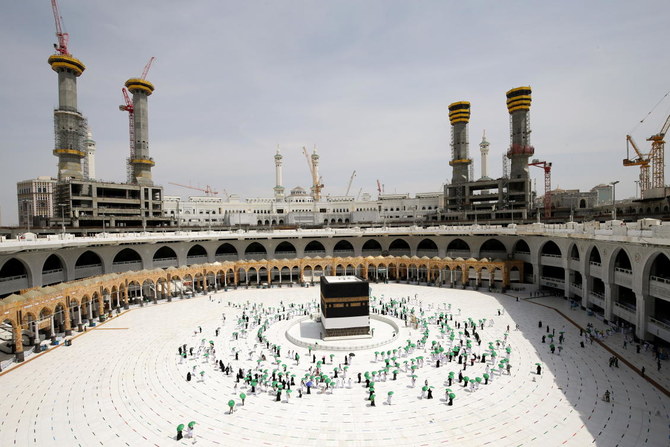
Muslim pilgrims perform tawaf around Kaaba in the Grand Mosque in the holy city of Makkah, Saudi Arabia July 17, 2021. (Reuters)
2 / 7
The holy Kaaba is seen as the first group of pilgrims perform tawaf at the Grand Mosque during the annual Hajj pilgrimage, in the holy city of Makkah, Saudi Arabia, July 17, 2021. (Reuters)
3 / 7
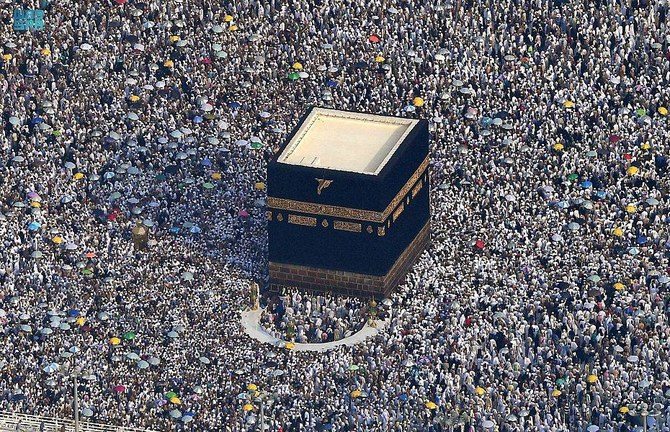
The holy Kaaba during a pre-pandemic Hajj. (File/SPA)
4 / 7
The holy Kaaba during a pre-pandemic Hajj. (File/SPA)
5 / 7
The holy Kaaba during a pre-pandemic Hajj. (File/SPA)
6 / 7
The holy Kaaba during a pre-pandemic Hajj. (File/SPA)
7 / 7
The holy Kaaba during a pre-pandemic Hajj. (File/SPA)
Short Url
Updated 17 July 2021
Follow

The history of the Holy Kaaba

  • In Islamic history, the Kaaba was built by Prophet Ibrahim and his son Ismail
  • The Quraysh reconstructed the pre-Islamic Kaaba around 608 C.E.

All Muslims seek to perform Hajj at least once in their lifetime. Hajj is the fifth pillar of Islam and is conditional — only for those who are able. The Kaaba, which means cube in Arabic, is 15 meters high and covered in black silk.
The mount where the Kaaba is located was a shrine and existed long before pre-Islamic times. In Islamic history, the Kaaba was built by Prophet Ibrahim and his son Ismail.


The Quraysh tribe, which ruled Makkah, reconstructed the pre-Islamic Kaaba around 608 C.E. with alternating stone and wood courses. 
A door was built above ground level to safeguard it from intruders and floods. The Black Stone, which Muslims aim to touch and kiss while performing Umrah and Hajj, and statues of pagan gods were kept in the pre-Islamic Kaaba.


In 620, Prophet Muhammad was expelled from Makkah and exiled to Yathrib, which is today known as Madinah. 
The shrine became the main site for Muslim prayer and pilgrimage after the prophet’s return to Makkah around 629 and 630. On his victorious return to Makkah, the prophet is said to have cleansed the Kaaba of idols, restoring the shrine to Prophet Ibrahim’s monotheism.


Muslims honor the Black Stone, which is said to have been sent to Prophet Ibrahim by the Angel Gabriel. In the year of his death, 632, Prophet Muhammad undertook his final journey, establishing the rites of pilgrimage.


Saudi Arabia pays Yemeni government $346.6m to meet salary shortfall

Updated 10 min 13 sec ago
Follow

Saudi Arabia pays Yemeni government $346.6m to meet salary shortfall

  • The payment is part of the Kingdom’s ongoing work to promote stability and development for the Yemenis

RIYADH: Saudi Arabia has provided $346.6 million (1.3 blln SAR) to help pay Yemeni government employees the massive shortfall in their salaries.

The payment, under a ruling by Saudi Arabia’s King Salman and crown prince Mohammed bin Salman, was delivered through the Saudi Program for Development and Reconstruction of Yemen (SDRPY).

The payment is part of the Kingdom’s ongoing work to promote stability and development for the Yemenis, the SDRPY said in a statement released on its X.com account.

The statement added that the initiative aimed to strengthen economic, financial and monetary stability in Yemen, enhance the capacity of government institutions, improve governance and transparency, and enable the private sector to drive sustainable economic growth.

Yemeni Presidential Leadership Council chairman Rashad Al-Alimi thanked the Saudi royals for the support, describing it as an extension of the Kingdom’s longstanding support for the Yemeni people.

And Al-Alimi said the support sent a message of confidence in Yemen’s path of recovery as well as the in the government’s ability to strengthen national institutions and reinforce security and stability.

Adding that Yemen’s ongoing partnership with Saudi Arabia represented an important choice for a more stable future.

And he called for a unified effort to support the reconstruction of the country’s instituions, as well as improve living conditions and advance economic and social development.