Ugandan weightlifter missing in Japan before Olympics

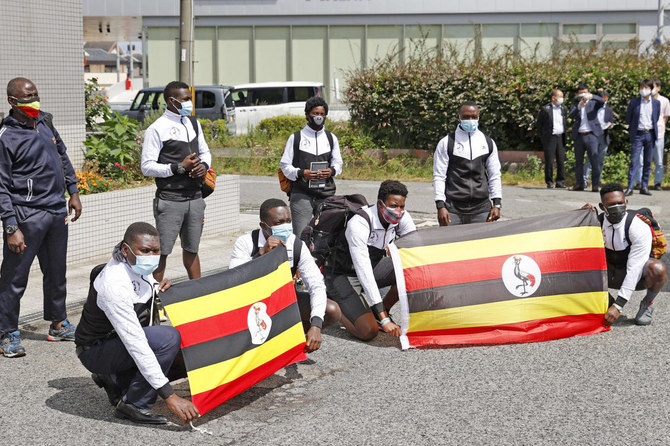
Ugandan Olympic delegation members pose with their national flags on arrival in Izumisano city, Osaka. A Ugandan athlete was reported missing by local officials Friday. (AP)
Short Url
Updated 16 July 2021
Follow

Ugandan weightlifter missing in Japan before Olympics

  • Julius Ssekitoleko, 20, failed to show up for a coronavirus test and was not in his hotel room
  • Ugandan sports officials said the athlete recently found out he wouldn’t compete at the Games due to quota system

TOKYO: A Ugandan weightlifter has gone missing during an Olympic training camp in Japan after learning he would not be able to compete, Japanese and Ugandan officials said Friday.
Authorities were searching for Julius Ssekitoleko, 20, who failed to show up for a coronavirus test and was not in his hotel room, host city Izumisano said in a statement.
Ugandan sports officials said the athlete had recently found out he would not be able to compete at the Games because of a quota system.
“One member of the Ugandan delegation, which the city received as a host town, has gone missing and cannot be reached,” the city near Osaka said in a statement.
“The city is making all efforts to search for the individual. We have reported the matter to police.”
The statement said Ssekitoleko was last seen shortly after midnight inside the hotel by a fellow athlete.
He failed to conduct a required PCR test by shortly after noon and the alarm was raised when he was not found in his hotel room.
Salim Musoke Ssenkungu, president of the Ugandan Weightlifting Federation, told AFP that Ssekitoleko had been training “very hard” for his first Olympic weightlifting competition but was told this week that he would not be allowed to compete and had to return home.
“If someone is there in Japan and is assuming he is going to compete but then gets bad news, of course he is going to be upset,” Ssenkungu said.
The young athlete had recently won a bronze in the Africa Weightlifting Championships and was considered experienced despite his youth, he added.
“He’s not from a rich family so it took a lot of interest and energy from him to be successful,” Ssenkungu said.
Donald Rukare, president of the Uganda Olympic Committee, said officials had only just been informed about the disappearance.
“We are also trying to find out (what happened). We are in contact with the team in Osaka,” he told AFP.
Uganda’s delegation arrived in Japan last month, headed for a pre-Games training camp in Izumisano, in Osaka region.
But a coach tested positive on arrival, and other delegation members were subsequently asked to self-isolate, with a second member later testing positive.
Virus cases are rising in Tokyo, which is under a state of emergency, and there is heavy scrutiny in Japan of infection risks linked to the Games.
Athletes and other Olympic participants are subject to strict rules including regular testing and limits on their movement.
Teams in training camps are limited to their hotels and training sites, and barred from moving around freely and interacting with local residents.
There have been claims however of some violations of the rules by Olympic participants and the government said Friday it had asked organizers to investigate and punish anyone found to be flouting the regulations.
The Games open in a week’s time, but spectators have been barred from all events in Tokyo and surrounding areas, and will be allowed into just a handful of venues outside the capital.


Arts festival’s decision to exclude Palestinian author spurs boycott

Randa Abdel Fattah. (Photo/Wikipedia)
Updated 12 January 2026
Follow

Arts festival’s decision to exclude Palestinian author spurs boycott

  • A Macquarie University academic who researches Islamophobia and Palestine, Abdel-Fattah responded saying it was “a blatant and shameless act of anti-Palestinian racism and censorship,” with her lawyers issuing a letter to the festival

SYDENY: A top Australian arts festival has seen ​the withdrawal of dozens of writers in a backlash against its decision to bar an Australian Palestinian author after the Bondi Beach mass shooting, as moves to curb antisemitism spur free speech concerns.
The shooting which killed 15 people at a Jewish Hanukkah celebration at Sydney’s Bondi Beach on Dec. 14 sparked nationwide calls to tackle antisemitism. Police say the alleged gunmen were inspired by Daesh.
The Adelaide Festival board said last Thursday it would disinvite Randa ‌Abdel-Fattah from February’s ‌Writers Week in the state of South Australia because “it ‌would not ​be ‌culturally sensitive to continue to program her at this unprecedented time so soon after Bondi.”

FASTFACTS

• Abdel-Fattah responded, saying it was ‘a blatant and shameless act of anti-Palestinian racism and censorship.’

• Around 50 authors have since withdrawn from the festival in protest, leaving it in doubt, local media reported.

A Macquarie University academic who researches Islamophobia and Palestine, Abdel-Fattah responded saying it was “a blatant and shameless act of anti-Palestinian racism and censorship,” with her lawyers issuing a letter to the festival.
Around 50 authors have since withdrawn from the festival in protest, leaving it in doubt, local media reported.
Among the boycotting authors, Kathy Lette wrote on social media the decision to bar Abdel-Fattah “sends a divisive and plainly discriminatory message that platforming Australian Palestinians is ‘culturally insensitive.'”
The Adelaide Festival ‌said in a statement on Monday that three board ‍members and the chairperson had resigned. The ‍festival’s executive director, Julian Hobba, said the arts body was “navigating a complex moment.”

 a complex and ‍unprecedented moment” after the “significant community response” to the board decision.
In the days after the Bondi Beach attack, Jewish community groups and the Israeli government criticized Prime Minister Anthony Albanese for failing to act on a rise in antisemitic attacks and criticized protest marches against Israel’s war in ​Gaza held since 2023.
Albanese said last week a Royal Commission will consider the events of the shooting as well as antisemitism and ⁠social cohesion in Australia. Albanese said on Monday he would recall parliament next week to pass tougher hate speech laws.
On Monday, New South Wales state premier Chris Minns announced new rules that would allow local councils to cut off power and water to illegally operating prayer halls.
Minns said the new rules were prompted by the difficulty in closing a prayer hall in Sydney linked to a cleric found by a court to have made statements intimidating Jewish Australians.
The mayor of the western Sydney suburb of Fairfield said the rules were ill-considered and councils should not be responsible for determining hate speech.
“Freedom ‌of speech is something that should always be allowed, as long as it is done in a peaceful way,” Mayor Frank Carbone told Reuters.